
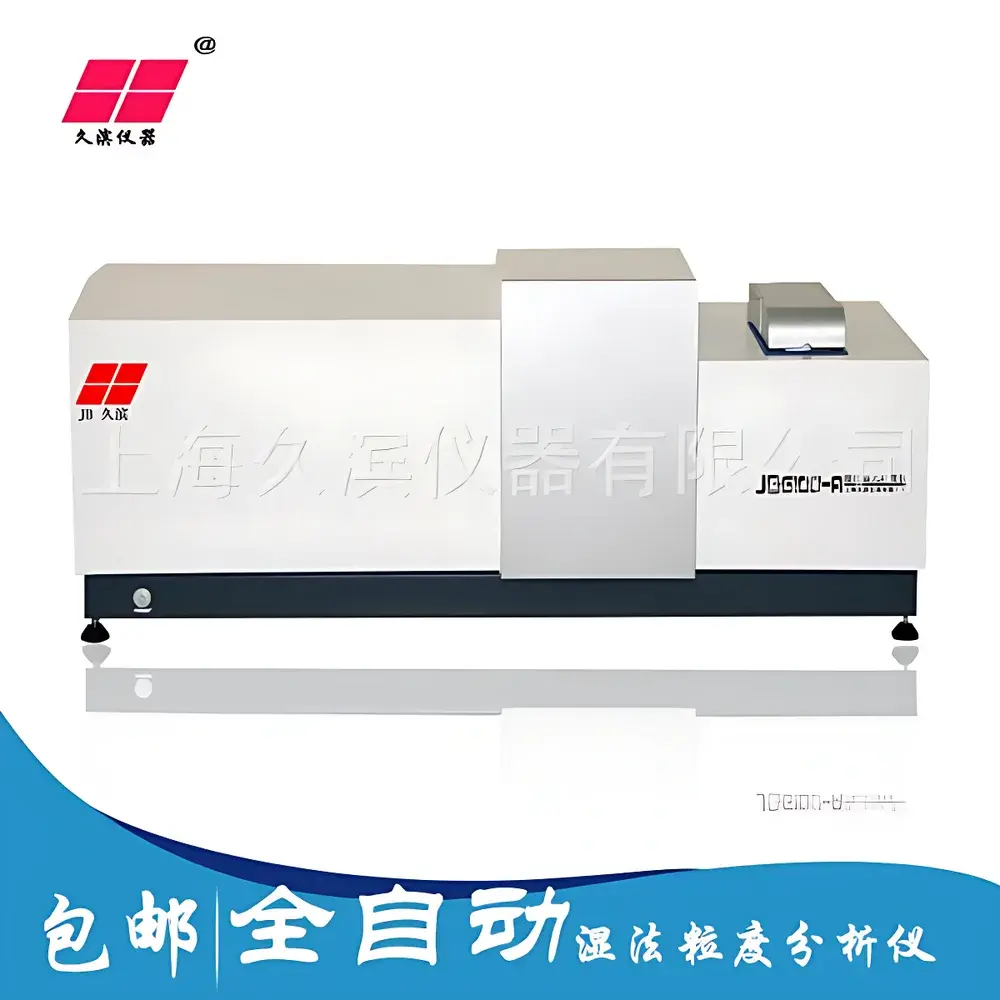
JB6100-A Wet-Dispersion Fully Automated Laser Particle Size Analyzer
| Brand | Jiubin Instruments |
|---|---|
| Model | JB6100-A |
| Origin | Shanghai, China |
| Disperser Type | Wet Dispersion System |
| Measurement Range | 0.01 µm – 2000 µm |
| Repeatability | <0.5% RSD (D50 of NIST-traceable standard reference materials) |
| Measurement Time | ≤10 s per analysis (optical acquisition only) |
| Detector Channels | 121 |
| Laser Source | Dual-beam, fiber-coupled, λ = 650 nm, P > 10 mW |
| Optical Path Calibration | Fully automated real-time alignment |
| Compliance | ISO 13320:2020, GB/T 19077–2016, ASTM D4294–22 (applicable for colloidal & suspension systems) |
| Sample Handling | Self-cleaning fluidic path with zero residual carryover |
| Environmental Design | Dust- and shock-resistant chassis |
Overview
The JB6100-A is a high-precision, fully automated laser diffraction particle size analyzer engineered for rigorous routine and R&D applications in pharmaceuticals, advanced ceramics, battery cathode slurries, pigment dispersions, and nanomaterial synthesis. It operates on the Mie scattering theory and Fraunhofer diffraction principles—validated under ISO 13320:2020—with a convergent beam Fourier transform optical architecture that eliminates focal plane dependency and ensures angular scattering data integrity across the full dynamic range. The instrument integrates a proprietary wet dispersion module featuring laminar-flow circulation, ultrasonic deagglomeration (0–100 W adjustable), and programmable flow-rate control (50–300 mL/min), enabling stable suspension delivery without sedimentation or air entrapment. Its 121-channel silicon photodiode array captures scattered light from 0.01° to 165°, supporting robust inversion algorithms for submicron resolution and broad multimodal distribution quantification.
Key Features
- Automated optical path alignment system: Real-time motorized lens positioning and laser centering ensure long-term measurement stability without manual recalibration.
- Zero-residue fluidic pathway: Patented non-stagnant circulation loop with integrated purge-and-rinse cycles minimizes cross-contamination between samples—critical for GMP-compliant QC labs.
- Anti-bubble optical design: Optimized flow cell geometry and pressure-balanced inlet suppress microbubble formation; validated by ISO 13320 Annex B for bubble-sensitive suspensions.
- Dual-beam laser source: Fiber-coupled 650 nm diode (P > 10 mW) with redundant reference beam enables continuous power monitoring and automatic intensity compensation during extended operation.
- Industrial-grade mechanical construction: Aluminum alloy chassis with vibration-damping feet and IP54-rated enclosure meet ISO 20483 environmental requirements for lab and pilot-plant deployment.
- Optional chemically inert wetted materials: Hastelloy C-276 pump heads, PTFE-lined sample cells, and sapphire optical windows support aggressive solvents including acetone, phenol, xylene, and concentrated HNO₃/H₂SO₄ solutions.
Sample Compatibility & Compliance
The JB6100-A accommodates aqueous and organic suspensions with densities up to 2.8 g/cm³ and viscosities ≤500 mPa·s (at 25 °C). It supports standardized test protocols for ISO 13320-compliant reporting (D10, D50, D90, span, specific surface area), and its data output structure aligns with FDA 21 CFR Part 11 audit trail requirements when paired with validated software configuration. All factory calibrations are traceable to NIST SRM 1963 (10.02 ± 0.12 µm) and SRM 2800 (1.22 ± 0.05 µm), with documented uncertainty budgets per ISO/IEC 17025. The system meets GLP documentation standards for raw material release testing in API manufacturing environments.
Software & Data Management
Jiubin Particle Analysis Suite (v4.3) provides intuitive workflow-driven operation—from method creation and SOP-based dispersion parameter presets to automated report generation in PDF/XLSX formats compliant with ICH Q5A and USP <729>. Raw scattering patterns are stored in HDF5 format with embedded metadata (timestamp, operator ID, calibration log, environmental sensor readings). Audit trail functionality records all user actions—including parameter modifications, calibration events, and result deletions—with immutable timestamps and digital signature verification. Export modules support LIMS integration via ASTM E1467-compliant XML schema and direct SQL database push.
Applications
- Pharmaceutical formulation: Quantifying nanoparticle drug carriers (e.g., liposomes, polymeric micelles) and assessing milling endpoint in wet media grinding processes.
- Electrode slurry QC: Monitoring graphite/SiOx anode and NMC/LFP cathode particle distributions to predict coating uniformity and electrochemical performance.
- Colloidal silica and alumina production: Verifying narrow PSD control in sol-gel synthesis and detecting agglomerate reformation post-dilution.
- Pigment and ink dispersion: Correlating Dv50 shift with rheological behavior and jetting reliability in inkjet formulations.
- Environmental nanomaterial monitoring: Characterizing engineered nanoparticles in wastewater effluents following EPA Method 8030B sampling protocols.
FAQ
What ISO and ASTM standards does the JB6100-A comply with?
It conforms to ISO 13320:2020 (laser diffraction), ISO 20483:2022 (general requirements for particle characterization), GB/T 19077–2016 (Chinese national standard), and supports ASTM D4294–22 for suspended particulate systems.
Is the instrument suitable for regulatory submissions under FDA or EMA guidelines?
Yes—when deployed with validated software configuration, full audit trail enabled, and calibrated against NIST-traceable reference materials, it meets data integrity requirements for IND/NDA filings and EU Annex 11 compliance.
Can the system handle highly viscous or abrasive slurries?
Standard configuration supports viscosities up to 500 mPa·s; optional high-torque peristaltic pumps and ceramic wear-resistant tubing extend capability to 1200 mPa·s and abrasive mineral slurries.
How is measurement repeatability verified during routine use?
Built-in daily verification protocol runs three consecutive measurements on SRM 1963; deviation exceeding 0.5% RSD triggers automatic recalibration alert and logs diagnostic parameters for root-cause analysis.
Does the software support multi-user role-based access control?
Yes—administrator, analyst, and reviewer roles enforce segregation of duties; password policies, session timeouts, and electronic signatures comply with 21 CFR Part 11 Subpart B.



