
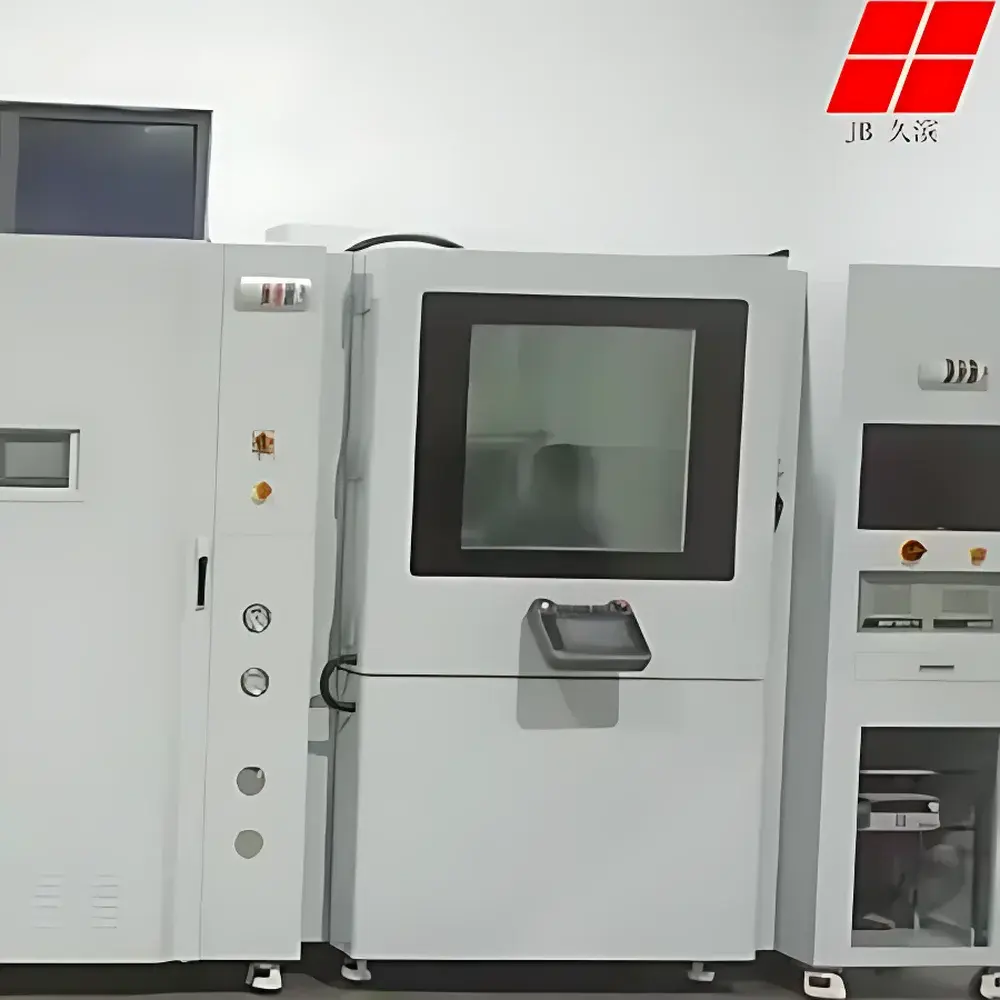
Jiubin JB-JM8 Hermeticity Test Bench
| Brand | Jiubin |
|---|---|
| Origin | Shanghai, China |
| Manufacturer Type | Authorized Distributor |
| Country of Origin | China |
| Model | JB-JM8 |
| Pricing | Available Upon Request |
| Test Pressure Range | 0–100 MPa |
| Pressure Control Accuracy | ±0.1 MPa |
| Test Media | Compressed Air, Nitrogen, Oxygen, or Other Inert Gases |
| Number of Test Ports | 1 (Configurable) |
| Control System | Servo-Driven Pressure Regulation with PC Interface |
| Data Output | Real-Time Pressure Curve Display, USB Storage, Printable Test Reports |
| Structural Design | Fully Enclosed Frame with Castor-Mounted Mobility |
| Compliance | Designed for ISO 5208, ASTM E493, and EN 1759-2 Prequalification Requirements |
Overview
The Jiubin JB-JM8 Hermeticity Test Bench is an engineered pressure integrity verification system designed for static pneumatic leak testing and proof-pressure evaluation of pressurized components. It operates on the principle of controlled gas pressurization followed by pressure decay analysis or hold-time monitoring to quantify leakage rates in sealed systems. Unlike hydrostatic test benches, the JB-JM8 utilizes compressible gaseous media—such as nitrogen, dry air, or oxygen—enabling non-destructive, residue-free validation of sealing performance under realistic service conditions. The system is built around a servo-controlled pressure regulation architecture that eliminates manual regulator dependency, ensuring repeatable ramp profiles, stable dwell phases, and precise endpoint control. Its modular construction supports integration into both R&D laboratories and production line QA/QC environments where traceability, safety, and regulatory alignment are critical.
Key Features
- Servo-driven pressure generation and regulation system delivering continuous, programmable control across the full 0–100 MPa range with ±0.1 MPa accuracy at steady state.
- Fully welded-free pressure train using certified ASME B16.5-compliant fittings and ISO-KF vacuum-grade seals; all high-pressure components sourced from Tier-1 international suppliers for long-term reliability and maintenance accessibility.
- Integrated industrial PC interface supporting customizable test sequences—including multi-step pressure ramps, dwell periods, and automated pass/fail logic based on user-defined pressure decay thresholds.
- Real-time graphical visualization of pressure vs. time curves via embedded HMI; data exportable in CSV format through standard USB 2.0 port for post-test analysis in MATLAB, Excel, or LIMS platforms.
- Self-contained structural frame with vibration-damped casters, front-access service panel, and ergonomic operator interface—designed for floor-standing deployment in ISO Class 7 cleanrooms or industrial test bays.
- Built-in safety interlocks including overpressure cut-off (settable up to 110% of max rated pressure), emergency depressurization valve, and dual-channel pressure transducer redundancy per IEC 61508 SIL2 requirements.
Sample Compatibility & Compliance
The JB-JM8 accommodates a broad spectrum of pressure-containing components, including but not limited to gate/check/ball valves (DN10–DN300), ASME Section VIII Div. 1 pressure vessels, DOT/ISO-certified gas cylinders, aerospace hydraulic accumulators, automotive brake calipers, HVAC heat exchangers, and medical gas manifold assemblies. It meets functional requirements outlined in ISO 5208 (industrial valve leakage classification), ASTM E493 (leak rate quantification via pressure decay), EN 1759-2 (flanged pipe fitting pressure testing), and supports GLP/GMP documentation workflows compliant with FDA 21 CFR Part 11 when paired with validated software add-ons. All wetted materials conform to NACE MR0175/ISO 15156 for sour service compatibility where required.
Software & Data Management
The system ships with Jiubin TestSuite v3.2—a Windows-based application enabling test method creation, parameter scripting (ramp rate, dwell duration, acceptance criteria), electronic signature capture, and audit-trail generation. Each test session logs timestamped metadata including ambient temperature, operator ID, calibration certificate IDs, and raw sensor outputs. Exported reports include annotated pressure curves, statistical summaries (mean drift, standard deviation), and compliance statements referencing applicable standards. Optional IQ/OQ documentation packages and third-party calibration certificates (NIST-traceable transducers) are available upon request to support equipment qualification under ISO/IEC 17025-accredited laboratories.
Applications
- Validation of valve seat leakage per ISO 5208 Class A–D ratings during final assembly inspection.
- Proof testing of composite overwrapped pressure vessels (COPVs) used in satellite propulsion systems prior to flight qualification.
- Leak screening of fuel rail manifolds in Tier-1 automotive supply chains under DIN 75200 accelerated aging protocols.
- Post-weld integrity verification of stainless steel sanitary piping in pharmaceutical bioreactor skids (ASME BPE 2023).
- Functional testing of MEMS pressure sensors and piezoresistive transducers during wafer-level burn-in cycles.
- Verification of O-ring compression set resistance in cryogenic seal assemblies exposed to liquid nitrogen cycling.
FAQ
What gases can be used as test media on the JB-JM8?
Compressed air, nitrogen, oxygen, argon, helium, and other non-corrosive, non-reactive gases may be employed—subject to material compatibility verification and local regulatory approval for oxygen service.
Is the system suitable for helium mass spectrometer leak testing?
No—the JB-JM8 is configured for pressure decay and hold testing only; it does not integrate with external helium sniffing or vacuum chamber interfaces.
Can multiple test specimens be evaluated simultaneously?
The standard configuration includes one dedicated test port; multi-station expansion modules with independent pressure control are available as factory-installed options.
Does the unit comply with CE or UKCA marking requirements?
Yes—fully compliant with EU Machinery Directive 2006/42/EC, PED 2014/68/EU (for Category IV devices up to 100 MPa), and EMC Directive 2014/30/EU; technical files available for notified body review.
What is the recommended calibration interval for pressure transducers?
Annual calibration is advised per ISO/IEC 17025 guidelines; field verification using deadweight testers is supported via the system’s zero-balance and span-check functions.



