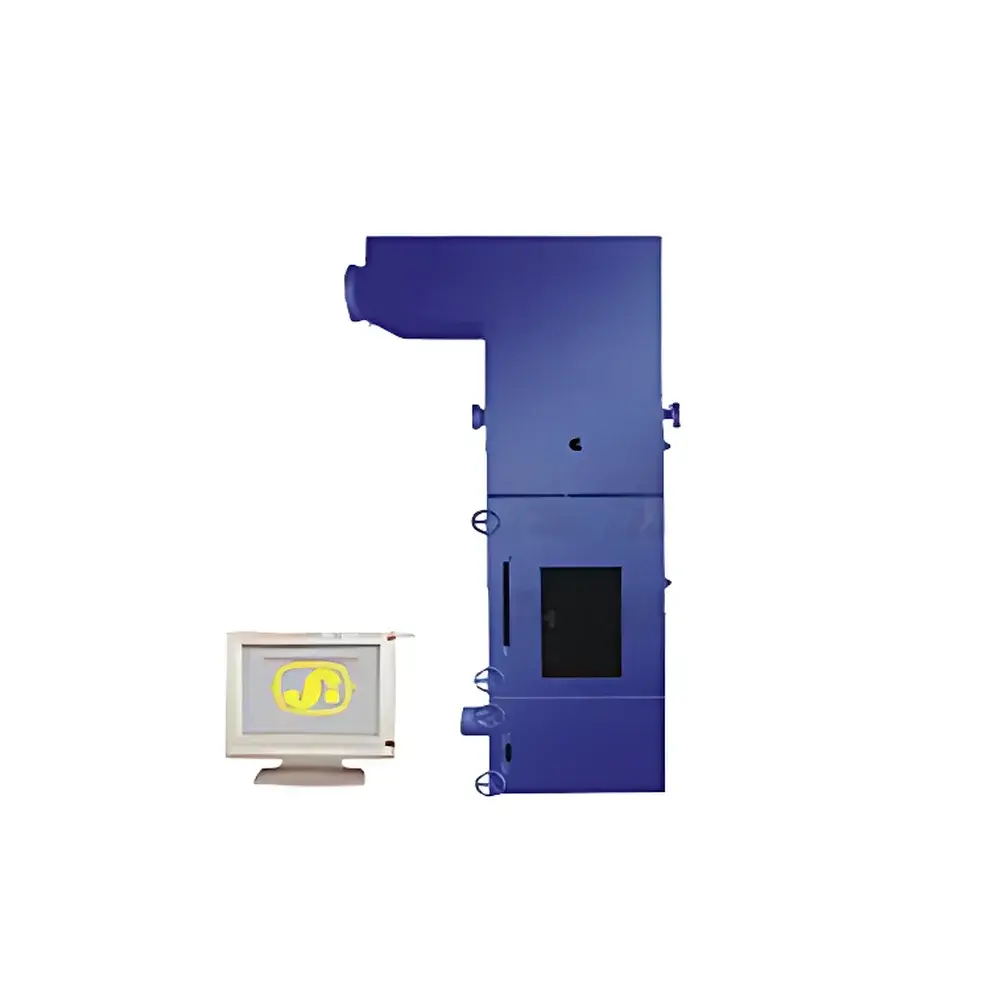
JB-Brookfield JB-321A Building Material Flame Retardancy Testing Furnace
| Brand | JB-Brookfield |
|---|---|
| Model | JB-321A |
| Origin | Shanghai, China |
| Compliance | GB/T 8625–2005 |
| Temperature Sensor Range | 0–250 °C, Accuracy ±0.5% FS |
| Fuel Gas Flowmeter | 0–50 L/min |
| Air Flowmeter | 0–50 L/min |
| Timer Range | 0–99 min (Standard Flame Application Duration: 10 min) |
| Burner Dimensions | 200 mm × 200 mm × 3.5 mm (Orifice Thickness) |
| Overall Dimensions (W×D×H) | 1020 mm × 1020 mm × 3930 mm |
| Warranty | 12-month parts & labor coverage |
| Service | On-site installation, commissioning, and operator training included |
Overview
The JB-Brookfield JB-321A Building Material Flame Retardancy Testing Furnace is a vertically oriented combustion test apparatus engineered to evaluate the flame propagation resistance of rigid and semi-rigid building materials under standardized thermal exposure conditions. It operates in accordance with the principle of vertical furnace testing defined in GB/T 8625–2005, “Test Method for Determination of Fire Resistance of Building Materials,” which simulates upward flame spread along the surface of vertically mounted specimens under controlled air/fuel flow and thermal input. The system comprises a refractory-lined vertical combustion chamber, precision-controlled gas and air supply manifolds, calibrated thermocouple arrays, a programmable digital timer, and a fixed-position burner assembly. Unlike horizontal flame tests (e.g., ASTM D635), this configuration emphasizes heat feedback dynamics and char layer stability—critical parameters for assessing whether a material meets the regulatory threshold for “difficult-to-ignite” or “flame-retardant” classification in structural and interior finish applications.
Key Features
- Vertically aligned furnace architecture with 3930 mm total height, enabling full-scale evaluation of standard 1000 mm × 400 mm specimens as specified in GB/T 8625.
- Dual independent mass flow control for propane/natural gas and compressed air, each equipped with calibrated rotameters (0–50 L/min range) ensuring repeatable stoichiometric combustion profiles.
- High-stability K-type thermocouples (0–250 °C, ±0.5% full scale) mounted at three axial positions within the furnace chamber to monitor temperature gradient development during flame exposure.
- Digital timer with 1-second resolution and user-lockable 10-minute flame application interval, synchronized with burner ignition and gas valve actuation for strict protocol adherence.
- Stainless-steel burner head (200 mm × 200 mm surface area, 3.5 mm orifice plate thickness) designed to deliver uniform thermal flux distribution across the specimen face.
- Integrated safety interlocks including gas leak detection, overtemperature cutoff, and emergency shutdown circuitry compliant with IEC 61000-6-2 electromagnetic immunity requirements.
Sample Compatibility & Compliance
The JB-321A accommodates flat, non-combustible or combustible building material specimens—including mineral wool boards, fiber-cement panels, gypsum composites, phenolic foams, and coated wood-based products—provided they meet dimensional tolerances per GB/T 8625 (thickness ≤ 100 mm; density ≥ 50 kg/m³). Specimens are mounted vertically in a steel frame with defined edge clearance to minimize lateral heat loss. The furnace satisfies national mandatory testing requirements for Class B1 (flame-retardant) and Class B2 (combustible) material certification under China’s GB 8624–2012 fire performance classification system. While not directly certified to ISO 5657 or EN 13823, its operational envelope aligns with core physical principles underlying those standards, facilitating comparative analysis in multi-jurisdictional compliance workflows.
Software & Data Management
The JB-321A operates via embedded microcontroller logic with no proprietary software dependency; all operational parameters are set manually via front-panel membrane switches and analog dials. Real-time temperature and flow data are displayed on dual 4-digit LED readouts. For GLP/GMP-aligned laboratories, optional RS-485 serial output (available upon request) enables integration with third-party SCADA or LIMS platforms for audit-trail generation, timestamped parameter logging, and electronic record retention. All test sequences—including flame-on duration, peak temperature, and post-flame smoldering time—are manually recorded in accordance with GB/T 8625 reporting templates, supporting FDA 21 CFR Part 11–compatible documentation when paired with validated electronic notebooks.
Applications
- Pre-certification screening of insulation materials prior to GB 8624 classification testing.
- Quality control verification for manufacturers of fire-rated ceiling tiles, wall panels, and structural sheathing.
- R&D validation of intumescent coatings and halogen-free flame retardant formulations under realistic convective heating conditions.
- Technical support for fire safety engineering assessments in high-rise residential and public infrastructure projects.
- Training platform for fire testing technicians accredited under CNAS-CL01 (ISO/IEC 17025) requirements.
FAQ
What standards does the JB-321A explicitly support?
GB/T 8625–2005 is the primary referenced standard; supplementary alignment exists with test protocols in GB 8624–2012, GA 111–2010 (fire door components), and JC/T 412.1–2018 (fiber-cement boards).
Is calibration traceability provided with the instrument?
Yes—each unit ships with NIST-traceable calibration certificates for thermocouples and flowmeters, valid for 12 months from date of shipment.
Can the furnace be modified for alternative fuel gases?
The burner and gas train are configured for propane or natural gas per GB/T 8625; conversion to butane or liquefied petroleum gas (LPG) requires factory recalibration and pressure regulator replacement.
What maintenance intervals are recommended?
Monthly visual inspection of refractory lining integrity and quarterly verification of flowmeter zero-point drift using certified reference gas; full preventive maintenance every 12 months by authorized service personnel.
Is remote diagnostics supported?
No native remote access capability is integrated; however, optional Ethernet-to-RS485 gateways may be deployed to enable supervised remote monitoring within secure intranet environments.
Related Products