
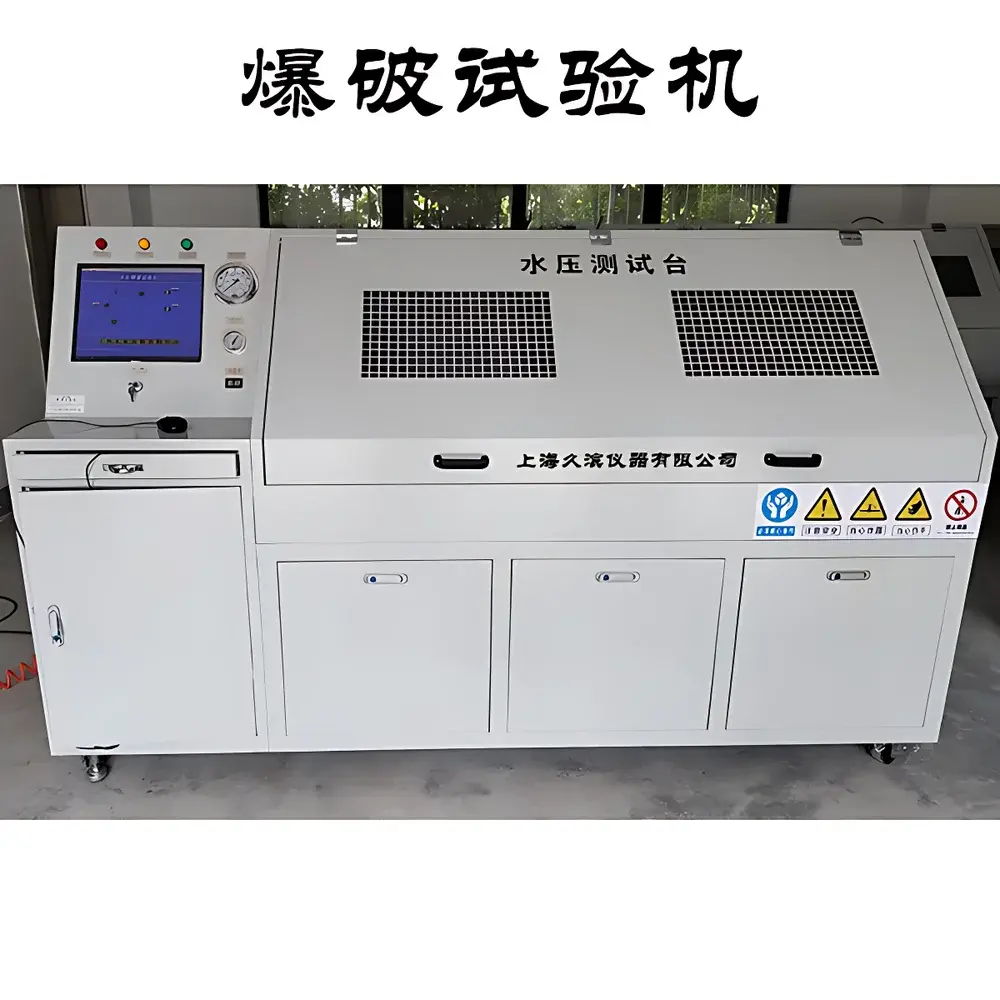
Jiubin JB-20 Hydraulic Burst and Static Pressure Pulsed Testing Machine
| Brand | Jiubin |
|---|---|
| Origin | Shanghai, China |
| Model | JB-20 |
| Pressure Range | 0–20 MPa |
| Pressure Display Resolution | 0.001 MPa |
| Pressure Control Accuracy | +2% (upper limit), −1% (lower limit) |
| Temperature Control Range | Ambient to 95 °C |
| Temperature Uniformity | ±1 °C |
| Test Duration Capacity | 0 min to 9999.59 h |
| Maximum Specimen OD | 630 mm |
| Power Supply (Pressure System) | AC 220 V, 1.5 kW |
| Power Supply (Temperature System) | AC 380 V, 4.5 kW |
| Standard Compliance | GB/T 6111, GB/T 15560, ASTM D1598, ASTM D1599, ISO 1167, ISO 12090, EN 922, USP <661>, FDA 21 CFR Part 11 (software-enabled audit trail) |
Overview
The Jiubin JB-20 Hydraulic Burst and Static Pressure Pulsed Testing Machine is a fully automated, multi-channel pressure endurance testing system engineered for long-term static hydraulic pressure evaluation and instantaneous burst resistance assessment of thermoplastic, composite, and metallic piping systems. It operates on the principle of controlled internal pressurization using purified water as the test medium, maintaining precise pressure and temperature conditions in accordance with internationally recognized hydrostatic pressure test standards—including ISO 1167-1:2014 (Plastics pipes and fittings — Resistance to internal pressure — Part 1: General method), ISO 12090:2018 (Plastics pipes — Determination of burst pressure), ASTM D1598 (Time-to-Failure of Plastic Pipe Under Constant Internal Pressure), and ASTM D1599 (Short-Term Hydrostatic Strength of Thermoplastic Pipe). The system applies sustained hoop stress to pipe specimens under thermostatically stabilized bath conditions, enabling determination of time-dependent failure behavior, creep rupture life, and ultimate burst pressure values at defined service temperatures (up to 95 °C). Its architecture supports both continuous static hold tests and pulsed pressure profiles—critical for evaluating fatigue resistance in dynamic service environments such as potable water distribution, gas transmission, and district heating networks.
Key Features
- Multi-channel independent control: Up to 12 parallel test circuits, each with isolated pressure regulation, leak detection, and autonomous rupture recognition—ensuring uninterrupted operation across unaffected channels during specimen failure.
- Dual-mode pressure management: Integrated pulse-duty-cycle compensation technology unifies ramp-up and top-up phases into a single control loop, eliminating redundant solenoid pathways and reducing component wear while enhancing long-term repeatability.
- High-fidelity pressure regulation: Italian-sourced EL1804 plunger pump (16 MPa max output), paired with German GSR high-pressure solenoid valves (20 MPa rating) and UK-made PT210B pressure transducers (0.001 MPa resolution), ensures stable pressure maintenance within ±1% lower/±2% upper tolerance bands.
- Thermal stability engineering: Stainless-steel jacketed constant-temperature bath with dual-zone circulation, PID-controlled heating (ambient to 95 °C), and ±1 °C uniformity across full immersion volume—validated per ISO 12090 Annex B.
- Modular fixture system: A-type wedge-grip clamps available in OD ranges from Φ16 mm to Φ630 mm; stainless-steel or carbon-steel construction; threaded engagement mechanism delivering >30 kN axial sealing force without deformation of brittle polymer specimens.
- Redundant control architecture: Embedded PLC (Delta DVP series) and HMI touchscreen interface operate independently of PC host; all critical safety functions—including overpressure cutoff, thermal runaway shutdown, and leakage-triggered channel isolation—remain active even when computer communication is interrupted.
Sample Compatibility & Compliance
The JB-20 accommodates a broad spectrum of piping materials and configurations: polypropylene (PP-R, PP-B, PP-A), polyethylene (PE, PE-Xa, PE-Xc), polyvinyl chloride (PVC-U, PVC-C), crosslinked polyethylene (PEX), chlorinated polyvinyl chloride (CPVC), aluminum-plastic composite (PAP), and multilayer coextruded structures. It supports standardized specimen geometries per ISO 1167, ASTM D2122, and EN 922—including straight pipe sections, socket-fused joints, electrofusion couplings, and mechanically assembled transitions. All operational protocols comply with GLP and GMP documentation requirements. When configured with optional software modules, the system satisfies FDA 21 CFR Part 11 criteria for electronic records and signatures—including user authentication, audit trail logging, data integrity validation, and role-based access control. Full traceability is maintained for pressure setpoints, temperature profiles, elapsed time stamps, and event-driven alarms (e.g., rupture, leakage, thermal deviation).
Software & Data Management
The optional Windows-based Static Hydraulic Testing Software (v5.2+) provides real-time visualization of pressure vs. time curves for each channel, synchronized with temperature and duration metrics. Data acquisition occurs at ≥10 Hz sampling frequency, stored in encrypted SQLite databases with SHA-256 checksum verification. Users may export raw datasets in CSV or XML formats compliant with LIMS integration standards (ASTM E1482, ISO/IEC 17025). Reporting templates adhere to ISO/IEC 17025 Clause 7.8 and include automatic calculation of hoop stress (σ = P × D / (2 × e)), failure classification (creep rupture vs. brittle fracture), and statistical confidence intervals for time-to-failure distributions. Audit trails record operator ID, timestamp, parameter changes, manual overrides, and system error logs—with immutable retention for ≥10 years. Remote monitoring via Ethernet TCP/IP is supported, enabling centralized supervision across distributed laboratory networks.
Applications
This instrument serves as a primary qualification tool in R&D laboratories, quality assurance departments, and third-party certification bodies for validating mechanical performance claims under simulated service conditions. Typical use cases include: accelerated lifetime prediction of PE100 gas distribution pipelines per ISO 13760; verification of pressure class ratings for PP-R hot-water systems per DIN 8077/8078; comparative creep rupture analysis of PEX-a vs. PEX-b tubing per ASTM F876/F877; regulatory conformance testing for medical-grade PVC infusion sets (ISO 8536-4); and type approval of aluminum-plastic composite tubes for radiant floor heating (EN 15880). It also supports research into environmental stress cracking (ESC) mechanisms, synergistic degradation under combined thermal–mechanical loading, and validation of finite element models used in pipe design optimization.
FAQ
What standards does the JB-20 explicitly support?
It meets all technical requirements of GB/T 6111, GB/T 15560, ASTM D1598, ASTM D1599, ISO 1167, ISO 12090, EN 922, and related national and regional specifications for plastic pipe hydrostatic testing.
Can the system perform both static hold and burst tests in one run?
Yes—the control firmware allows sequential execution: first a prolonged static pressure phase (per ISO 1167), followed by ramped pressure increase until rupture (per ISO 12090), with automatic transition and event logging.
Is distilled or deionized water mandatory for testing?
Yes. The integrated purification reservoir and inline filtration (0.5 µm ceramic cartridge) prevent scaling and corrosion in high-pressure manifolds, extending service intervals for solenoids, check valves, and pressure sensors.
How is temperature uniformity verified across the bath?
Three calibrated PT100 sensors are spatially distributed (top/mid/bottom); the controller maintains gradient ≤0.5 °C across full working volume, validated per ISO 12090 Annex B calibration protocol.
Does the system support remote diagnostics and firmware updates?
Yes—via secure SSH-enabled Ethernet port; diagnostic logs, sensor calibration histories, and firmware version metadata are accessible through authenticated web interface.



