
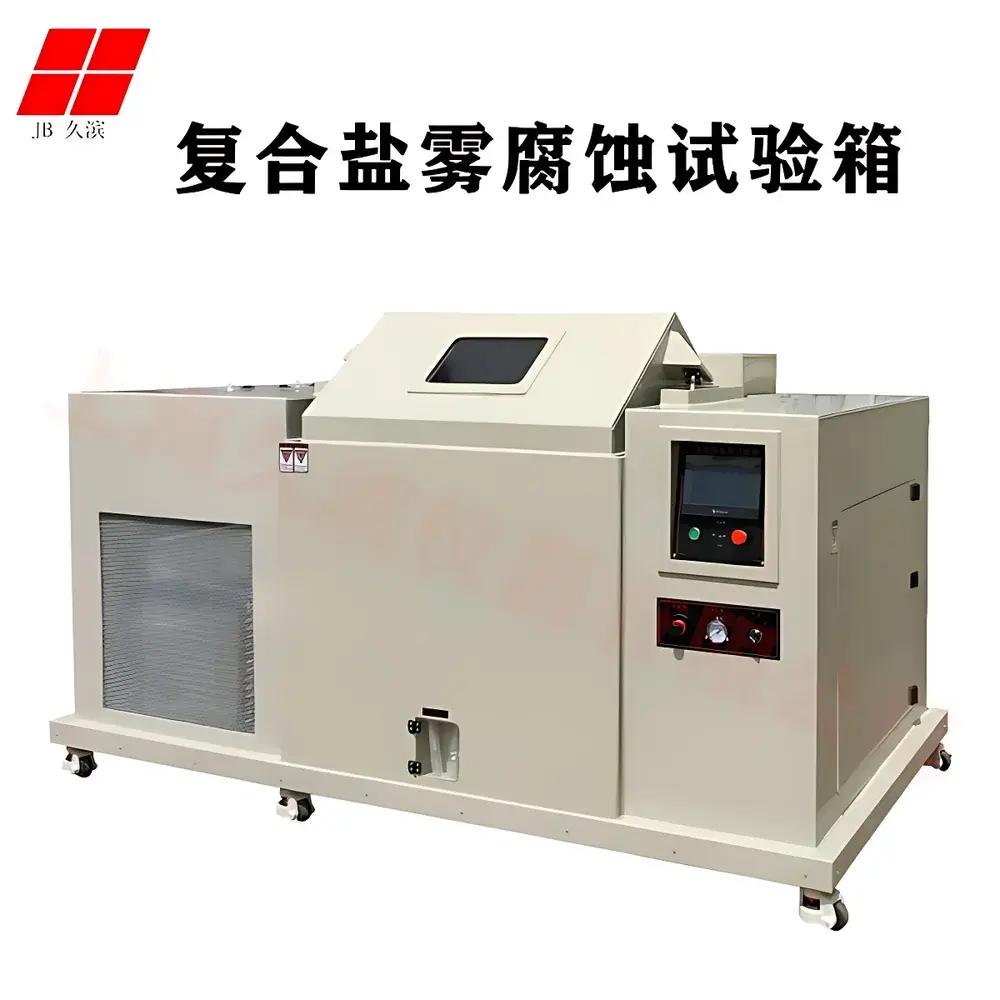
Jiubin JB-106D Composite Salt Spray Corrosion Test Chamber
| Brand | Jiubin |
|---|---|
| Origin | Shanghai, China |
| Model | JB-106D |
| Chamber Construction | Full PVC Body with Structural Reinforcement |
| Spray System | Dual-Mode (Continuous & Programmable) |
| Nozzle Type | Precision Borosilicate Glass Nozzle (≥4000 hr crystallization-free operation) |
| Temperature Control | Digital PID Controller with Platinum RTD Sensor (±0.3 °C accuracy) |
| Humidity Generation | Saturated Steam Heating + Henry’s Law–Based Pressure Tank Humidification |
| Safety Protection | Dual Over-Temperature Cut-off + Low-Water Level Alarm |
| Compliance | GB/T 2423.17 (Neutral Salt Spray), GB/T 2423.18 (Acetic Acid Salt Spray) |
| Display & Interface | Integrated Front-Panel Control Module with Real-Time Parameter Monitoring |
Overview
The Jiubin JB-106D Composite Salt Spray Corrosion Test Chamber is an engineered environmental simulation system designed to evaluate material and coating resistance to corrosive degradation under controlled cyclic conditions. It operates on the fundamental principles of accelerated electrochemical corrosion testing—specifically, the controlled generation and deposition of sodium chloride aerosol in a thermally and hygrothermally regulated chamber. Unlike basic salt fog cabinets, the JB-106D implements a multi-phase test protocol that integrates neutral salt spray (NSS), acetic acid salt spray (AASS), and optional humidity conditioning cycles—enabling replication of real-world exposure sequences encountered in marine, coastal, and industrial atmospheres. Its design conforms to internationally referenced test standards including GB/T 2423.17 and GB/T 2423.18, and supports method development aligned with ISO 9227, ASTM B117, and JIS Z2371 where applicable. The chamber’s architecture prioritizes measurement repeatability, long-term operational stability, and operator safety through passive and active fail-safes.
Key Features
- Full-chamber construction from high-purity, UV-stabilized PVC board, reinforced with internal three-dimensional structural bracing to maintain dimensional integrity across thermal cycling and prolonged exposure.
- Dual-mode spray control: supports both continuous salt fog generation and programmable intermittent cycles—critical for simulating diurnal or tidal wet/dry transitions.
- Borosilicate glass atomizing nozzles rated for ≥4000 hours of uninterrupted operation without crystallization-induced clogging, ensuring consistent droplet size distribution and mass flux over time.
- Integrated digital PID temperature controller with platinum resistance thermometer (RTD) sensing—providing ±0.3 °C stability across the operating range (RT to 50 °C).
- Direct steam injection heating system combined with a pressure-saturated humidification tank governed by Henry’s Law principles—delivering rapid temperature ramp rates and precise relative humidity control during non-spray phases.
- Dual independent over-temperature protection circuits and low-water-level detection with visual/audible alerts—meeting IEC 61000-6-2 EMC and Class II electrical safety requirements.
- Front-panel unified control interface with simultaneous display of chamber temperature, saturation temperature, spray duration, elapsed test time, and fault status codes.
Sample Compatibility & Compliance
The JB-106D accommodates standard test specimens up to 600 mm × 450 mm × 400 mm (W × D × H) and supports rack-mounted sample orientation per ISO 9227 guidelines. It is routinely deployed for evaluating metallic substrates, painted surfaces, electroplated finishes, anodized aluminum, and polymer-coated fasteners. All operational parameters—including salt concentration (5 ± 1% NaCl w/v), pH (6.5–7.2 for NSS; 3.1–3.3 for AASS), and fog deposition rate (1.0–2.0 mL/80 cm²/h)—are verifiable via traceable calibration procedures. The system satisfies documentation requirements for GLP-compliant laboratories and provides audit-ready logs suitable for internal quality review or third-party certification against ISO/IEC 17025.
Software & Data Management
While the JB-106D operates via embedded hardware controls, its analog and digital signal outputs (0–10 V / 4–20 mA) are compatible with external data acquisition systems for time-series logging of temperature, humidity, and spray actuation status. Optional RS-485 Modbus RTU integration enables centralized monitoring in multi-chamber test facilities. All alarm events—including temperature deviation, low reservoir level, and heater fault—are timestamped and stored locally for minimum 30 days. For regulated environments, supplementary validation packages (IQ/OQ documentation templates, calibration certificates, and uncertainty budgets) are available upon request to support FDA 21 CFR Part 11–aligned electronic record retention.
Applications
- Corrosion resistance validation of automotive body panels, brake calipers, and under-hood components per OEM-specific Cyclic Corrosion Test (CCT) protocols.
- Quality assurance of aerospace fasteners and landing gear coatings subjected to MIL-STD-810H Method 509.6.
- Pre-market screening of consumer electronics enclosures (e.g., smartphones, outdoor sensors) per IEC 60068-2-11.
- Comparative lifetime modeling of zinc-nickel, electrophoretic, and powder-coated steel substrates in infrastructure applications.
- Supporting R&D of corrosion-inhibiting additives in lubricants and coolants via controlled immersion–fog hybrid test sequences.
FAQ
What standards does the JB-106D directly support out-of-the-box?
It natively executes GB/T 2423.17 (NSS) and GB/T 2423.18 (AASS); configuration files for ISO 9227 and ASTM B117 can be implemented via parameter adjustment and verification.
Can the chamber perform humidity-only or dry-hot storage phases within a single test cycle?
Yes—the pressure tank and steam heating system allow stable RH control from 30% to 98% at temperatures up to 50 °C, enabling full CCT profiles when paired with external timer logic.
Is the glass nozzle certified to any international durability standard?
No formal certification exists, but its ≥4000-hour service life under continuous 5% NaCl fog has been validated per internal endurance testing conducted in accordance with ISO 16750-4 Annex C.
Does the unit include calibration documentation for metrological traceability?
Factory calibration reports (temperature, spray rate, pH) with NIST-traceable references are supplied; annual recalibration services are available through authorized Jiubin technical partners.
What maintenance intervals are recommended for long-term reliability?
Daily: visual inspection of nozzle and water reservoir; Weekly: cleaning of saturator tank and pressure vessel; Quarterly: RTD verification and PID tuning check; Annually: full system performance verification per GB/T 5170.8.



