
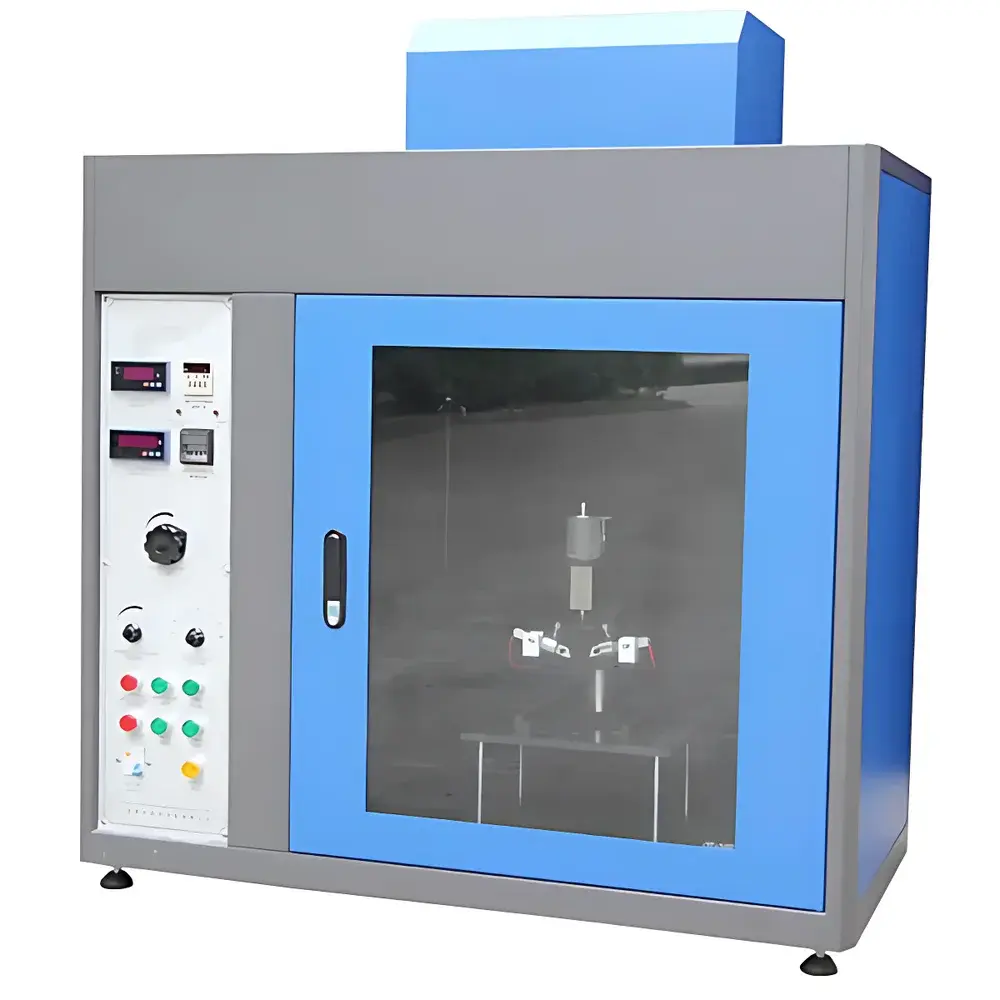
Jiubin Instruments JB-5120 Tracking Resistance Tester
| Brand | Jiubin Instruments |
|---|---|
| Origin | Shanghai, China |
| Manufacturer Type | Authorized Distributor |
| Country of Origin | China |
| Model | JB-5120 |
| Pricing | Available Upon Request |
| Chamber Volume | 0.5 m³ |
| Electrode Dimensions | 5 mm (L) × 2 mm (W) × 12 mm (H) |
| Electrode Material | Platinum |
| Electrode Edge Angle | 30° bevel |
| Electrode Spacing | 4.0 mm |
| Electrode Contact Force | 1.0 N |
| Test Voltage Range | 100–600 V (adjustable) |
| Power Supply Rating | 2100 W |
| Voltage Drop at Short-Circuit | ≤50 V (at 600 V, 1.0 A) |
| Tracking Detection Threshold | ≥0.5 A sustained for 2 s |
| Droplet Height Adjustment | 30–40 mm |
| Droplet Density | 44–55 drops/cm³ |
| Droplet Interval | 30 ± 5 s |
Overview
The Jiubin Instruments JB-5120 Tracking Resistance Tester is a precision-engineered apparatus designed to evaluate the comparative tracking index (CTI) and proof tracking index (PTI) of solid insulating materials under controlled electrotechnical stress and surface contamination. It operates in accordance with internationally recognized test standards—including IEC 60112, ASTM D3638, and GB/T 4207—to assess the resistance of polymeric, laminated, or composite electrical insulation surfaces to the formation of conductive carbonized paths (tracking) when exposed to voltage and electrolytic contaminant droplets. The device replicates real-world degradation mechanisms wherein moisture, dust, and ionic contaminants accumulate on insulator surfaces, enabling leakage current that thermally degrades the material and initiates progressive carbonization. Its robust architecture ensures stable electrode alignment, repeatable droplet delivery, and precise voltage regulation—critical for achieving high reproducibility across inter-laboratory studies and quality assurance workflows.
Key Features
- Precision-machined platinum electrodes with a defined 30° beveled edge to ensure consistent contact geometry and minimize localized field distortion during high-voltage application.
- Adjustable electrode spacing (fixed at 4.0 mm per standard requirements) and calibrated normal force (1.0 N) applied to the specimen surface, ensuring compliance with mechanical loading specifications in IEC 60112 Annex B.
- Digitally regulated DC/AC voltage supply (100–600 V range), capable of maintaining output stability within ±2% under load, with automatic voltage recovery logic following short-circuit events.
- Integrated droplet dispensing system featuring height-adjustable nozzles (30–40 mm above specimen), volumetrically calibrated flow control, and programmable interval timing (30 ± 5 s), enabling strict adherence to standardized electrolyte delivery protocols.
- Self-contained test chamber (0.5 m³ internal volume) constructed from non-conductive, flame-retardant polymer housing with integrated ventilation and fume extraction interface for safe handling of decomposition byproducts.
- Real-time current monitoring circuitry with dual-threshold detection: primary alarm triggered upon sustained current ≥0.5 A for ≥2 seconds, aligned with IEC 60112 Clause 9.2 for definitive tracking onset identification.
Sample Compatibility & Compliance
The JB-5120 accommodates flat, rigid specimens up to 150 mm × 150 mm × 12 mm (L × W × H), including thermosets, thermoplastics, laminates, and filled composites used in electrical enclosures, terminal blocks, PCB substrates, and connector housings. Specimen mounting fixtures ensure planar alignment and thermal isolation from the base plate. All operational parameters—including voltage ramp rate, droplet composition (typically 0.1% ammonium chloride solution), and environmental conditioning—are configurable to satisfy test condition variants specified in IEC 60112 Edition 4 (2020), UL 746A, and GB/T 4207–2012. The instrument supports full traceability documentation required for ISO/IEC 17025-accredited laboratories and meets mechanical safety requirements per IEC 61010-1.
Software & Data Management
The JB-5120 operates via embedded firmware with local LCD interface for manual mode execution. For automated test sequencing and regulatory compliance, it integrates with optional PC-based control software supporting CSV export of time-stamped voltage, current, and event logs. Audit trail functionality records operator ID, parameter changes, start/stop timestamps, and pass/fail determinations—enabling alignment with GLP and GMP data integrity expectations. Raw measurement data conforms to IEEE 1547-2018 metadata conventions and may be imported into LIMS platforms via standardized ODBC drivers. No cloud connectivity or remote access capabilities are implemented, preserving data sovereignty and minimizing cybersecurity exposure vectors.
Applications
- Comparative evaluation of CTI values for material qualification in low-voltage power distribution components.
- Validation of molding compound formulations for automotive EV battery housings subjected to under-hood humidity and salt spray exposure.
- Quality conformance testing of FR-4 and polyimide-based PCB laminates prior to high-density routing design release.
- Failure analysis of arc-tracked insulators recovered from field-failure investigations in industrial motor control centers.
- Supporting technical documentation packages for CE marking submissions under the Low Voltage Directive (2014/35/EU) and RoHS compliance verification.
FAQ
What standards does the JB-5120 explicitly support?
IEC 60112 (2020), ASTM D3638-22, GB/T 4207–2012, UL 746A, and ISO 23805 for comparative tracking index determination.
Is calibration certification included with shipment?
Yes—each unit ships with a factory-issued calibration report traceable to CNAS-accredited reference standards, covering electrode geometry verification, voltage output accuracy, and droplet volume consistency.
Can the instrument operate with alternative electrolytes beyond ammonium chloride solution?
Yes—provided the liquid exhibits defined conductivity (e.g., 0.1% NaCl or 1.0% NH₄Cl per IEC 60112 Annex C), and viscosity remains within 1.0–1.5 cP to ensure consistent droplet formation and fall dynamics.
What maintenance intervals are recommended for platinum electrodes?
Electrode cleaning with analytical-grade ethanol and soft lint-free swabs is advised after every 10 test cycles; visual inspection for pitting or residue accumulation should occur before each test session.
Does the JB-5120 meet requirements for FDA-regulated medical device component testing?
While not FDA-cleared as a standalone device, its test methodology and output data are admissible in biocompatible polymer validation dossiers (e.g., ISO 10993-1) when operated under documented SOPs compliant with 21 CFR Part 11 electronic record controls.



