
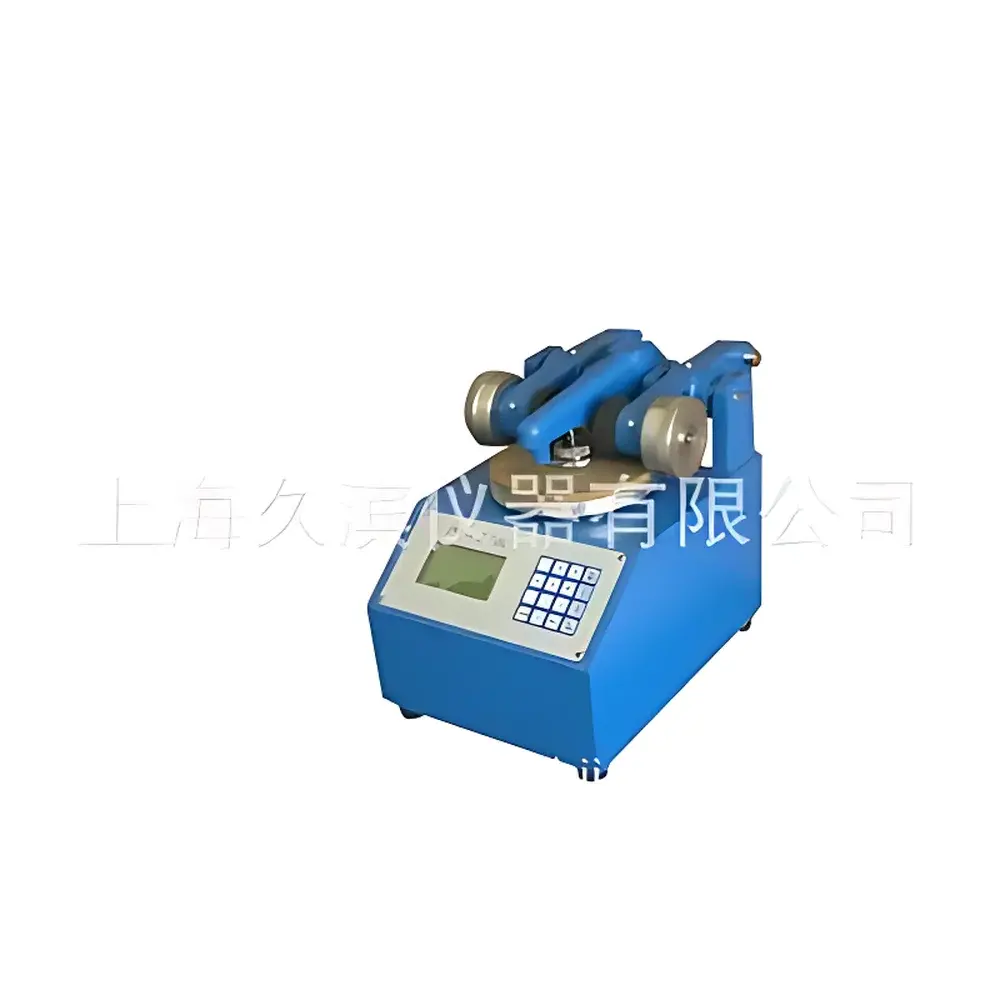
Jiubin JM-V Coating Abrasion Tester & Film Wear Resistance Instrument
| Brand | Jiubin Instruments |
|---|---|
| Origin | Shanghai, China |
| Manufacturer Type | Authorized Distributor |
| Region of Manufacture | Domestic (China) |
| Model | JM-V |
| Pricing | Upon Request |
Overview
The Jiubin JM-V Coating Abrasion Tester is a precision-engineered instrument designed for standardized evaluation of wear resistance in organic coatings, laminates, and sheet materials under controlled rotary abrasion conditions. It operates on the principle of dual-counterrotating abrasive wheels mounted at fixed angular offsets relative to a horizontally rotating test specimen platform—enabling formation of orthogonal, intersecting circular wear tracks across the entire sample surface. This geometry eliminates directional bias inherent in linear reciprocating abrasion testers and ensures isotropic wear distribution, thereby supporting statistically robust quantification of coating durability per ASTM D4060, ISO 7784-2, GB/T 1768–2006, GB/T 15036.2, GB/T 15102, GB/T 18102, and GB/T 4893.8. The device employs a high-torque stepper motor (2.5 A, 21 kg·cm holding torque) to drive the turntable at precisely regulated speeds of 60 ± 2 rpm or 70 ± 2 rpm—minimizing speed drift caused by line voltage fluctuations and ensuring inter-laboratory reproducibility critical for QC/QA workflows in paint, flooring, automotive OEM, and wood composite industries.
Key Features
- Stepper motor-driven turntable with dual-speed selection (60/70 ± 2 rpm) and real-time digital monitoring via LCD interface
- Configurable load application system: four standard weights (250 g, 500 g, 750 g, and 1000 g nominal; actual applied loads adjusted for 250 g pressurizing sleeve)
- Interchangeable abrasive wheels (standard size: Φ51.4 × 12.7 mm) compatible with alumina, silicon carbide, and custom grit media per test specification requirements
- Dual-wheel counter-rotation geometry generating uniform, multi-directional wear patterns without preferential orientation artifacts
- Integrated vacuum suction port with height-adjustable nozzle (1–2 mm clearance from sample surface) for continuous dust extraction during testing
- Modular balancing system using calibrated counterweights (1 g, 2 g, 5 g, 10 g, 20 g for coating tests; 1 g, 2 g, 5 g for wood substrates) to compensate for wheel mass asymmetry
- Programmable cycle counting with automatic stop, audible alert, and cumulative run tracking—supporting repeat-test protocols without manual intervention
Sample Compatibility & Compliance
The JM-V accommodates rigid flat specimens up to 100 mm × 100 mm × 20 mm (L × W × H), including cured paint films on metal, wood, or plastic panels; decorative laminates (HPL, melamine); PVC and PET films; coated paperboard; textile laminates; and engineered wood products. Its mechanical architecture and operational parameters align with multiple international and national standards: ISO 7784-2 (paint and varnish abrasion resistance), ASTM D4060 (organic coating abrasion resistance using Taber abraser), GB/T 1768–2006 (Chinese standard for paint film abrasion resistance), GB/T 15036.2 (solid wood flooring abrasion), GB/T 15102 (melamine-faced boards), GB/T 18102 (laminate flooring), and GB/T 4893.8 (furniture surface abrasion). While not certified for GLP or FDA 21 CFR Part 11 compliance out-of-the-box, its deterministic control logic, non-volatile parameter storage, and audit-ready cycle logging support integration into validated quality systems when paired with documented SOPs and periodic calibration verification.
Software & Data Management
The JM-V operates via embedded firmware with no external PC dependency. All operational parameters—including target revolutions, current speed mode, accumulated cycles, and real-time revolution count—are displayed and editable through a 4-digit LED/LCD interface. Input validation is confirmed acoustically (“beep” feedback per digit entry), and erroneous entries are cleared via dedicated “Set Clear”, “Count Clear”, and “Cycle Clear” keys. The unit stores no raw data files but maintains persistent counters for total cycles executed, enabling traceability across maintenance intervals and operator shifts. For laboratories requiring electronic records, optional RS-232 or USB-to-serial adapters (sold separately) allow integration with third-party data acquisition software for timestamped export of cycle completion events and runtime logs.
Applications
This instrument serves as a core tool in R&D labs developing high-durability architectural, marine, and industrial coatings; QC departments validating batch-to-batch consistency of floor finishes and automotive clearcoats; and certification bodies performing third-party conformance testing against ISO and GB standards. Typical use cases include comparative ranking of acrylic vs. polyurethane topcoats under 500-cycle abrasion loads; evaluating scratch recovery behavior of self-healing polymer films; assessing wear resistance of UV-cured wood veneers; and verifying compliance of laminate flooring samples prior to CE or CARB certification. Its adaptability to both soft (paper, textiles) and hard (metal, ceramic-coated substrates) materials makes it suitable for cross-material benchmarking studies where standardized mechanical stress application is essential.
FAQ
What standards does the JM-V comply with?
The JM-V is engineered to meet the mechanical and procedural requirements of GB/T 1768–2006, ISO 7784-2, ASTM D4060, GB/T 15036.2, GB/T 15102, GB/T 18102, and GB/T 4893.8.
Can I use non-standard abrasive wheels?
Yes—the wheel mounting mechanism accepts any 51.4 mm diameter × 12.7 mm thick abrasive disc with compatible arbor hole geometry; users must validate wheel balance and wear rate against reference materials.
Is calibration documentation provided?
The instrument ships with a factory verification report confirming turntable speed accuracy, load application tolerance, and dimensional conformity to design specifications.
How often does the unit require maintenance?
Annual lubrication of the turntable bearing and inspection of stepper motor coupling are recommended; sanding wheel wear should be monitored per 50 test cycles and replaced when groove depth falls below 0.5 mm.
Does the JM-V support GLP-compliant data archiving?
While the base unit lacks built-in electronic signature or audit trail features, its deterministic operation and cycle-based logging enable full traceability when used within a documented quality management system with defined calibration and usage procedures.





