
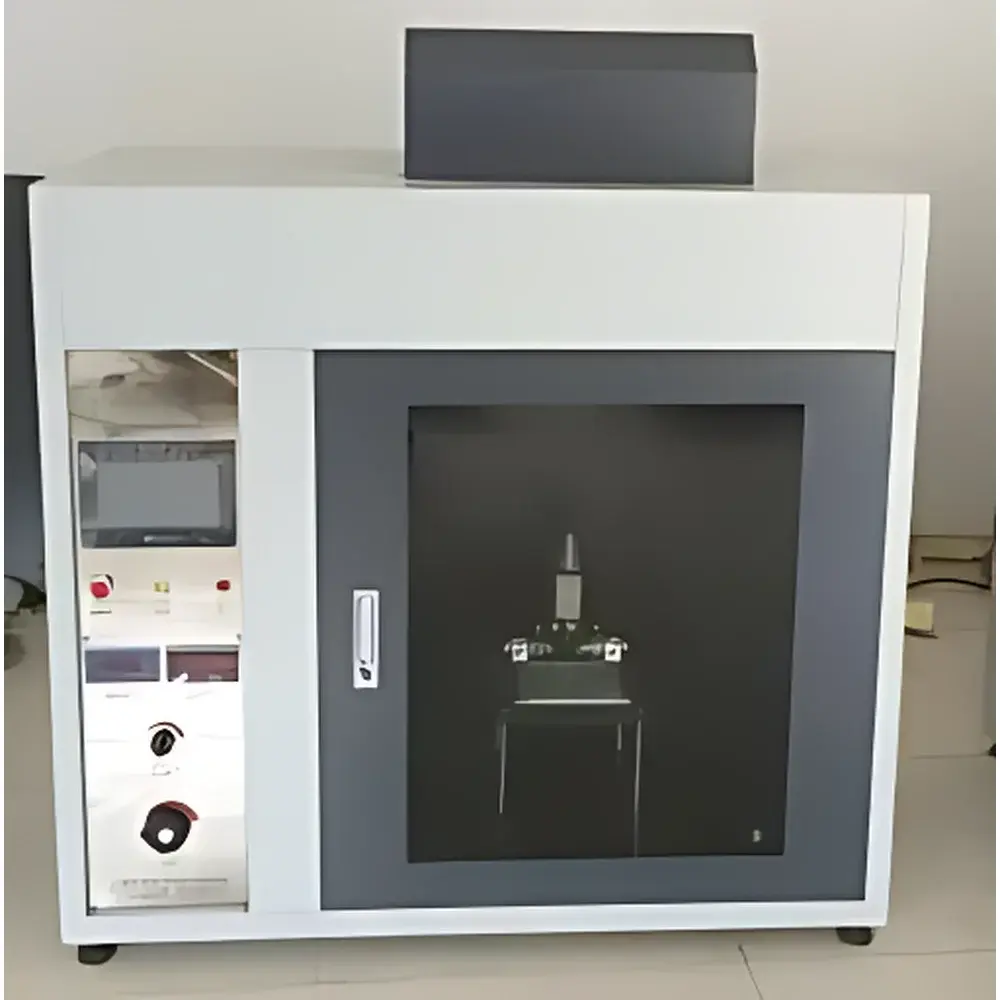
JB-512B Touchscreen Tracking Resistance Tester – Jiubin Instruments
| Brand | Jiubin Instruments |
|---|---|
| Model | JB-512B |
| Control System | Taiwan Weinview 7-inch color HMI touchscreen |
| Electrode Material | Copper base with platinum-tipped electrodes |
| Electrode Force | 1.0 ± 0.05 N per electrode |
| Droplet Interval | 30.0 ± 0.1 s |
| Test Voltage Range | 100–600 V AC (48–60 Hz), voltage drop ≤10% at short-circuit current of 1.0 ± 0.1 A |
| Droplet Height | 30–40 mm |
| Droplet Volume | 44–55 drops per cm³ (≈18.2–22.7 µL/drop) |
| Short-Circuit Detection | Relay cutoff triggered when current >0.5 A sustained for ≥2 s |
| Chamber Internal Volume | 0.5 m³ (optional 0.75 m³ or 1.0 m³) |
| External Dimensions | 1170 mm (W) × 630 mm (D) × 1330 mm (H) |
| Enclosure Material | Powder-coated steel plate |
| Exhaust Port Diameter | 100 mm |
| Power Supply | AC 220 V / 50 Hz / 10 A |
| Compliance | IEC 60112:2009, GB/T 4207–2012, UL 746A, ASTM D3638–2007, DIN 53480 |
Overview
The JB-512B Touchscreen Tracking Resistance Tester is an electromechanical test system engineered to evaluate the comparative tracking index (CTI) and proof tracking index (PTI) of insulating materials under high-voltage, humid, and contaminant-laden conditions. It operates on the principle of controlled electrolytic degradation: a conductive ammonium chloride (NH₄Cl) solution is dispensed in precise droplets onto the surface of a flat polymer specimen while a calibrated AC voltage is applied across two platinum-tipped copper electrodes. The resulting leakage current initiates localized carbonization—progressing into conductive tracks that bridge the electrodes. Failure is defined as sustained short-circuit current (>0.5 A for ≥2 s), triggering automatic power cutoff and recording. Designed strictly to IEC 60112:2009 and its harmonized national standards—including GB/T 4207–2012, UL 746A, ASTM D3638–2007, and DIN 53480—the JB-512B delivers repeatable, auditable results essential for material qualification in electrical enclosures, connectors, circuit boards, and automotive high-voltage components.
Key Features
- Integrated 7-inch Weinview color HMI touchscreen interface with intuitive PLC-based logic control—enabling real-time parameter monitoring, test sequencing, and event logging without external PCs.
- Precision electromagnetic valve-controlled droplet delivery system, calibrated to dispense 44–55 drops per cm³ (18.2–22.7 µL/drop) with ≤0.02 g repeatability over 20-drop cycles.
- Platinum-coated copper electrodes ensure long-term corrosion resistance and stable contact geometry; each applies a mechanically verified force of 1.0 ± 0.05 N via integrated load calibration using supplied handheld digital scale.
- Fixed-dimension test chamber (standard 0.5 m³ internal volume) constructed from powder-coated steel with 100 mm exhaust port—compatible with fume extraction ducting up to 3.5 m in length.
- Wide-range AC voltage supply (100–600 V, 48–60 Hz) with built-in short-circuit regulation: voltage sag remains ≤10% at 1.0 ± 0.1 A fault current, ensuring compliance with IEC 60112 voltage stability requirements.
- Automated pass/fail logic: relay-driven power interruption upon detection of ≥0.5 A current sustained for ≥2 seconds—fully traceable via front-panel status indicators and non-volatile event timestamps.
Sample Compatibility & Compliance
The JB-512B accommodates flat, rigid specimens measuring up to 100 mm × 100 mm × 6 mm (thickness), with surface planarity maintained via adjustable stainless-steel leveling stand. Specimens must be preconditioned per IEC 60112 Section 8 (typically 23 °C / 50% RH for ≥24 h). The system supports standardized contamination solutions including NH₄Cl (supplied), with optional NaCl or custom electrolytes validated per user-defined protocols. All operational parameters—including droplet interval (30.0 ± 0.1 s), electrode spacing (4.0 mm, verified by included stainless-steel gauge), and vertical drop height (35 ± 5 mm)—are fixed per standard methodology to eliminate operator-induced variability. Full traceability is ensured through mechanical calibration artifacts (e.g., 4 mm gauge, electronic scale) and factory documentation aligned with ISO/IEC 17025 principles for testing laboratories.
Software & Data Management
While the JB-512B operates autonomously via embedded PLC firmware, it generates timestamped digital logs stored in internal flash memory (retention ≥10,000 test records). Each log entry includes test ID, start/stop time, applied voltage, total droplet count, failure event flag, and relay activation timestamp. Data export is supported via USB port (FAT32-formatted drive) in CSV format for integration into LIMS or QA databases. Optional RS-485 Modbus RTU interface enables remote supervision in networked lab environments. Audit trail functionality satisfies GLP and GMP-aligned documentation requirements, with immutable event markers for voltage application, droplet initiation, and fault response—fully compatible with FDA 21 CFR Part 11 readiness when deployed with validated access controls and electronic signature workflows.
Applications
- CTI/PTI classification of thermoplastics (e.g., PBT, PA66, PC), thermosets (epoxy, phenolic), and filled composites used in terminal blocks, switch housings, and EV battery module enclosures.
- Comparative evaluation of flame-retardant additives (e.g., aluminum hydroxide, melamine cyanurate) on tracking resistance under accelerated contamination stress.
- Quality assurance screening in incoming raw material inspection for Tier-1 automotive suppliers and industrial connector manufacturers.
- Supporting UL Recognition and IEC Certification submissions requiring third-party validated tracking test reports.
- Research into surface modification techniques—including plasma treatment, nano-coating, and micro-texturing—to delay track initiation and propagation.
FAQ
What standards does the JB-512B fully support out-of-the-box?
IEC 60112:2009, GB/T 4207–2012, UL 746A, ASTM D3638–2007, and DIN 53480—all implemented via fixed hardware configuration and calibrated dispensing/voltage parameters.
Is the chamber volume customizable?
Yes: standard 0.5 m³; optional 0.75 m³ and 1.0 m³ configurations are available with reinforced structural framing and extended exhaust ducting compatibility.
How is electrode force verified during routine operation?
Using the supplied palm-sized digital scale (0.01 g resolution) and stainless-steel 4 mm gauge—procedures documented in the operator manual per ISO 17025 verification guidelines.
Can test data be exported to laboratory information management systems (LIMS)?
Yes: CSV-formatted logs exported via USB or Modbus RTU interface support automated ingestion into common LIMS platforms with configurable field mapping.
Does the system meet electromagnetic compatibility (EMC) requirements for laboratory use?
Yes: CE-marked per EN 61326-1:2013 (industrial environment) and EN 61000-6-3:2007 for radiated emissions, with internal filtering on all AC input and solenoid driver circuits.



