
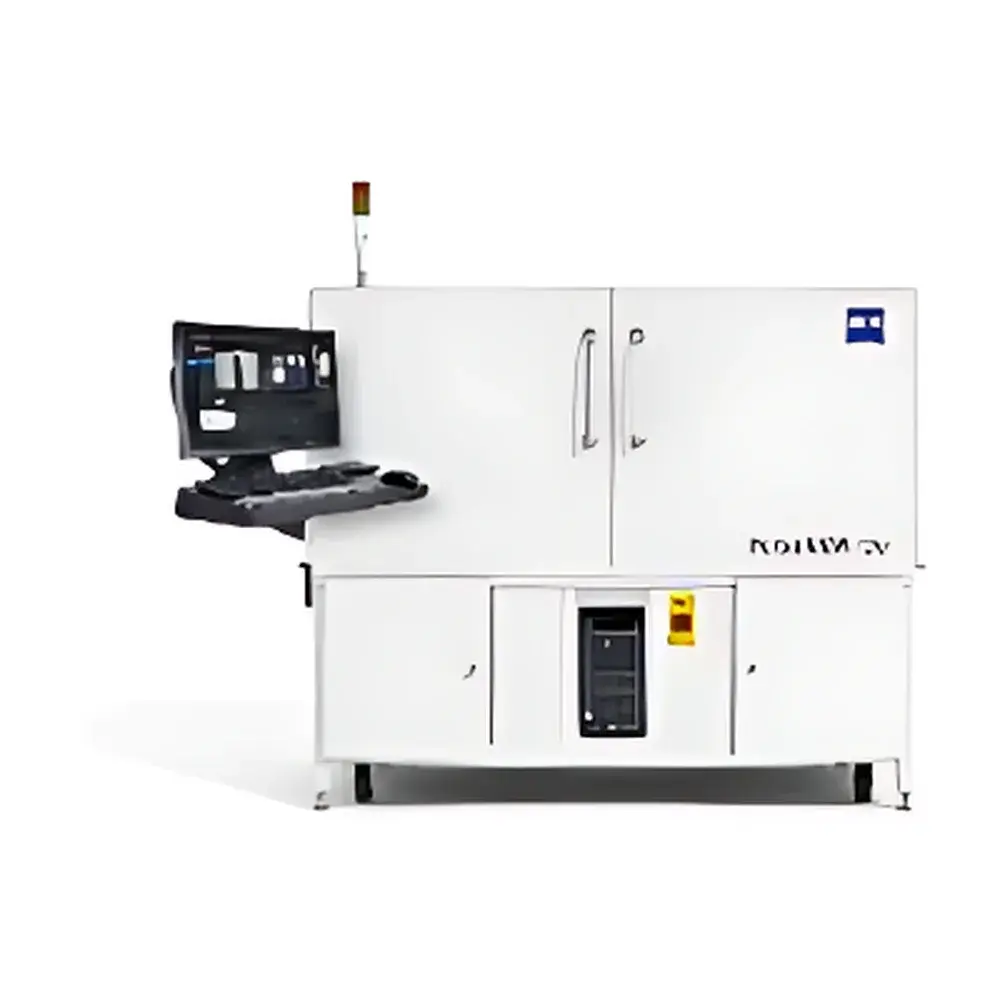
ZEISS VersaXRM 615 & VersaXRM 730 Industrial Micro-CT Systems
| Brand | ZEISS |
|---|---|
| Origin | Germany |
| Model | VersaXRM 615 & VersaXRM 730 |
| Resolution | 500 nm (VersaXRM 615), 450 nm (VersaXRM 730) |
| Minimum Voxel Size | 40 nm |
| Imaging Modes | Absorption, Phase Contrast, Diffraction Contrast |
| In Situ Capability | 4D Dynamic Imaging |
| AI-Enhanced Reconstruction | ART Advanced Reconstruction Toolbox |
| Fast Scan Mode | Sub-60-second 3D scan |
| Compliance | Fully compatible with GLP/GMP workflows and ASTM E1441, ISO 15787, and USP <1089> for non-destructive 3D characterization |
Overview
The ZEISS VersaXRM 615 and VersaXRM 730 are high-performance industrial micro-computed tomography (micro-CT) systems engineered for non-destructive, quantitative 3D imaging across research and advanced manufacturing environments. Leveraging a dual-stage magnification architecture—combining geometric magnification via high-power microfocus X-ray sources with optical magnification through scintillator-optical lens coupling—the VersaXRM platform achieves exceptional spatial resolution while preserving large field-of-view flexibility. Unlike conventional CT systems constrained by fixed detector geometry or source-detector distance trade-offs, the VersaXRM series delivers true sub-micron resolution (500 nm for VersaXRM 615; 450 nm for VersaXRM 730) at extended working distances—enabling high-fidelity imaging of intact, unsectioned samples up to 300 mm in diameter and 400 mm in height. The system operates on the physical principles of X-ray attenuation, phase-shift interference, and Bragg diffraction, supporting multi-contrast modalities essential for characterizing low-Z materials, heterogeneous composites, and crystalline microstructures without staining, coating, or destructive sectioning.
Key Features
- True spatial resolution down to 450 nm (VersaXRM 730) and 500 nm (VersaXRM 615), validated per ASTM E1441 Annex A3 using line-pair test objects
- Minimum reconstructed voxel size of 40 nm—achievable via high-magnification optical coupling and precision stage metrology
- Dual-contrast imaging capability: absorption contrast for density mapping, propagation-based phase contrast for edge enhancement in low-absorption specimens, and diffraction contrast for grain orientation and strain mapping in polycrystalline materials
- 4D in situ/operando compatibility: integrated mechanical, thermal, and electrochemical stages support time-resolved 3D imaging under load, heating (–20 °C to 1000 °C), or battery cycling conditions
- FAST Mode acquisition: full-volume 3D reconstruction in under 60 seconds for rapid screening and iterative experiment design
- ART (Advanced Reconstruction Toolbox): AI-accelerated iterative reconstruction algorithms that reduce noise, suppress ring artifacts, and enhance signal-to-noise ratio—particularly beneficial for low-dose or high-throughput scans
- Modular hardware architecture: supports field-upgradable X-ray sources (up to 160 kV), detectors (CMOS and sCMOS options), and sample manipulation stages
Sample Compatibility & Compliance
The VersaXRM 615 and 730 accommodate a broad spectrum of sample types—from mm-scale semiconductor packages to cm-scale geological cores or whole biological specimens (e.g., fossilized insects in amber, murine brain tissue, lithium-ion pouch cells). Their large chamber volume and motorized 5-axis sample manipulator enable multi-scale correlative workflows: macro-to-micro region-of-interest targeting without physical repositioning. All systems comply with IEC 61000-6-3 (EMC) and IEC 61000-6-4 standards, and meet radiation safety requirements per IEC 61331-1. Data integrity and audit readiness are ensured through native support for FDA 21 CFR Part 11–compliant electronic signatures, secure user access control, and full audit trails in ZEISS Scout-and-Scan software. The platform is routinely deployed in GLP-certified labs and aligns with ISO/IEC 17025 documentation practices for method validation and uncertainty quantification.
Software & Data Management
Acquisition, reconstruction, and analysis are unified within ZEISS Scout-and-Scan Control Software—a deterministic, scriptable environment supporting Python API integration for automated batch processing and custom workflow orchestration. Raw projections are stored in standardized HDF5 format with embedded metadata (source parameters, geometry calibration, timestamp, operator ID). Reconstruction leverages GPU-accelerated FDK and SART algorithms; ART modules integrate deep learning denoisers trained on physically accurate forward models—not generic image filters. Post-processing includes quantitative morphometry (porosity, connectivity, tortuosity), grain segmentation via diffraction contrast tomography (DCT), and mesh generation for FE simulation export (STL, PLY, Nastran). Data provenance is preserved end-to-end—from raw sinogram to segmented volume—with SHA-256 checksums and version-controlled project archives.
Applications
- Materials Science: 3D pore network analysis in catalysts and fuel cell membranes; fatigue crack propagation tracking in additively manufactured alloys
- Electronics & Semiconductors: Void detection in solder joints; delamination mapping in fan-out wafer-level packaging; TSV (through-silicon via) integrity assessment
- Energy Storage: In operando lithium plating/stripping visualization in NMC/graphite cells; SEI layer thickness evolution during cycling
- Geosciences: Digital rock physics modeling of tight sandstone permeability; fossil morphology quantification with sub-cellular detail
- Life Sciences: Vasculature network reconstruction in cleared murine brains; bone-implant osseointegration monitoring over time
- Advanced Manufacturing: Dimensional verification of turbine blade internal cooling channels; fiber orientation tensor analysis in carbon-fiber composites
FAQ
What distinguishes VersaXRM from laboratory-based nano-CT systems?
Unlike nano-CT platforms requiring ultra-high vacuum and micron-scale samples, VersaXRM maintains nanoscale resolution while accommodating centimeter-scale specimens under ambient or controlled environmental conditions—eliminating the need for destructive trimming or embedding.
Can VersaXRM systems be integrated into automated production QA lines?
Yes—via Ethernet/IP and OPC UA interfaces, the systems support scheduled scanning, pass/fail thresholding against reference volumes, and direct output to MES/QMS platforms such as Siemens Opcenter or ETQ Reliance.
Is phase contrast imaging quantitative?
Phase retrieval is implemented using the single-distance Paganin method or multi-distance approaches, yielding quantitative refractive index decrement maps—calibrated against known polymer standards traceable to NIST SRM 2088.
How is AI used in ART without compromising traceability?
All AI-enhanced reconstructions generate dual outputs: the AI-denoised volume and its corresponding residual error map; both are archived alongside training metadata (model version, hyperparameters, validation RMSE) to satisfy ISO/IEC 17025 clause 7.7.2.
Do VersaXRM systems support diffraction contrast tomography (DCT)?
Yes—when equipped with a monochromatic beam option and high-resolution area detector, the VersaXRM 730 enables 3D grain mapping via DCT, compliant with ASTM E2822 for crystallographic orientation imaging.



