
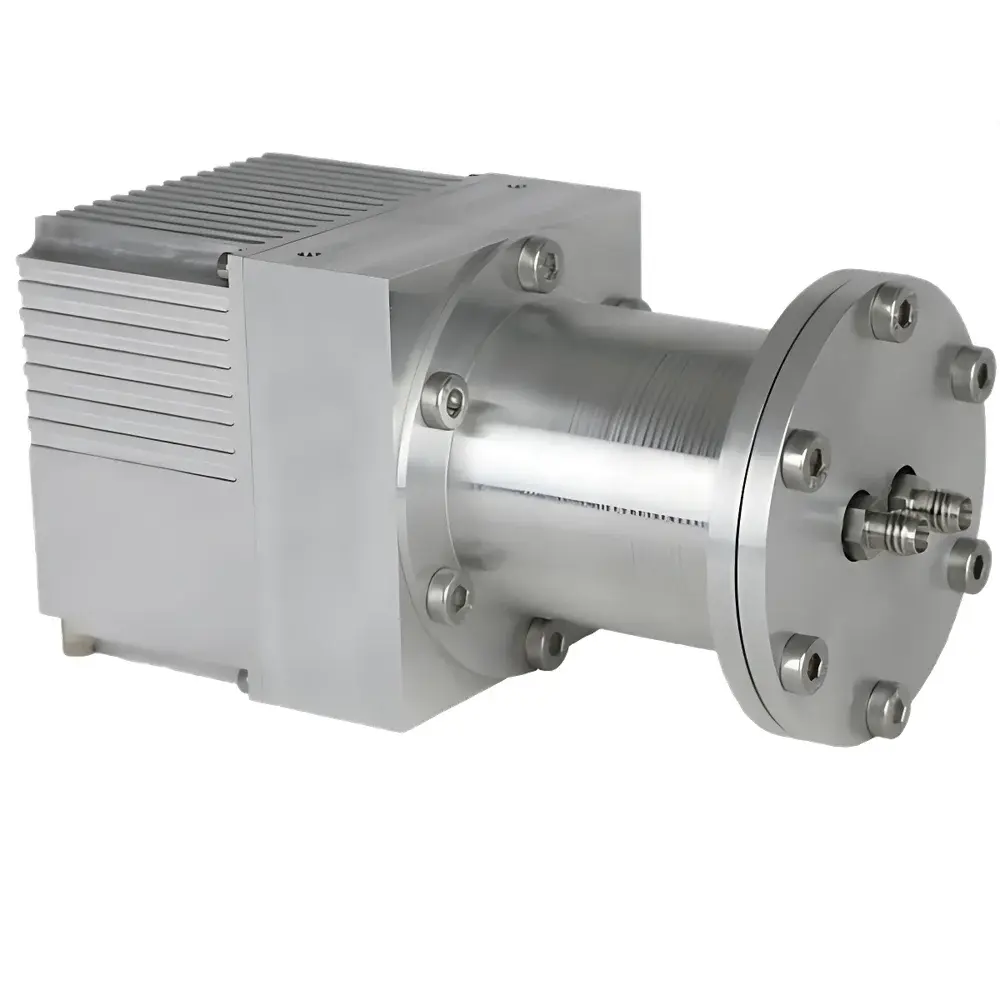
ONUEE EMIR-PAS Laser Photoacoustic Spectroscopy Gas Sensor Module
| Brand | ONUEE |
|---|---|
| Origin | France |
| Model | EMIR-PAS |
| Instrument Type | Tunable Quantum Cascade Laser-Based Mid-IR Photoacoustic Spectrometer |
| Detection Principle | Laser Photoacoustic Spectroscopy (LPAS) |
| Key Gases | H₂O, NO, NO₂, CO, CO₂, NH₃, CH₄, N₂O, SF₆ |
| Detection Limit | Sub-ppm (gas-dependent) |
| Accuracy | <1% of reading or LOD |
| Repeatability | <1% of reading or LOD |
| Response Time (T90) | Typically <5 s |
| Measurement Frequency | Up to 10 Hz |
| Sample Flow Rate | <80 mL/min |
| Cell Volume | 1 mL |
| Operating Pressure | 0.5–2 bar.a (requires integrated pressure sensor) |
| Power Supply | 24 V DC, ~10 W |
| Communication | RS485, Modbus RTU |
| Dimensions | 115 × 170 × 108 mm |
| Weight | <2 kg |
| Environmental Operating Range | 10–30 °C, 0–95% RH (non-condensing) |
| Compliance | Designed for industrial integration in EPA-, ISO-, and IEC-compliant monitoring systems |
Overview
The ONUEE EMIR-PAS is a compact, OEM-grade laser photoacoustic spectroscopy (LPAS) gas sensing module engineered for continuous, real-time, multi-species trace gas analysis in demanding industrial and environmental applications. Unlike conventional non-dispersive infrared (NDIR) or electrochemical sensors, the EMIR-PAS leverages tunable quantum cascade laser (QCL) sources operating in the mid-infrared spectral region (typically 3–12 µm), where fundamental vibrational absorption bands of target gases exhibit maximum cross-sections and minimal spectral interference. Light from the QCL is modulated at an acoustic resonance frequency and directed into a sealed, miniaturized photoacoustic cell (1 mL volume). Absorption of laser energy by target gas molecules induces localized heating, generating periodic pressure waves—detected with high signal-to-noise ratio by a low-noise MEMS microphone. This all-optical, zero-moving-parts architecture eliminates optical alignment drift, mirror degradation, and consumable components—ensuring long-term stability and metrological robustness without recalibration intervals typical of extractive analyzers.
Key Features
- Multi-gas capability: Simultaneous quantification of up to four gases—including H₂O, NO, NO₂, CO, CO₂, NH₃, CH₄, N₂O, and SF₆—within a single compact module
- Sub-ppm detection limits: Achieved via high-power, narrow-linewidth QCLs and optimized acoustic cell design; LODs range from <0.02 ppm (SF₆) to <0.4 ppm (CH₄), depending on gas and configuration
- High metrological fidelity: Accuracy <1% of reading or LOD; repeatability <1% under stable environmental conditions
- Ultra-fast response: T90 <5 seconds across full dynamic range (typical), enabling real-time process feedback and transient emission capture
- Low sample demand: Requires only <80 mL/min volumetric flow—compatible with micro-pumping systems and minimizing auxiliary power consumption
- Industrial-grade packaging: Rugged aluminum housing (115 × 170 × 108 mm, <2 kg), IP65-rated electrical interface, and passive thermal management for unattended operation
- OEM-ready integration: RS485/Modbus RTU digital interface, 24 V DC supply (~10 W), and standardized 1/8″ Swagelok inlet/outlet fittings
Sample Compatibility & Compliance
The EMIR-PAS is designed for direct, in-situ or extractive measurement of humid, particulate-free gas streams within specified pressure (0.5–2 bar.a) and temperature (10–30 °C) envelopes. Its immunity to optical fouling and absence of optical windows make it suitable for monitoring aggressive or condensing matrices—such as biogas, flue gas, transformer headspace, and hydrogen distribution lines—without inline filtration or drying. The module complies with electromagnetic compatibility requirements per IEC 61326-1 and meets mechanical robustness criteria aligned with IEC 60068-2 environmental testing standards. While not certified as a standalone safety device, its architecture supports integration into SIL2-capable systems when deployed with redundant pressure/temperature monitoring and external validation per IEC 61511. Data integrity protocols—including timestamped raw acoustic spectra and diagnostic flags—are structured to support GLP/GMP-aligned audit trails when paired with compliant host software.
Software & Data Management
The EMIR-PAS operates with ONUEE’s proprietary embedded firmware, delivering self-diagnostic capabilities including laser health monitoring, microphone sensitivity verification, pressure/temperature compensation, and automatic baseline correction. Host-side software (Windows/Linux compatible) provides real-time concentration visualization, configurable alarm thresholds (high/low, rate-of-change), data logging (CSV/SQLite), and remote firmware updates via Modbus register mapping. All measurements are traceably referenced to NIST-traceable calibration certificates provided per unit. The system supports time-synchronized multi-channel acquisition when deployed alongside complementary sensors (e.g., O₂, pressure, flow), enabling stoichiometric and mass-balance calculations required for regulatory reporting under EPA Method 21, ISO 14064, or EN 15267-3.
Applications
- Air quality & emissions monitoring: Real-time NOx, CO, and NH3 tracking in urban hotspots, livestock barns, wastewater treatment off-gases, and landfill biofilters
- Hydrogen infrastructure: H2 purity verification (ppm-level moisture, CO, CH4) during production, compression, dispensing (HRS), and storage integrity checks
- Energy & utilities: SF6 leak detection in GIS switchgear, transformer fault gas analysis, and biogas upgrading control (CO2/CH4/H2S)
- Chemical & pharmaceutical manufacturing: In-line monitoring of reaction headspace (NH3, CO, N2O) and solvent vapor traces (CH4, H2O)
- Research & development: Lab-scale kinetic studies requiring sub-second gas concentration resolution and multi-component spectral deconvolution
FAQ
Does the EMIR-PAS require periodic calibration with certified gas standards?
No—its QCL wavelength stability and photoacoustic signal linearity enable drift-free operation over 6–12 months. However, field validation using traceable span gas is recommended annually or after major maintenance.
Can the module operate in saturated humidity environments?
It tolerates up to 95% RH non-condensing. For applications involving dew formation (e.g., biogas sampling), upstream chilled mirror or permeation dryer integration is advised to prevent condensation inside the acoustic cell.
Is pressure compensation mandatory?
Yes—absolute pressure measurement is required for quantitative accuracy, as LPAS signal amplitude scales linearly with total pressure. An integrated or external pressure transducer must be connected and configured via Modbus.
What is the minimum detectable concentration for SF₆ in transformer oil headspace analysis?
Under optimized configuration (enhanced averaging, 1-second dwell), sub-10 ppb detection is achievable; standard factory configuration guarantees <20 ppb LOD with <1% precision at 0.1 ppm.
How is laser safety managed in the EMIR-PAS?
All QCLs are Class 1M enclosed systems per IEC 60825-1:2014—no user-accessible laser radiation; no interlocks or safety eyewear required during normal operation.





