
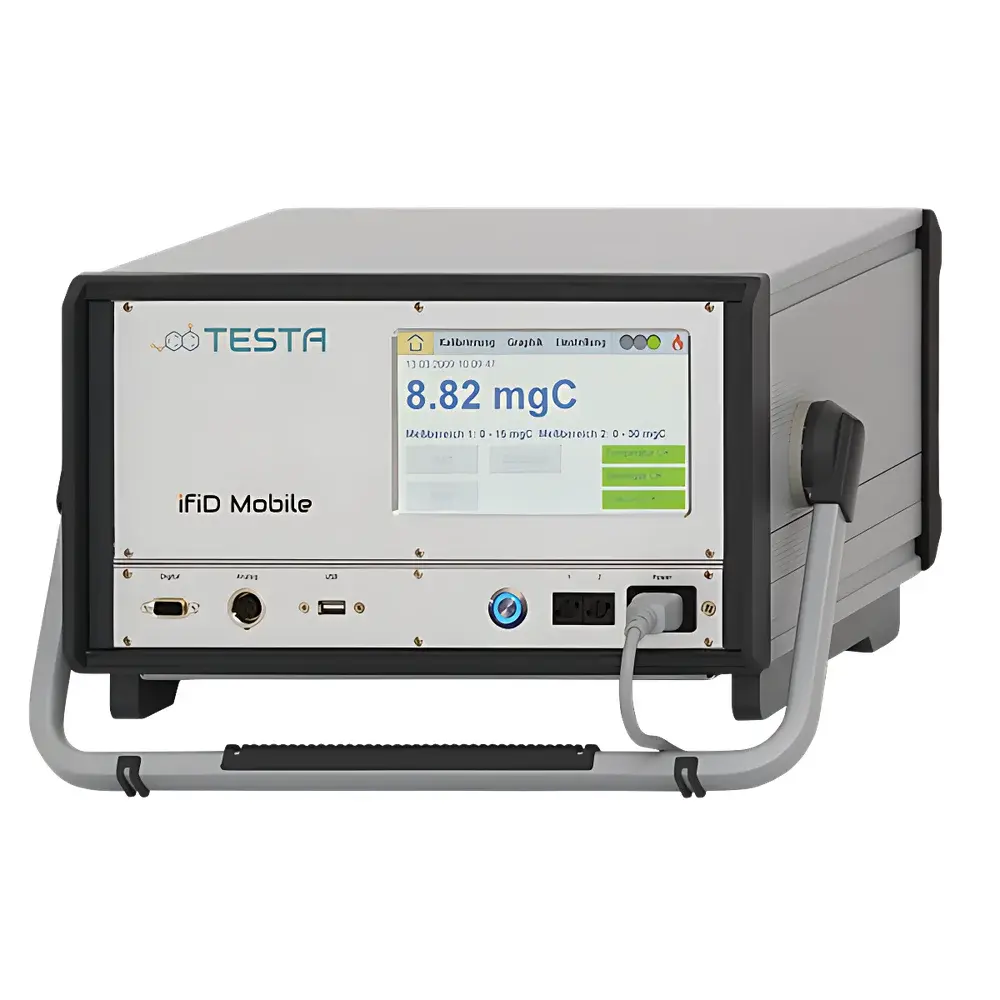
Testa iFiD mobile Portable Total Hydrocarbon Analyzer
| Brand | Testa |
|---|---|
| Origin | Germany |
| Model | iFiD mobile |
| Detection Principle | Flame Ionization Detection (FID) |
| Instrument Type | Portable |
| Measurement Range | 0–30,000 ppmC₁ |
| Response Time | 1 s (T₉₀) |
| Repeatability | ±1% of full scale |
| Zero Drift | ±1% FS over 24 h |
| Detector Temperature | 190 °C |
| Hot Filter Temperature | 300 °C |
| Warm-up Time | 15 min |
| Power Supply | 100–240 V AC, 50–60 Hz, 350 W |
| Operating Temperature | 0–45 °C |
| Enclosure Rating | IP40 |
| Dimensions | 178 × 370 × 420 mm |
| Weight | 12 kg |
| Fuel Gas | H₂ (Grade 5) or He/H₂ mixture |
| Burner Air | Built-in pump, flow-controlled |
| Calibration Gases | C₃H₈, CH₄, C₂H₆ |
| Zero Gas | N₂ or synthetic air |
| Sample Flow Control | Internal pressure compensation (−150 to +500 hPa) |
| Analog Output | 0–20 mA / 0–10 V |
| Digital Interface | Ethernet, RS232 |
| Data Storage | USB flash drive |
| Remote Access | VNC-compatible |
| Optional | Integrated zero-air generator, thermal desorption cleaning cycle |
Overview
The Testa iFiD mobile is a field-deployable, flame ionization detector (FID)-based portable total hydrocarbon (THC) analyzer engineered for real-time, quantitative measurement of volatile organic compounds (VOCs) and hydrocarbon species in ambient, industrial, and emission-related gas streams. Unlike photometric or PID-based instruments, the iFiD mobile leverages the universal, carbon-mass-sensitive response of FID technology—ensuring linear, stoichiometric detection of all organic compounds containing ≥1 carbon atom (expressed as ppmC₁), independent of molecular structure. Its fully integrated design includes a heated sampling path, high-temperature ceramic filter (up to 300 °C), and thermally stabilized FID chamber (190 °C), enabling robust operation in humid, particulate-laden, or condensable VOC environments—critical for stack testing, fence-line monitoring, and indoor air quality surveys where sample integrity cannot be compromised by cooling or adsorption losses.
Key Features
- Simultaneous quantification of total hydrocarbons (THC), methane (CH₄), and non-methane hydrocarbons (NMHC) via dual-channel FID configuration with internal hydrocarbon speciation logic
- Single, wide dynamic range (0–30,000 ppmC₁) eliminating range-switching artifacts and calibration discontinuities
- 7-inch capacitive TFT touchscreen interface with real-time graphical display of concentration trends, alarm thresholds, and diagnostic status
- Integrated hot filtration system (300 °C) and thermally assisted gas-path cleaning protocol to prevent carbon buildup and maintain baseline stability
- Onboard pressure-compensated mass flow control (−150 to +500 hPa) ensuring consistent sample delivery under variable stack or ambient backpressure conditions
- Internal response factor correction matrix for multi-gas calibration (C₃H₈, CH₄, C₂H₆), traceable to NIST-traceable standards
- USB-host data logging with timestamped CSV export; supports GLP-compliant audit trails when paired with optional software suite
Sample Compatibility & Compliance
The iFiD mobile is validated for direct analysis of unfiltered, humid, or particulate-impacted gas matrices—including ambient air, process vents, combustion exhaust, paint booth effluents, and landfill/leak survey samples. Its heated inlet and ceramic filter mitigate condensation and aerosol interference, meeting ASTM D6348–22 requirements for gaseous hydrocarbon determination in emissions testing. The instrument conforms to IEC 61000-6-2 (EMC immunity) and IEC 61000-6-4 (EMC emission) standards. While not intrinsically safe certified, its IP40 enclosure is suitable for non-hazardous area deployment per EN 60529. All firmware and data handling routines support 21 CFR Part 11–compliant electronic records when used with validated VNC remote access and encrypted USB storage protocols.
Software & Data Management
Data acquisition and instrument control are managed via embedded Linux-based firmware supporting both local touchscreen operation and remote VNC session control from Windows/macOS/Linux workstations. Real-time analog outputs (0–20 mA / 0–10 V) enable integration into SCADA or DCS systems without protocol conversion. Digital communication includes Modbus TCP over Ethernet and ASCII command sets via RS232. Internal memory buffers up to 30 days of second-resolution data; USB export generates ISO 8601–formatted .csv files with metadata headers (instrument ID, calibration date, operator tag, environmental conditions). Optional PC software provides automated report generation aligned with EU Directive 2010/75/EU (IED) and US EPA Method 25A compliance templates.
Applications
- Regulatory fence-line monitoring per US EPA Method 25A and EN 12619 for petrochemical, refinery, and chemical manufacturing facilities
- Indoor air quality (IAQ) assessment in automotive coating booths, semiconductor cleanrooms, and pharmaceutical production suites
- Leak detection and repair (LDAR) programs requiring rapid, on-site THC screening at valves, flanges, and connectors
- Mobile source emissions evaluation—including diesel engine exhaust, marine auxiliary generators, and compressed natural gas (CNG) refueling stations
- Research-grade VOC profiling during atmospheric chemistry field campaigns or biogenic emission studies
FAQ
What gases does the iFiD mobile detect?
It detects all organic compounds ionized by the FID—quantified collectively as total hydrocarbons (THC) in ppmC₁—and differentiates methane (CH₄) and non-methane hydrocarbons (NMHC) using internal algorithmic subtraction based on dual-FID signal processing.
Is hydrogen fuel safety managed onboard?
Yes—the instrument incorporates leak-tight gas manifolds, catalytic hydrogen recombiners, and automatic shutoff valves triggered by pressure anomaly or flame-out detection, compliant with German TRBS 2152 Part 2 guidelines for portable H₂ systems.
Can it operate continuously for unattended monitoring?
With external power and periodic zero/span verification (recommended every 24 h), the iFiD mobile supports extended autonomous operation; internal battery backup is not provided, but DC-AC inverters (12/24 V) are field-tested and documented.
Does it meet EPA or EU regulatory method requirements?
It is designed to fulfill performance criteria of EPA Method 25A (THC) and EN 12619 (stationary source NMHC), though final method compliance requires site-specific validation per QA/QC protocols including daily system suitability checks and cylinder gas audits.
Is the heated filter replaceable in the field?
Yes—the 300 °C ceramic filter cartridge is user-replaceable without tools; lifetime exceeds 6 months under typical industrial use, with diagnostics logging cumulative thermal cycles and pressure drop history.
Related Products







