
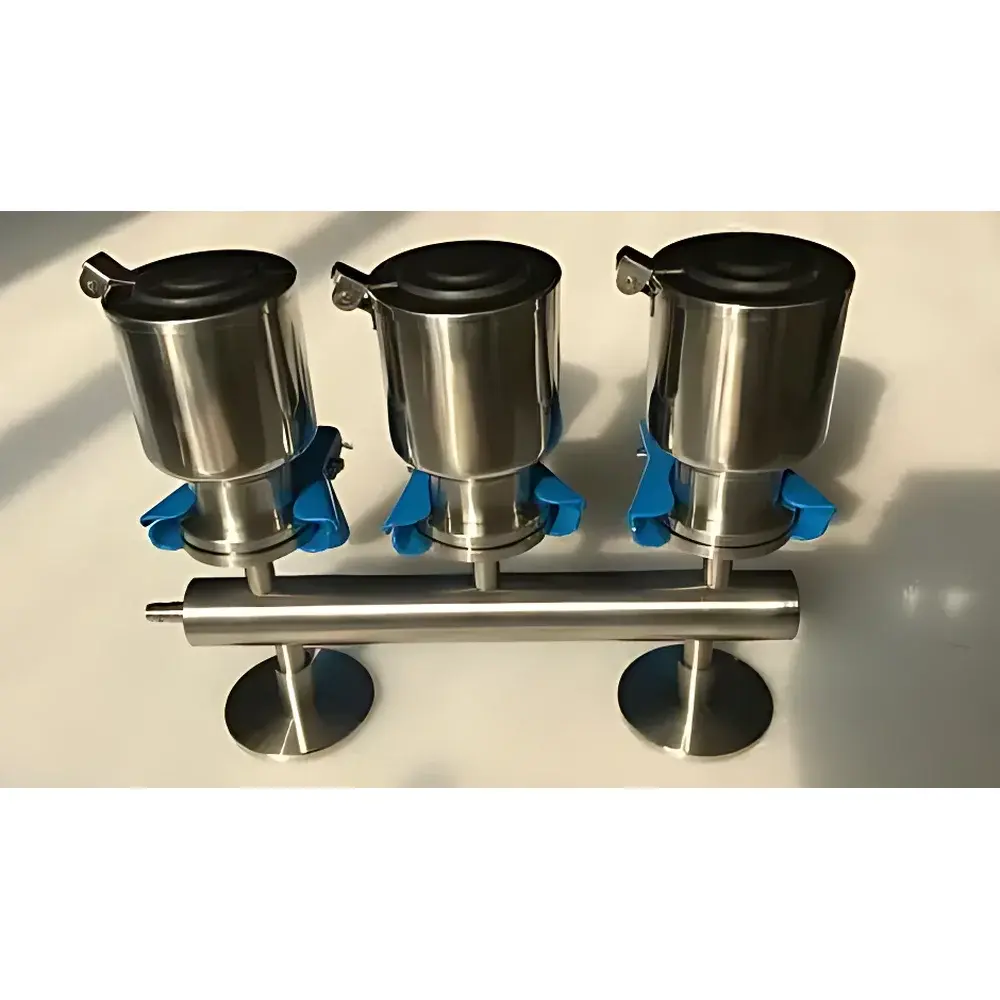
Fitlylab FTL-W1 Triple-Station Stainless Steel Microbial Filtration System
| Brand | Fitlylab |
|---|---|
| Origin | Guangdong, China |
| Model | W1 |
| Material | Fully Stainless Steel (316L-grade components) |
| Filter Cup Diameter | φ47 mm or φ50 mm |
| Membrane Pore Size | 0.22 µm or 0.45 µm |
| Configuration | Triple-station with independent valve control per station |
| Sterilization Compatibility | Autoclavable (121 °C, 20 min, steam) |
| Compliance | Designed for ISO 7218, ASTM D5673, and USP <61> microbiological testing workflows |
| Includes | Stainless steel filtration cups, stainless steel support screens, stainless steel manifold支架, stainless steel isolation valves, anodized aluminum clamps, silicone tubing, overflow-prevention collection flask, vacuum pump interface |
Overview
The Fitlylab FTL-W1 Triple-Station Stainless Steel Microbial Filtration System is a precision-engineered, manually operated vacuum filtration platform designed for standardized microbial enumeration in compliance with international pharmacopoeial and environmental testing protocols. Based on the principle of membrane filtration—where liquid samples are drawn under controlled negative pressure through sterile, low-protein-binding membranes—the system enables quantitative recovery of viable microorganisms (e.g., total aerobic bacteria, coliforms, Pseudomonas spp.) from aqueous matrices. Unlike traditional single-unit glass sintered funnels, the FTL-W1 integrates three parallel filtration stations within a unified, fully metallic architecture—eliminating organic material contact points, minimizing extractables, and ensuring thermal stability across repeated sterilization cycles. Its modular valve manifold allows sequential or simultaneous operation of all three stations using a single vacuum source, significantly reducing hands-on time and inter-sample cross-contamination risk in high-throughput QC laboratories.
Key Features
- Fully stainless steel construction (body, cups, support screens, valves, and manifold)—no plastic or polymer components in fluid path; compliant with FDA-recommended materials for pharmaceutical water system validation.
- Independent stainless steel isolation valves per station—enabling selective activation, real-time flow monitoring, and individual pressure regulation without interrupting ongoing filtrations.
- Anodized aluminum clamping mechanism engineered for consistent 12–15 N·m torque delivery—ensuring reproducible gasket compression and leak-free sealing between cup, membrane, and base plate across ≥500 autoclave cycles.
- Autoclavable at 121 °C for 20 minutes (steam sterilization); validated for ≥100 consecutive sterilization cycles without dimensional drift or surface pitting.
- Compatible with standard 47 mm and 50 mm diameter, 0.22 µm or 0.45 µm pore size membranes—including mixed cellulose ester (MCE), polyethersulfone (PES), and nylon—supporting both qualitative presence/absence and quantitative colony-forming unit (CFU) assays.
- No consumable seals or O-rings in primary filtration path—reducing maintenance frequency and eliminating silicone or EPDM-related leachables that compromise low-bioburden analysis.
Sample Compatibility & Compliance
The FTL-W1 is validated for use with potable water, purified water (PW), water for injection (WFI), environmental swab rinsates, pharmaceutical process rinse solutions, food and beverage extracts, and wastewater effluents. It meets mechanical and operational requirements outlined in ISO 7218:2017 (Microbiology of food and animal feeding stuffs), ASTM D5673-22 (Standard Test Method for Enumeration of Total Coliforms and Escherichia coli in Water by Membrane Filtration), and USP General Chapter (Microbiological Examination of Nonsterile Products). The absence of adhesive-lined gaskets and polymer wetted parts ensures compatibility with stringent GMP environments where extractables profiling (per ICH Q5C and USP ) is required. All stainless steel surfaces are electropolished to Ra ≤ 0.4 µm finish, facilitating cleaning verification and residue removal per EU Annex 1 and FDA Aseptic Processing Guidance.
Software & Data Management
As a hardware-only, non-electronic filtration platform, the FTL-W1 does not incorporate embedded software or digital interfaces. However, it is fully compatible with laboratory information management systems (LIMS) and electronic lab notebooks (ELN) via manual entry of filtration parameters (sample volume, membrane type, incubation conditions, CFU counts). Its deterministic mechanical design supports full auditability: each valve actuation, cup installation, and sterilization cycle can be documented in batch records per 21 CFR Part 11-compliant procedures when paired with validated paper-based or electronic logbooks. The system requires no firmware updates, calibration certificates, or cybersecurity controls—reducing IT validation burden in regulated QC labs.
Applications
- Routine microbial monitoring of purified water systems in pharmaceutical manufacturing facilities.
- Environmental monitoring (EM) program execution for Grade A/B cleanrooms per ISO 14644-1 and EU GMP Annex 1.
- Raw material and finished product bioburden testing in accordance with USP , EP 2.6.12, and JP 4.06.
- Drinking water quality assessment per WHO Guidelines for Drinking-water Quality and EPA Method 1603.
- Research-scale filtration of cell culture supernatants, fermentation broths, and enzyme solutions where metal ion leaching must be minimized.
- Validation studies for filter integrity (bubble point, diffusion test) prior to sterilizing-grade filtration steps.
FAQ
Is the FTL-W1 suitable for sterility testing per USP ?
Yes—when used with 0.22 µm rated membranes and integrated into a validated aseptic workflow, the FTL-W1 serves as an acceptable filtration manifold for sterility test sample preparation.
Can I use it with aggressive solvents like acetone or ethanol?
No—while stainless steel resists corrosion, silicone tubing and certain membrane chemistries (e.g., nitrocellulose) are incompatible with organic solvents. Use only aqueous or mild buffer solutions.
Does the system include a vacuum pump?
No—the FTL-W1 is supplied as a filtration manifold only; users must provide a compatible vacuum source (typically –80 kPa minimum) and overflow protection flask.
What is the maximum recommended filtration volume per cup?
For optimal microbial recovery and membrane integrity, limit single-run volumes to ≤500 mL per cup when using 0.45 µm membranes, or ≤100 mL when using 0.22 µm membranes.
How often should the stainless steel components be passivated?
Passivation is recommended after initial commissioning and following any abrasive cleaning procedure; annual re-passivation is advised for continuous GMP operation per ASTM A967.




