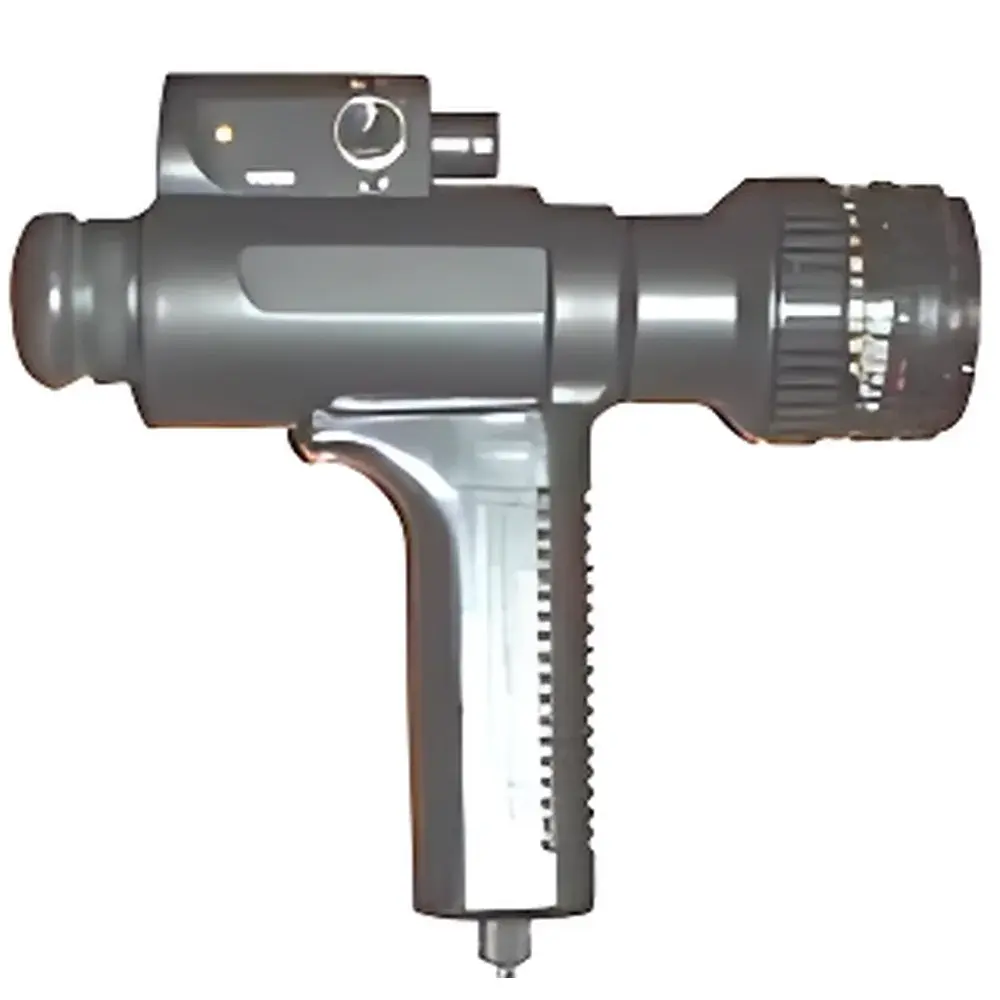
Electrophysics Abris-M Version 2 Infrared Viewer
| Brand | Electrophysics |
|---|---|
| Origin | Belarus |
| Model | Abris-M Version 2 |
| Spectral Range | 350–2000 nm (UV/IR) |
| Resolution (center wavelength) | 60 lp/mm |
| Field of View | 18° |
| Magnification | 2× |
| Objective Lens | F2/50 mm with adjustable iris |
| Focus Range | 0.25 m to ∞ |
| Working Distance | 12.5 ± 0.2 mm |
| Battery | 1.5 V AAA (3 V internal HV conversion) |
| HV Output | 16–18 kV |
| Phosphor Emission | ~550 nm (green) |
| Screen Non-Uniformity | <20% |
| Response Non-Uniformity | <15% |
| Image Distortion | <18% |
| Battery Life | ~35 h |
| Weight | 0.55 kg |
| Dimensions | 205 × 78 × 52 mm |
| Operating Temperature | −10 °C to +40 °C |
| Mounting Thread | 1/4″-20 UNC |
| Compliance | CE, RoHS, IEC 61010-1 (safety), ISO 9001-manufactured supply chain |
Overview
The Electrophysics Abris-M Version 2 Infrared Viewer is a high-sensitivity, image-intensifying optical instrument engineered for real-time visualization of non-visible radiation across the ultraviolet (270 nm) to near-infrared (2000 nm) spectrum. Unlike thermal imaging systems, it operates on the principle of photoelectron conversion: incident photons strike an S-1 photocathode — an oxygen-enriched multialkali material optimized for broad spectral response — generating a proportional electron image. This electron flux is accelerated by an internally generated 16–18 kV potential and focused onto a phosphor screen emitting green light at ~550 nm, viewable through an adjustable eyepiece. The device requires no external power source during operation; activation is momentary via a push-button switch that initiates high-voltage generation from a single 1.5 V AAA cell (internally stepped up). Its design prioritizes laboratory-grade reproducibility, low-light detection fidelity, and compatibility with regulated optical workflows — particularly where direct beam observation of pulsed or CW lasers (e.g., Nd:YAG at 1064 nm, Er:glass at 1540 nm, or quantum cascade sources up to 2 µm) is required under controlled illumination conditions.
Key Features
- Extended spectral sensitivity from 350 nm to 2000 nm, covering UV-A, visible, NIR, and short-wave IR (SWIR) bands — validated for laser alignment, fiber coupling, and fluorescence excitation applications.
- 2× magnification objective (F2/50 mm) with integrated adjustable iris for dynamic control of irradiance exposure and depth-of-field optimization.
- High-resolution imaging performance: ≥60 line pairs per millimeter (lp/mm) at center wavelength, enabling discrimination of fine spatial features in reflected or scattered IR patterns.
- Robust mechanical architecture: aluminum alloy housing, IP54-rated ingress protection against dust and incidental moisture, and 1/4″-20 UNC tripod interface for stable mounting in optical benches or field deployments.
- Low-threshold detectability: capable of resolving continuous-wave laser beams at power densities as low as 20 µW/cm² at 1064 nm (measured at 1 m distance), compliant with ANSI Z136.1 Class 3R exposure limits when used with appropriate attenuation.
- Integrated safety logic: automatic HV shutdown after button release; residual charge dissipation within minutes; built-in overexposure protection to prevent irreversible photocathode fatigue.
Sample Compatibility & Compliance
The Abris-M Version 2 is compatible with reflective targets including polished metals (Al, Cu, stainless steel), anodized surfaces, and IR-reflective calibration standards — but not diffuse absorbers such as plain paper or matte black materials, which reduce signal-to-noise ratio below usable thresholds. It supports standardized test configurations per ASTM E1316 (Standard Terminology for Nondestructive Examinations) and ISO/IEC 17025-accredited metrology environments when paired with traceable neutral density filters (e.g., OD 1.3–3.0 at 1064 nm). While not classified as medical or diagnostic equipment, its use in forensic document examination aligns with EN 16110-1 (forensic imaging standards), and its construction adheres to EU Directive 2014/30/EU (EMC) and 2011/65/EU (RoHS). No FDA 510(k) or CE medical device classification applies; it is designated as a general-purpose optical measurement aid.
Software & Data Management
As a purely analog electro-optical viewer, the Abris-M Version 2 does not incorporate embedded firmware, digital signal processing, or native data logging. However, it integrates seamlessly into digital documentation pipelines via optional accessories: a C-mount video adapter (VA-1) enables connection to industrial CCD/CMOS cameras compliant with IEEE 1394 or USB3 Vision protocols; microscope adapters support coupling to upright or inverted research-grade microscopes (e.g., Zeiss Axio, Leica DM series) for IR-fluorescence mapping. When used with calibrated camera systems, output images may be archived under GLP-compliant metadata frameworks (e.g., DICOM-SR or TIFF-EP with EXIF tags), supporting audit trails in QA/QC labs governed by ISO/IEC 17025 or pharmaceutical GMP Annex 11 requirements for electronic records.
Applications
- Laser system alignment and beam profiling for Nd:YAG (1064 nm), Er:YAG (2940 nm — via harmonic generation), and tunable OPO sources.
- Fiber optic end-face inspection and coupling efficiency verification in telecom (1310/1550 nm) and datacom SWIR links.
- Non-invasive analysis of pigment degradation, ink differentiation, and underdrawing recovery in cultural heritage conservation (per CEN/TS 16093).
- In vivo plant physiology studies involving chlorophyll fluorescence induction (720–780 nm) and stress-induced NIR reflectance shifts.
- Forensic latent print development using IR-excited luminescent powders or dye-stained residues.
- Failure analysis of semiconductor packaging via IR transmission imaging through silicon substrates (up to 1100 nm).
FAQ
Can the Abris-M Version 2 be used to view mid-wave or long-wave infrared radiation (3–14 µm)?
No. Its S-1 photocathode has negligible quantum efficiency beyond 2000 nm; MWIR/LWIR detection requires cooled MCT or microbolometer-based thermal imagers.
Is direct viewing of laser beams in free space safe or technically feasible?
Direct beam viewing is strictly prohibited. The device visualizes scattered or reflected radiation only — e.g., from metallic surfaces or calibrated diffusers — and must always be operated within ANSI Z136.1 maximum permissible exposure (MPE) limits.
What is the minimum detectable pulse energy for nanosecond or picosecond lasers?
Detection depends on peak irradiance and temporal duty cycle. For 10 ns pulses at 1064 nm, threshold fluence is approximately 5 µJ/cm²; synchronization is not supported — observation is quasi-real-time without time-gated capability.
Does the unit require periodic recalibration?
No factory recalibration is specified. Photocathode sensitivity drift is minimal under normal use; users should verify performance annually using NIST-traceable broadband IR sources or calibrated laser diodes per ISO/IEC 17025 clause 6.5.2.
Can the Abris-M Version 2 be operated continuously for extended periods?
Yes — battery life exceeds 35 hours under typical intermittent use. For uninterrupted operation, the optional AC/DC 110–220 V to 3 V adapter provides stable input without thermal derating or HV instability.