
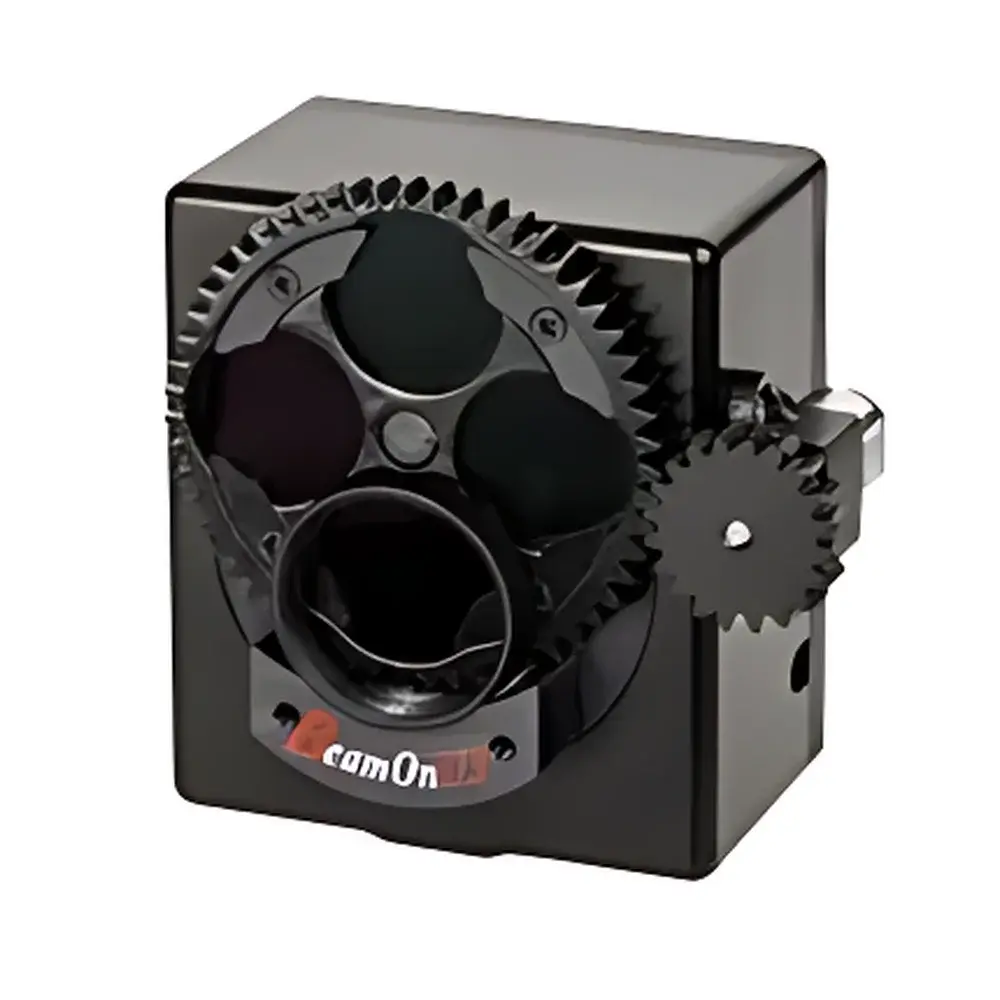
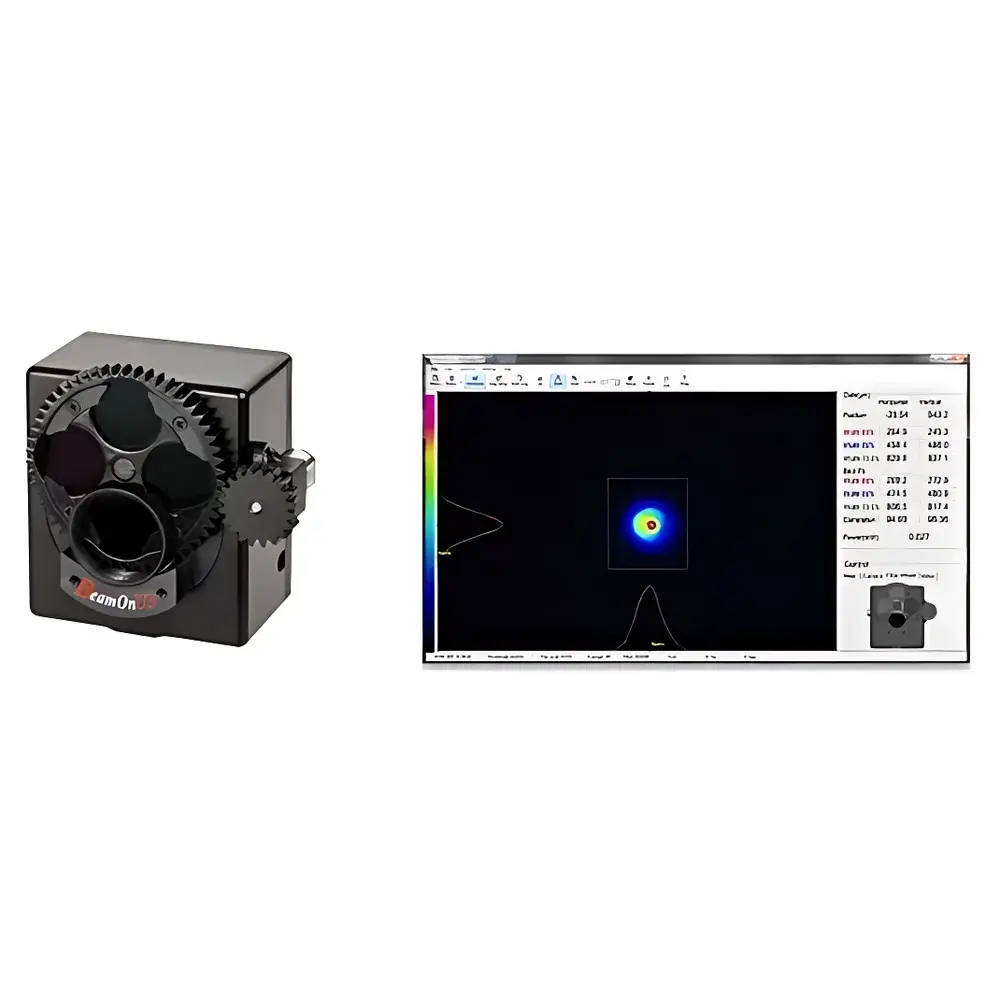
Duma Optronics BeamOn U3 Camera-Based Laser Beam Profiler
| Brand | Duma Optronics |
|---|---|
| Origin | Israel |
| Model | BeamOn U3 |
| Spectral Range | 190–1600 nm |
| Detector Type | WSR (Wide Spectral Range) CMOS |
| Active Area | 6.47 mm × 4.83 mm |
| Pixel Size | 8.6 µm (H) × 8.3 µm (V) |
| Interface | USB 2.0 |
| Frame Rate | 25 Hz (standard), up to 5 fps with extended shutter control |
| Shutter Speed | 1/50×256 s to 1/100,000 s |
| Gain Range | 6–41 dB |
| Power Supply | 5 V, 0.6 A (USB bus-powered) |
| Operating Temperature | −10 °C to +50 °C (non-condensing) |
| Damage Threshold | 50 W/cm² / 1 J/cm² (with all included ND filters) |
| Saturation Power Density | ~1 mW/cm² @ 633 nm (unattenuated) |
| Minimum Detectable Intensity | ~160 µW/cm² @ 1550 nm |
| Dimensions | 80 mm × 78.5 mm × 49 mm |
| Weight | ~400 g (including cable) |
Overview
The Duma Optronics BeamOn U3 is a high-precision, camera-based laser beam profiler engineered for quantitative characterization of continuous-wave (CW) and pulsed laser beams across an exceptionally broad spectral range—from deep ultraviolet (190 nm) to near-infrared (1600 nm). Unlike scanning-slit or knife-edge profilers, the BeamOn U3 employs a wide-spectral-range (WSR) CMOS sensor with calibrated pixel response and integrated neutral density (ND) filtering, enabling direct, non-scanning 2D intensity mapping of beam cross-sections. Its optical architecture supports accurate measurement of beam parameters including spatial intensity distribution, centroid position, beam width (per ISO 11146-1:2005 definitions), ellipticity, and M² estimation when coupled with optional beam propagation modules. Designed for integration into laser development labs, industrial alignment stations, and OEM subsystems, the device operates entirely via USB 2.0—eliminating external power supplies or frame grabbers—while maintaining robust thermal stability and mechanical rigidity for repeatable metrology under variable ambient conditions.
Key Features
- True wide-spectrum detection: validated responsivity from 190 nm to 1600 nm, covering excimer, Ti:sapphire, Nd:YAG, fiber, and quantum cascade laser sources
- High dynamic range imaging: programmable gain (6–41 dB) and ultra-low-noise shutter control (down to 1/100,000 s) enable simultaneous capture of weak pilot beams and intense focal spots
- ISO-compliant beam parameter extraction: automatic calculation of D4σ, knife-edge, and 1/e² widths; full compliance with ISO 11146-1:2005 and ISO 13694 for beam width and divergence reporting
- Real-time visualization and analysis: native support for 2D contour plots, 3D surface rendering, line profiles, and centroid trajectory tracking at up to 25 Hz
- Integrated attenuation system: three factory-calibrated ND filters mounted in a motorized filter wheel, ensuring safe operation at power densities up to 50 W/cm² and pulse energies up to 1 J/cm²
- Compact, USB-powered form factor: 80 × 78.5 × 49 mm housing with <400 g mass—designed for benchtop deployment, optical table integration, or embedded use in automated test stands
Sample Compatibility & Compliance
The BeamOn U3 accommodates free-space collimated, focused, and divergent beams without requiring beam expansion or reduction optics—provided the beam diameter falls within the 6.47 × 4.83 mm active area. It supports both Gaussian and non-Gaussian profiles—including top-hat, donut, multi-mode, and structured light patterns—with sub-pixel centroid resolution (<0.1 pixel RMS repeatability over 1000 frames). All measurements adhere to traceable calibration protocols per ISO/IEC 17025-accredited procedures performed by Duma’s metrology lab in Rehovot, Israel. The instrument meets CE, RoHS, and FCC Class B electromagnetic compatibility requirements. For regulated environments (e.g., medical laser manufacturing or aerospace QA), optional audit-trail-enabled software modules provide 21 CFR Part 11-compliant electronic records, user access control, and change history logging—fully compatible with GLP and GMP documentation workflows.
Software & Data Management
The BeamOn U3 ships with BeamGage Professional v7.x—a modular, Windows-based application supporting real-time acquisition, offline analysis, batch processing, and report generation. Core capabilities include multi-parameter time-series logging (centroid drift, width fluctuation, peak intensity decay), statistical process control (SPC) charting, histogram-based noise analysis, and export to CSV, HDF5, TIFF, and MATLAB .mat formats. SDKs for C++, C#, Python (via PyBeamGage), and LabVIEW enable seamless integration into custom automation frameworks (e.g., PLC-triggered acquisition or closed-loop adaptive optics control). All raw image data retains full bit-depth fidelity (12-bit ADC), and metadata—including timestamp, exposure, gain, filter position, and environmental temperature—is embedded in every saved frame for full experimental reproducibility.
Applications
- Quantitative verification of beam shaping optics (e.g., diffractive optical elements, microlens arrays, and axicons) in UV lithography and laser material processing
- In-process monitoring of fiber laser focus stability during cutting, welding, and additive manufacturing
- M² measurement of high-brightness diode lasers and VCSEL arrays using multi-distance propagation analysis
- Alignment validation of multi-wavelength laser combiners and ultrafast amplifier chains
- Characterization of ultrafast pulse spatial chirp and spatio-temporal coupling using gated or streak-camera synchronized acquisition modes
- Calibration of photodetector uniformity and CCD/CMOS sensor flat-field correction using known top-hat reference beams
FAQ
Can the BeamOn U3 measure pulsed lasers with repetition rates above 10 kHz?
Yes—provided pulse energy remains within saturation limits and trigger synchronization is implemented via external TTL input (optional accessory); maximum measurable PRF is constrained by frame rate (25 Hz standard) unless using burst-mode acquisition with internal buffering.
Is NIST-traceable calibration available for this model?
Duma Optronics provides factory calibration certificates traceable to PTB (Physikalisch-Technische Bundesanstalt) standards; full NIST-traceable recalibration services are offered annually through authorized service centers in Europe and North America.
Does the software support automated pass/fail criteria for production-line testing?
Yes—BeamGage Professional includes configurable acceptance thresholds for beam width, centroid deviation, and intensity uniformity, with XML-based recipe storage and automated PDF report generation per test cycle.
What is the minimum beam diameter resolvable at 1064 nm?
With diffraction-limited optics and optimal focusing, the system resolves features down to ≈12 µm (FWHM) based on Nyquist sampling of the 8.3 µm vertical pixel pitch; practical resolution depends on lens magnification and optical aberrations in the imaging path.
Can the device operate continuously for 24/7 monitoring applications?
Yes—the thermally stabilized sensor and passive heatsinking design permit unattended operation for >72 hours at ambient temperatures ≤40 °C; fanless architecture ensures zero vibration coupling to sensitive optical setups.




