
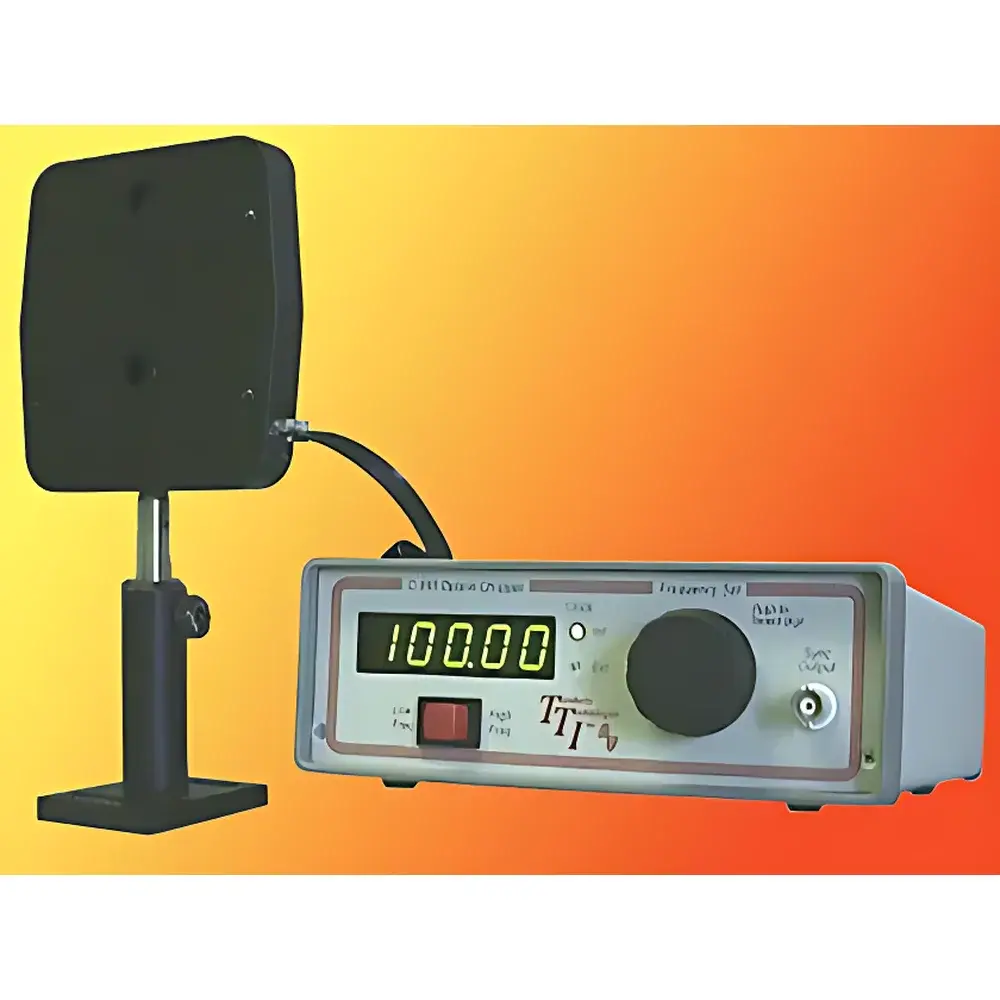
TTI C-995 v Optical Chopper
| Brand | TTI |
|---|---|
| Origin | USA |
| Model | C-995 v |
| Frequency Range | 4.0 Hz to 5 kHz (selectable via dual apertures) |
| Frequency Resolution | 0.001 Hz (via RS-232) |
| Display | 5-digit high-brightness green LED (565 nm, 14 mm digit height) |
| Phase Jitter | 0.1% peak-to-peak (3-slot), 1.0% peak-to-peak (30-slot) |
| Frequency Stability | ±25 ppm (0–40 °C, internal clock) |
| Phase Lock Response Time | <5 s (full range), <1 s (±10% step) |
| Input Compatibility | TTL/CMOS, 4.0 Hz–5.0 kHz |
| Aperture Dimensions | 30-slot: 15 mm H × 4.5 mm W |
| 3-slot | 15 mm H × 15 mm W |
| Housing | Square chopper head (4.75″ × 4.75″ × 2″), with two #8-32 mounting holes |
| Power | 85–260 VAC, 40–400 Hz, <20 W |
| Operating Temperature | 0–40 °C |
| Controller Dimensions | 2.8″ H × 7.5″ W × 8.5″ D |
| Chopper Head Dimensions | 4.5″ H × 4.5″ W × 2.5″ D |
| Weight | 2.25 kg |
Overview
The TTI C-995 v Optical Chopper is a precision laboratory-grade mechanical chopper designed for stable, repeatable modulation of continuous-wave (CW) light sources in spectroscopic, photometric, and lock-in detection applications. It operates on the principle of synchronous interruption of an optical beam using rotating slotted disks—engineered for high mechanical integrity and low phase noise. Unlike piezoelectric or acousto-optic modulators, the C-995 v delivers deterministic temporal gating with minimal harmonic distortion and zero intrinsic intensity drift. Its phase-locked loop (PLL) architecture enables precise synchronization to external reference clocks (TTL/CMOS-compatible, 4 Hz–5 kHz), making it suitable for time-resolved measurements requiring strict temporal coherence between excitation and detection electronics. The device is widely deployed in Fourier-transform infrared (FTIR) setups, photoacoustic spectroscopy, quantum optics alignment systems, and calibration-grade radiometry where duty-cycle fidelity and long-term frequency stability are critical.
Key Features
- Two interchangeable chopper wheels: 3-slot (optimized for low-frequency, high-duty-cycle operation) and 30-slot (designed for high-frequency, narrow-pulse modulation) — both centered on a 15 mm aperture height with slot widths of 15 mm and 4.5 mm respectively;
- High-resolution digital control: 5-digit green LED display (565 nm, 14 mm digit height) for real-time frequency readout and local front-panel entry at 0.1 Hz (high-frequency mode) or 0.01 Hz (low-frequency mode) resolution;
- RS-232 bidirectional interface (3-wire, 9600 baud, N,8,1) enabling remote configuration, real-time status interrogation, and sub-millihertz frequency setting (0.001 Hz resolution);
- PLL-based synchronization with <5 s full-range lock acquisition and <1 s response to ±10% frequency steps — ensuring robust tracking under dynamic experimental conditions;
- Mechanically stabilized chopper head with 10-turn precision potentiometer adjustment and physical blade interlock to prevent accidental exposure during operation;
- Universal AC input (85–260 VAC, 40–400 Hz, <20 W), eliminating need for external power conditioning in multi-lab environments;
- Compact, optomechanically compatible housing: square chopper head (4.75″ × 4.75″ × 2″) with dual #8-32 tapped mounting holes supporting height adjustment from 0.75″ to 13″ when paired with standard 1/2″ rods and optical posts.
Sample Compatibility & Compliance
The C-995 v is agnostic to light source type (laser, LED, thermal emitter) and wavelength range, provided beam diameter remains within the 15 mm aperture height and clears the defined slot width. It imposes no spectral filtering or polarization dependence. Mechanical design conforms to standard ISO 10110-7 and ANSI/OEOSC OP1.002 dimensional referencing practices for optical mounts. While not certified to specific regulatory standards (e.g., IEC 61000-6-3), its low EMI profile and galvanically isolated RS-232 interface support integration into GLP-compliant laboratories. Frequency stability (±25 ppm over 0–40 °C) meets typical requirements for traceable photometric calibration per ASTM E275 and ISO/IEC 17025–accredited measurement systems.
Software & Data Management
No proprietary software is required for basic operation; all functions are accessible via front-panel controls or ASCII-command RS-232 protocol (documented in the included technical manual). For automated workflows, users may integrate the C-995 v into LabVIEW, Python (pySerial), MATLAB, or EPICS environments using standard serial I/O libraries. The RS-232 port supports query-response commands for frequency setpoint, actual operating frequency, PLL lock status, and error flags — enabling full auditability and timestamped logging essential for FDA 21 CFR Part 11–aligned data integrity protocols. No firmware updates are field-serviceable; all calibration parameters are factory-trimmed and non-volatile.
Applications
- Lock-in amplifier reference signal generation for low-noise DC photodetection;
- Modulation transfer function (MTF) characterization of IR detectors and focal plane arrays;
- Time-gated fluorescence lifetime preliminary screening in teaching labs;
- Reference channel stabilization in dual-beam spectrophotometers;
- Beam blanking in ultrafast pump-probe alignment sequences;
- Calibration of optical power meters requiring known duty-cycle-modulated inputs;
- Phase-sensitive heterodyne detection in interferometric metrology systems.
FAQ
What is the maximum beam diameter supported by the C-995 v?
The chopper head accepts beams up to 15 mm in height; horizontal clearance depends on selected wheel — 4.5 mm for the 30-slot wheel, 15 mm for the 3-slot wheel.
Can the C-995 v operate without an external reference clock?
Yes — it includes a temperature-compensated internal crystal oscillator providing stable autonomous operation across its full 4 Hz–5 kHz range.
Is the RS-232 interface optically isolated?
No — the interface is electrically isolated via internal DC-DC conversion but does not include optical isolation. Users integrating into sensitive analog measurement chains should employ external isolation modules if ground-loop concerns exist.
Does the C-995 v support arbitrary waveform generation or variable duty cycle?
No — it is a fixed-ratio mechanical chopper. Duty cycle is determined solely by slot geometry (e.g., 3-slot ≈ 33%, 30-slot ≈ 3.3%) and cannot be adjusted independently of frequency.
How is phase jitter quantified, and under what conditions?
Phase jitter is measured as peak-to-peak deviation in zero-crossing timing over 1,000 cycles: 0.1% for the 3-slot wheel, 1.0% for the 30-slot wheel — both specified at nominal operating temperature (23 °C) and mid-range frequencies (100 Hz and 1 kHz respectively).



