
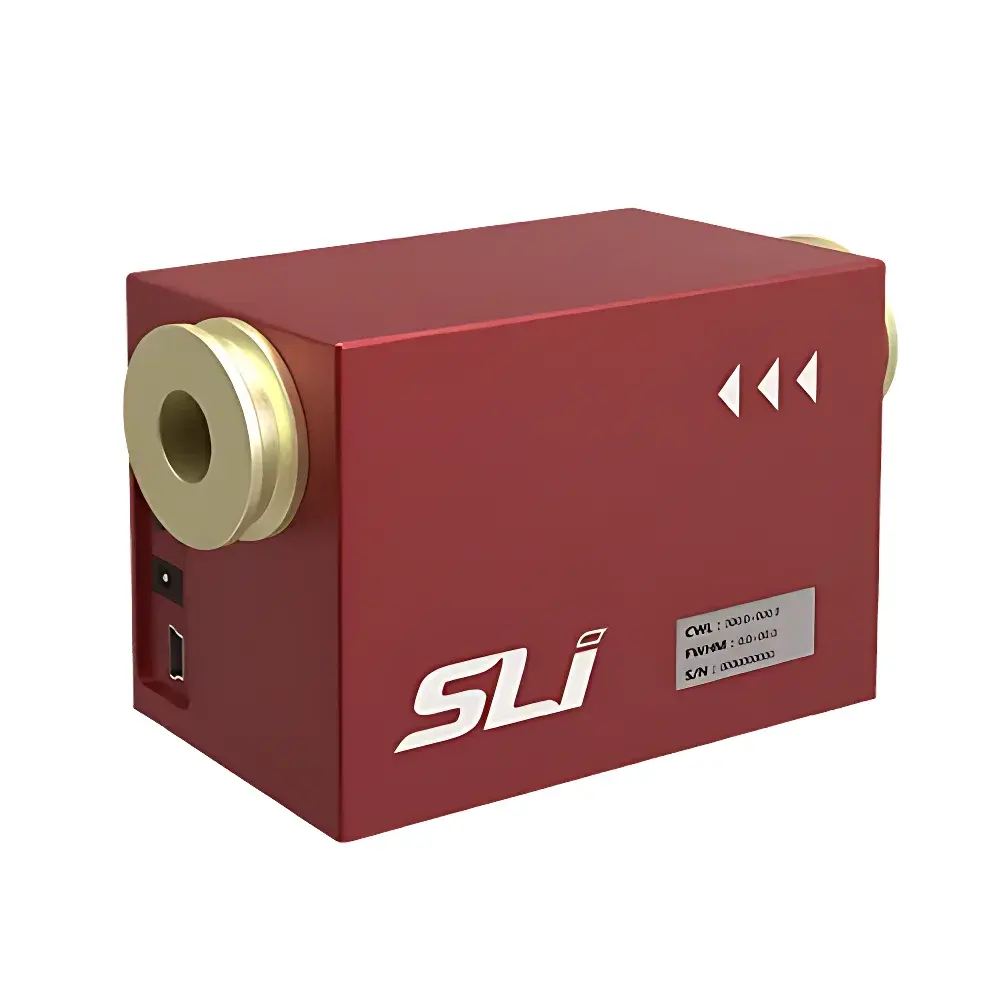
Spectrolight FWS Mono Automated Wavelength Selector
| Brand | Spectrolight |
|---|---|
| Origin | USA |
| Manufacturer Type | Authorized Distributor |
| Import Status | Imported |
| Model | FWS Mono |
| Price Range | USD 0–7,200 (est.) |
| Transmission Efficiency | >75% |
| Center Wavelength Accuracy | ±0.5 nm |
| FWHM Accuracy | ±0.5 nm |
| Optical Density (OD) | >6 (avg., 275–925 nm) |
| Minimum CW Step Size | 0.2 nm |
| Minimum FWHM Step Size | 1 nm |
| Tuning Speed | 70–200 ms |
| Aperture | 10 mm (imaging version) / 3 mm (laser-optimized version) |
| Spectral Range per Model | 358–900 nm (configurable by model) |
| FWHM Range | 2–16 nm (model-dependent) |
Overview
The Spectrolight FWS Mono Automated Wavelength Selector is an optomechanically engineered spectral filtering device designed for precision wavelength selection in imaging and spectroscopic applications. Unlike conventional monochromators or fixed-bandpass filter wheels, the FWS Mono leverages Spectrolight’s proprietary TwinFilm™ interference filter technology—combining tunable grating-based dispersion control with high-transmission, large-aperture thin-film filter architecture. This hybrid approach enables continuous, motorized tuning of both center wavelength (CW) and full width at half maximum (FWHM) bandwidth across the UV-Vis-NIR spectrum (275–900 nm), while preserving high optical throughput (>75%) and spatial fidelity required for quantitative imaging. The device operates as a stand-alone, USB-controlled spectral engine—requiring no external alignment, calibration software, or auxiliary optics—and is optimized for integration into fluorescence microscopes, hyperspectral cameras, life science instrumentation, and industrial machine vision systems.
Key Features
- Patented TwinFilm™ dual-filter architecture enabling simultaneous, independent tuning of center wavelength and bandwidth
- High transmission efficiency (>75%) across all standard models—minimizing photon loss in low-light applications such as single-molecule fluorescence or live-cell imaging
- Precision wavelength control: ±0.5 nm center wavelength accuracy and ±0.5 nm FWHM repeatability, traceable to NIST-traceable reference sources
- Rapid spectral reconfiguration: 70–200 ms settling time per wavelength step, supporting real-time spectral multiplexing and dynamic acquisition protocols
- Two mechanical configurations: 10 mm clear aperture for wide-field imaging and microscope coupling; 3 mm aperture variant optimized for collimated laser beam integration with reduced wavefront distortion
- USB 2.0 interface with vendor-provided SDK (C++, Python, LabVIEW) and native support for GenICam-compliant camera trigger synchronization
- No moving gratings or slits—solid-state actuation ensures long-term stability, shock resistance, and maintenance-free operation under laboratory or OEM deployment conditions
Sample Compatibility & Compliance
The FWS Mono is compatible with broadband illumination sources—including arc lamps, supercontinuum lasers, LED arrays, and white-light halogen sources—as well as narrowband pulsed or CW lasers when used with the laser-optimized aperture configuration. Its spectral performance meets key requirements for ISO/IEC 17025-accredited laboratories performing spectral validation of optical components. While not a medical device, its design adheres to IEC 61000-6-3 (EMC emission) and IEC 61000-6-2 (immunity) standards. For regulated environments (e.g., GLP/GMP-compliant life science R&D), optional audit trail logging and user-access controls are supported via firmware-enabled API extensions compliant with FDA 21 CFR Part 11 principles (electronic records and signatures).
Software & Data Management
Spectrolight provides the FWS Control Suite—a cross-platform application enabling GUI-based wavelength scanning, custom spectral sequence programming, and hardware-synchronized acquisition triggering. All device parameters—including CW, FWHM, exposure time, and shutter state—are logged with timestamped metadata in HDF5 or CSV format. The SDK supports deterministic command queuing and multi-threaded control, allowing integration into MATLAB, Python-based analysis pipelines (e.g., scikit-image, hyperspy), or commercial platforms such as MetaMorph, μManager, and NI LabVIEW. Firmware updates are delivered via signed binary packages with SHA-256 verification to ensure integrity and traceability.
Applications
- Fluorescence Microscopy: Enables rapid, software-defined excitation/emission switching without mechanical filter turrets—ideal for multicolor live-cell imaging, FRAP, and FLIM workflows
- Hyperspectral Imaging: Serves as a compact, high-throughput spectral engine for push-broom or snapshot hyperspectral systems, replacing bulky prism-grating assemblies
- Life Science Instrumentation: Integrated into flow cytometers, plate readers, and label-free biosensors requiring programmable spectral discrimination
- Industrial Machine Vision: Supports material classification, defect detection, and coating thickness verification using spectral reflectance signatures in production-line environments
- Laboratory Research: Used in ultrafast spectroscopy pump-probe setups, quantum dot characterization, and photostability assays where precise, repeatable bandpass selection is critical
FAQ
Is the FWS Mono compatible with third-party cameras and microscopes?
Yes—the device features standard C-mount and SM1-threaded interfaces, and its USB interface supports GenICam-compliant trigger handshaking for seamless synchronization with major scientific camera vendors (Andor, Hamamatsu, Basler, FLIR).
Can the FWS Mono be used with pulsed lasers?
The laser-optimized models (3 mm aperture) are specifically designed for use with nanosecond- to femtosecond-pulsed lasers up to 10 mJ/cm² fluence at 1064 nm; damage threshold data is provided in the technical specification sheet upon request.
Does the FWS Mono require periodic recalibration?
No—TwinFilm™ filters exhibit negligible drift over time or temperature (±0.05 nm/°C); factory calibration is stable for ≥5 years under normal lab conditions, and no user recalibration is necessary.
How is spectral bandwidth defined and verified?
FWHM values are measured using a calibrated spectroradiometer (Oriel MS260i) referenced to NIST SRM 2031 and reported as average across the full aperture; measurement uncertainty is ±0.3 nm (k=2).
What environmental conditions are recommended for optimal operation?
Operating temperature: 15–30 °C; relative humidity: 20–70% non-condensing; vibration isolation is recommended for sub-nm wavelength stability in interferometric applications.




