
Duma Optronics BA7-Si Multi-Scan Knife-Edge Laser Beam Profiler
| Key | Brand: Duma Optronics |
|---|---|
| Origin | Israel |
| Detector Type | Silicon (Si) |
| Aperture Shape | Square |
| Aperture Size | 9 mm × 9 mm |
| Spectral Range | 190–1990 nm |
| Beam Size Measurement Range | 3 µm – 9 mm |
| Spatial Resolution | 0.1 µm |
| A/D Resolution | 12-bit |
| Interface | USB 2.0 |
| Blade Count | 7 |
| Compliance | CE, RoHS |
| Software | BeamGage®-compatible SDK, ActiveX, TCP/IP, RS-232 |
Overview
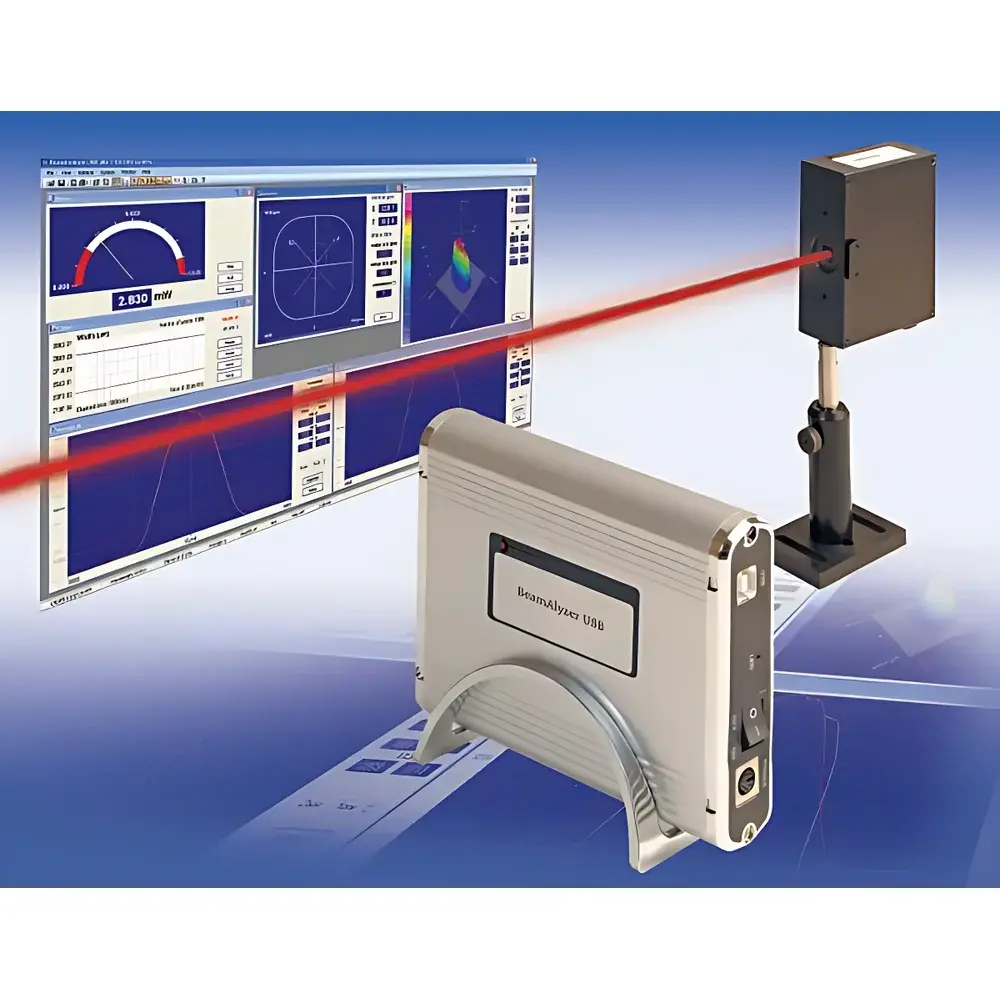
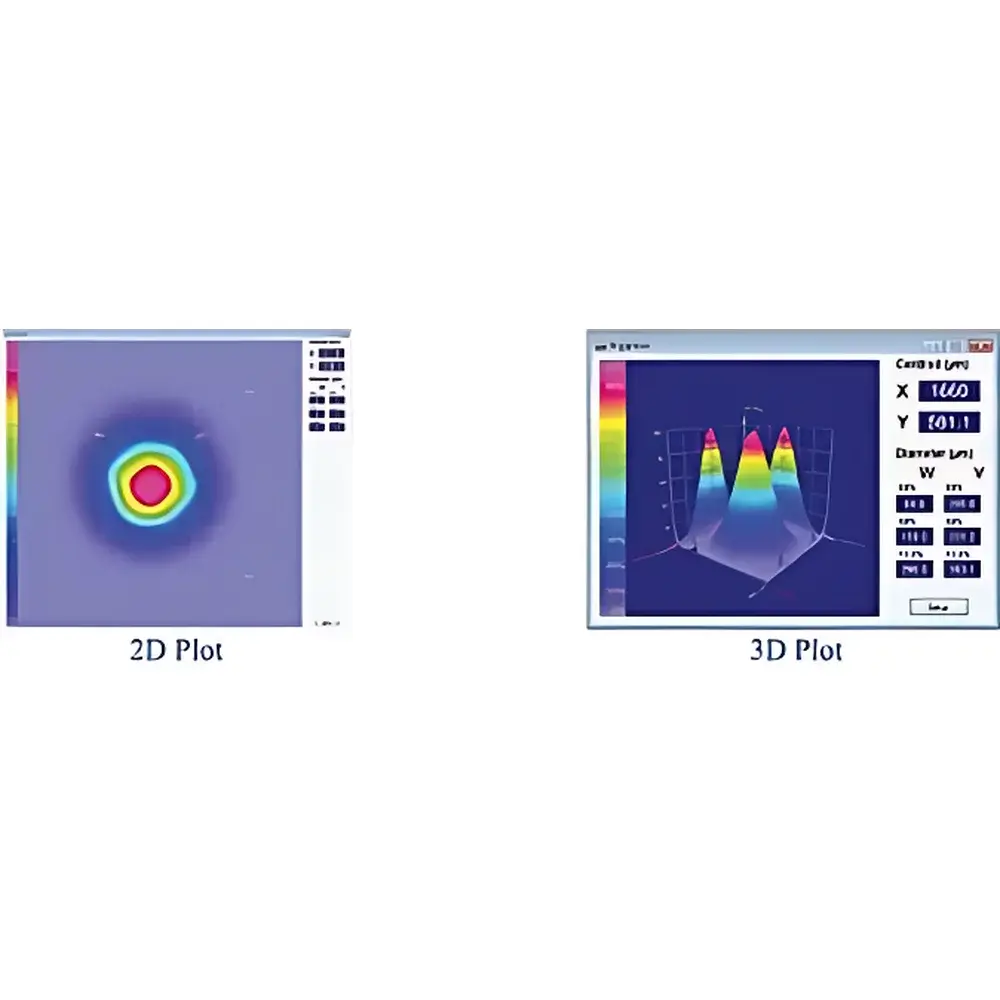
The Duma Optronics BA7-Si is a high-precision multi-scan knife-edge laser beam profiler engineered for quantitative characterization of continuous-wave and pulsed laser beams across ultraviolet, visible, and near-infrared spectra (190–1990 nm). Unlike camera-based profilers limited by pixel saturation and dynamic range constraints, the BA7-Si employs a patented tomographic reconstruction technique: seven synchronized silicon photodiode blades physically scan across the beam in orthogonal directions, acquiring intensity derivative profiles at sub-micron increments. These derivative signals are mathematically integrated—via convolution-based deconvolution algorithms—to reconstruct true 2D cross-sectional intensity distributions and full 3D volumetric beam models. This principle ensures accurate measurement of beam parameters—including M², beam width (D4σ, ISO 11146-1), centroid position, ellipticity, and peak irradiance—even for highly divergent, astigmatic, or low-contrast beams where CCD/CMOS sensors fail. The system operates under ISO/IEC 17025-aligned metrological traceability protocols and supports GLP/GMP-compliant audit trails when integrated with validated software environments.
Key Features
- Seven-blade scanning architecture enabling simultaneous orthogonal profiling for robust centroid and ellipticity calculation
- Silicon photodiode detector with 9 mm × 9 mm active square aperture, optimized for high linearity and low noise (NEP < 10 pW/√Hz)
- Sub-micron spatial resolution (0.1 µm step size) and beam size coverage from 3 µm to 9 mm—ideal for fiber-coupled diodes, ultrafast oscillators, and excimer sources
- Real-time 2D/3D beam visualization with iso-intensity surface rendering, cross-sectional slice extraction, and depth-resolved intensity projection
- 12-bit analog-to-digital conversion with hardware-accelerated sampling, delivering >60 dB dynamic range per scan
- Integrated power monitoring channel with selectable units (mW, µW, dBm) and calibrated NIST-traceable responsivity
- USB 2.0 interface with deterministic latency (< 5 ms frame-to-host transfer) and support for remote operation via TCP/IP or RS-232
Sample Compatibility & Compliance
The BA7-Si accommodates free-space and fiber-delivered beams without optical relaying—provided beam divergence remains within ±5° full angle. Its spectral response covers deep UV (190 nm) through NIR (1990 nm), making it suitable for excimer lasers (ArF, KrF), Ti:sapphire oscillators, quantum cascade lasers, and telecom-band sources. All mechanical and electronic components comply with CE Directive 2014/30/EU (EMC) and 2011/65/EU (RoHS). The measurement methodology adheres to ISO 11146-1:2005 (laser beam widths, divergence, and beam propagation ratio) and ASTM E1423-18 (standard guide for laser beam parameter measurements). Optional IQ/OQ documentation packages are available for FDA 21 CFR Part 11–regulated environments requiring electronic signature and audit trail functionality.
Software & Data Management
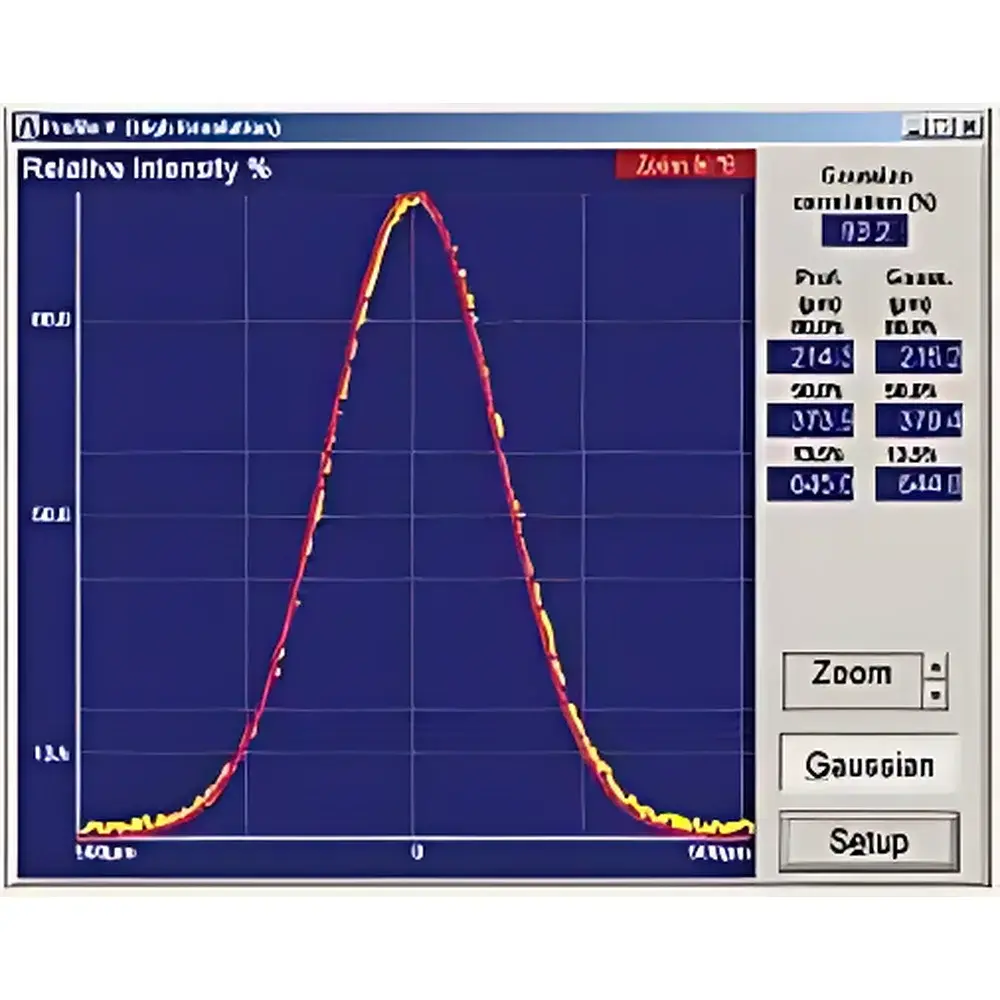
The included BeamStudio™ software provides a modular GUI for real-time acquisition, analysis, and reporting. Core modules include: (1) Live Profile View with dual-V/W orthogonal trace overlay; (2) Tomographic Reconstruction Engine generating ISO-compliant 2D/3D intensity maps; (3) Pass/Fail Threshold Engine supporting user-defined tolerances on beam width, position stability, and ellipticity per ANSI Z540.3; (4) Time-Series Dashboard for long-term drift analysis (up to 10⁶ data points/hour); and (5) Export Framework exporting raw profiles, reconstructed matrices, and summary statistics directly to CSV, Excel (.xlsx), or HDF5. All acquired data retain embedded metadata (timestamp, wavelength, integration time, blade calibration ID) and support ActiveX embedding into LabVIEW, MATLAB, or custom C++/C# applications. Audit logs record operator ID, parameter changes, and report generation events—enabling full compliance with GLP and GMP documentation requirements.
Applications
The BA7-Si serves critical roles in laser R&D, manufacturing QC, and regulatory validation workflows. It is routinely deployed for: alignment and optimization of ultrafast amplifier chains; verification of single-mode fiber coupling efficiency; M² certification of industrial CO₂ and fiber lasers per ISO 11146; qualification of UV lithography source uniformity; stability monitoring of DPSS lasers in semiconductor inspection tools; and beam parameter validation prior to FDA 510(k) submission for medical laser devices. Its tomographic fidelity enables reliable measurement of non-Gaussian beams—such as top-hat, Bessel, or vortex modes—where camera-based systems exhibit significant edge artifacts or dynamic range compression.
FAQ
What beam diameters can the BA7-Si accurately measure?
The system measures beam widths from 3 µm to 9 mm with ≤0.5% relative uncertainty (k=2) for stable CW beams, verified against NIST-traceable pinhole standards.
Does the BA7-Si support pulsed laser measurements?
Yes—when synchronized via external TTL trigger input, it captures single-shot profiles for pulses ≥10 ns duration at repetition rates up to 10 kHz.
Can I integrate the BA7-Si into an automated production test station?
Absolutely—the device exposes a full COM/ActiveX API, CLI commands over RS-232/TCP/IP, and supports headless operation via Windows Services for unattended batch testing.
Is calibration traceable to national standards?
Each unit ships with a factory calibration certificate referencing NIST SRM 2035 (silicon photodiode responsivity) and SRM 2034 (spatial scale), with optional annual recalibration services available.
How does tomographic reconstruction improve accuracy versus single-knife-edge methods?
Multi-blade scanning acquires redundant derivative projections, suppressing noise-induced integration errors and enabling deconvolution of diffraction-limited features below the mechanical step resolution—yielding superior fidelity in both beam wings and central peaks.




