
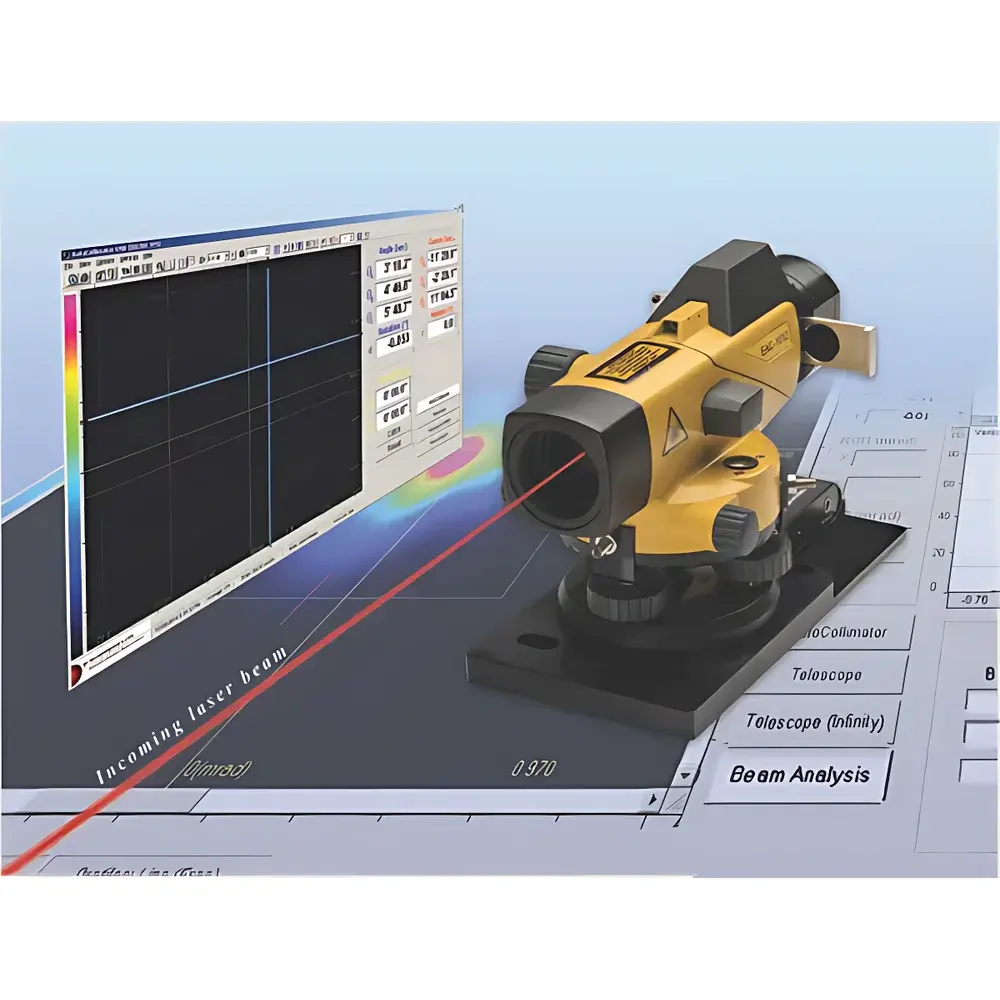
Duma Optronics EAC-1012-L Electronic Autocollimator
| Brand | Duma Optronics |
|---|---|
| Country of Origin | Israel |
| Model | EAC-1012-L |
| Field of View (Autocollimator) | 42′ (H) / 2520 arcsec |
| Field of View (Telescope Mode) | 84′ (H) / 5040 arcsec |
| Angular Resolution | 0.1 arcsec |
| Angular Accuracy | 2.5 arcsec |
| CCD Sensor | 1/2″ (1/3″ optional) |
| Light Source | LED |
| Clear Aperture | 36 mm |
| Focal Range | 30 cm to ∞ |
| Objective Thread | M67×0.75 |
| Reflector Mount | Ø64 mm, N.W. 280 g, Thread Ø16 mm, <5″ |
| Mass | 2.5 kg |
| Collimation Reference Line Stability | ±5 arcsec |
| Beam Divergence Measurement Range | 0.4–20 mrad |
| Max Optical Power Handling | 5 mW |
| Coarse Alignment Laser | 638 nm, <1.0 mW |
| Collimation Line Accuracy | 2 arcsec (10 µrad) |
Overview
The Duma Optronics EAC-1012-L is a high-precision electronic autocollimator engineered for metrological-grade angular measurement and optical alignment in research laboratories, precision manufacturing facilities, and aerospace instrumentation calibration environments. Based on the fundamental principle of autocollimation—where a collimated beam is retroreflected by a planar mirror and its displacement on a high-resolution CCD detector is translated into angular deviation—the EAC-1012-L delivers traceable, repeatable measurements at the micro-radian level. Unlike conventional visual or mechanical autocollimators, this instrument integrates a stabilized LED source, motorized focusing optics, and real-time digital image processing to eliminate parallax error and operator subjectivity. Its dual operational modes—autocollimation (for angular deviation and parallelism) and telescope (for extended-range surface flatness or multi-point alignment)—enable comprehensive characterization of optical and mechanical systems without hardware reconfiguration.
Key Features
- Sub-arcsecond resolution (0.1 arcsec) with certified accuracy of ±2.5 arcsec across full field of view (42′ horizontal)
- Dual-mode optical architecture supporting both autocollimation and telescope functions via software-selectable configuration
- Integrated coarse-alignment red laser (638 nm, <1.0 mW) for rapid initial setup—fully interlocked and Class 2 compliant per IEC 60825-1
- Motorized focus control with calibrated focal range from 30 cm to infinity, ensuring consistent wavefront sampling across diverse target distances
- High-stability reference line retention (±5 arcsec over thermal cycles and mechanical vibration), validated per ISO 10110-7 for optical component testing
- Beam divergence analysis capability (0.4–20 mrad) using centroid-based Gaussian fitting algorithms, supporting ISO 11146-1/2 compliant laser characterization
- M67×0.75 objective thread and standardized Ø64 mm reflector mount (with 16 mm tapped thread) for seamless integration with kinematic mirror mounts and motion stages
Sample Compatibility & Compliance
The EAC-1012-L is compatible with all optically flat, specularly reflective surfaces—including fused silica, BK7, silicon, and metal-coated mirrors—with minimum reflectivity >90% at visible wavelengths. It supports quantitative evaluation of optical components per ASTM E1392 (Standard Test Method for Measuring the Angular Deviation of Optical Surfaces), ISO 10110-7 (Surface irregularity and tilt), and ISO 1101 (Geometrical product specifications – tolerances of orientation and location). When deployed in regulated environments (e.g., medical device manufacturing or defense subcontracting), the system’s deterministic measurement chain, non-volatile calibration storage, and audit-ready output logs support compliance with FDA 21 CFR Part 11 requirements for electronic records and signatures when paired with validated software protocols.
Software & Data Management
Bundled with Duma’s Autocollimator Control Suite (ACS v5.x), the EAC-1012-L provides real-time angular deviation mapping, multi-target tracking, and automated sequence scripting for repetitive alignment tasks. All raw CCD frames, centroid coordinates, and calculated angles are timestamped and stored in HDF5 format—ensuring compatibility with MATLAB, Python (h5py), and LabVIEW for post-processing. The software includes built-in uncertainty propagation models based on ISO/IEC Guide 98-3 (GUM), enabling users to generate full measurement uncertainty budgets per ISO/IEC 17025. Export options include CSV, XML, and PDF reports with embedded calibration certificates traceable to NIST or PTB standards.
Applications
- Precision alignment of laser cavities, interferometer arms, and free-space optical communication terminals
- Characterization of wedge angle, prism apex error, and polygon mirror facet uniformity per ISO 10110-19
- Verification of linear stage straightness and rotary stage wobble using multi-position autocollimation (e.g., reversal method per ISO 230-2)
- Flatness assessment of large optical substrates (up to 300 mm diameter) via grid-based angular sampling
- Dynamic angular monitoring during thermal cycling or mechanical loading (when integrated with external DAQ systems)
- CD/DVD pickup lens assembly alignment and servo loop calibration in optical storage R&D
FAQ
Is the EAC-1012-L suitable for vacuum chamber integration?
Yes—the instrument features no internal outgassing materials and can be mounted externally with viewport-compatible beam paths; optional vacuum-rated versions with CF flange interfaces are available upon request.
Does it support real-time feedback for closed-loop alignment systems?
Yes—via Ethernet TCP/IP or RS-232, the EAC-1012-L streams angular data at up to 10 Hz with sub-millisecond latency, compatible with common motion controllers (e.g., Newport XPS, Aerotech A3200).
Can it measure non-planar surfaces such as spherical mirrors?
No—autocollimation requires a planar or near-planar reflector; for curved surfaces, the instrument must be used in conjunction with an auxiliary flat reference or adapted via null-compensation techniques.
What calibration documentation is provided?
Each unit ships with a factory calibration certificate traceable to PTB (Physikalisch-Technische Bundesanstalt), including temperature-dependent correction coefficients and residual error maps across the full FOV.
Is remote firmware update supported?
Yes—firmware upgrades are delivered via signed .bin files through the ACS software; updates preserve user calibration settings and comply with IEC 62443-4-2 security requirements.





