
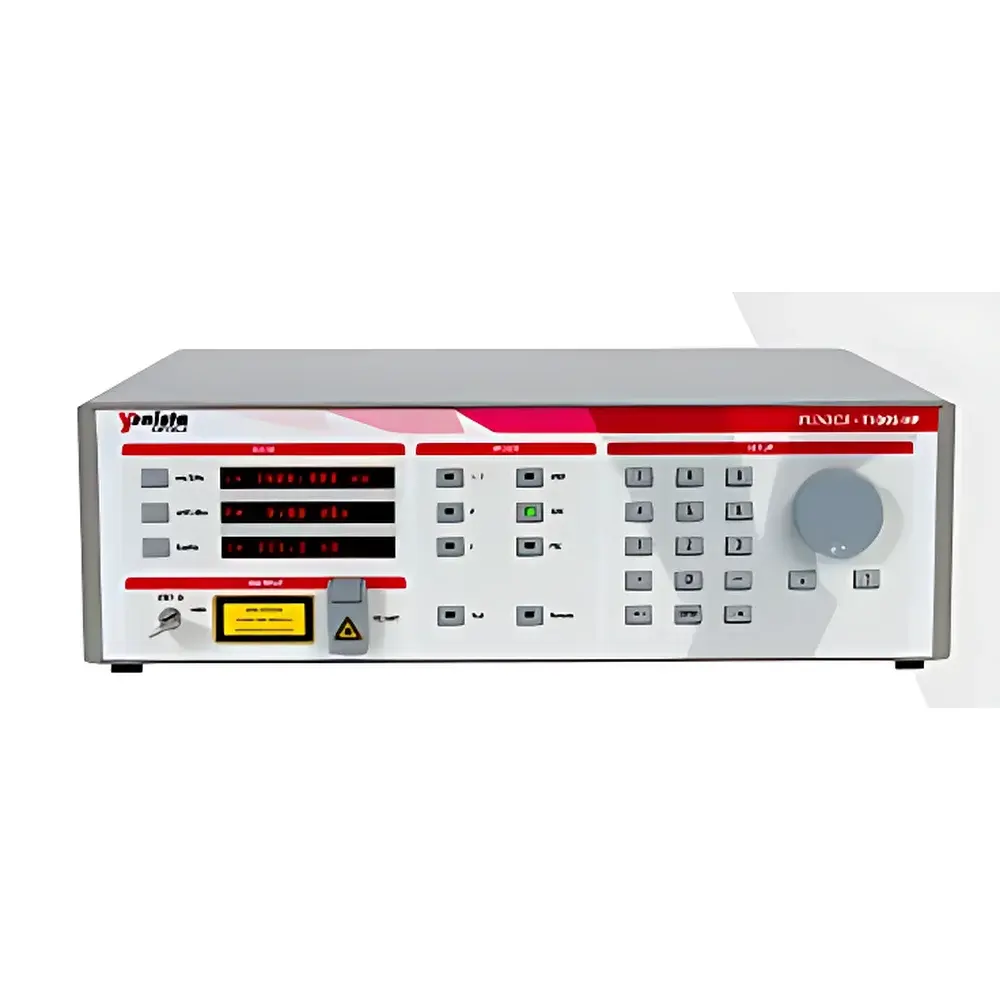
Yenista TUNICS T100S-HP High-Power Tunable Laser Source
| Brand | Yenista |
|---|---|
| Origin | France |
| Model | TUNICS T100S-HP |
| Wavelength Range | 1240–1680 nm |
| Output Power | ≥ +8 dBm (full range), ≥ +13 dBm (peak) |
| ASE Suppression Ratio (SSSER) | ≥ 90 dB (100 dB typical) |
| Wavelength Accuracy | ±20 pm |
| Wavelength Repeatability | 5 pm (typ.) |
| Tuning Resolution | 1 pm (0.1 pm in fine-tuning mode) |
| Linewidth | <400 kHz (coherence control off), >100 MHz (coherence control on) |
| RIN | –145 dB/Hz (typ.) |
| Scan Speed | 1–100 nm/s (continuous, mode-hop-free) |
| Power Stability | ±0.01 dB/h (±0.025 dB/24 h typ.) |
| Relative Humidity | <80% non-condensing |
| Operating Temperature | +15 °C to +30 °C |
| Laser Class | 1M |
| Dimensions | 448 × 370 × 133 mm |
| Weight | 12.5 kg |
| Interface | RS-232C, GPIB (IEEE-488.1) |
| Fiber Output | SMF or PMF (optional) |
| Connector | FC/APC |
Overview
The Yenista TUNICS T100S-HP is a high-performance external cavity tunable laser source engineered for precision optical characterization, telecom component testing, and advanced photonic research. Based on semiconductor gain medium with integrated wavelength-selective feedback, it delivers continuous, mode-hop-free tuning across up to 200 nm—spanning the full O-, E-, S-, C-, L-, and U-bands (1240–1680 nm). Its design emphasizes spectral purity, power stability, and metrological-grade wavelength accuracy, making it suitable for applications requiring traceable calibration, dense wavelength division multiplexing (DWDM) filter mapping, and coherent receiver characterization. Unlike fixed-wavelength or coarse-tuning sources, the T100S-HP employs a thermally stabilized diffraction grating and piezoelectric actuator system to achieve sub-picometer resolution and exceptional long-term repeatability—critical for automated test systems operating under GLP or manufacturing QA protocols.
Key Features
- High output power: ≥ +8 dBm over full tuning range; peak output ≥ +13 dBm (O- and C+L-band variants deliver ≥ +10 dBm)
- Ultra-low amplified spontaneous emission (ASE): Spontaneous emission suppression ratio (SSSER) ≥ 90 dB (100 dB typical), enabling high dynamic range optical spectrum analysis
- Exceptional wavelength stability: ±5 pm/h drift (±3 pm/h typical); absolute accuracy ±20 pm with 5 pm repeatability
- Fine-tuning capability: ±25 pm (±2 GHz) micro-adjustment range at 0.1 pm resolution
- Continuous, mode-hop-free scanning: Full-band sweeps from 1 nm/s to 100 nm/s; power flatness maintained within ±0.25 dB (typ.)
- Low relative intensity noise: –145 dB/Hz typical, supporting sensitive interferometric and coherent detection setups
- Flexible modulation support: DC–8 MHz sine / DC–1 MHz TTL low-frequency modulation; 30 kHz–200 MHz high-frequency modulation
- Standard interfaces: RS-232C and IEEE-488.1 (GPIB) for seamless integration into automated test benches compliant with SCPI command sets
Sample Compatibility & Compliance
The TUNICS T100S-HP is compatible with standard single-mode fiber (SMF-28) and polarization-maintaining fiber (PMF) outputs via FC/APC connectors. It meets IEC 60825-1:2014 for Class 1M laser safety when used with appropriate fiber-coupled delivery and interlocks. Its wavelength calibration traceability aligns with NIST-referenced spectral standards, supporting compliance with ISO/IEC 17025 laboratory accreditation requirements. The instrument’s thermal and mechanical design ensures stable operation in controlled lab environments (15–30 °C, <80% RH non-condensing), and its power supply conforms to IEC 61000-3-2 harmonic emission limits. For regulated industries—including telecom equipment qualification and optical component validation—the T100S-HP supports audit-ready operation when paired with validated software logging (e.g., timestamped wavelength/power records with user ID tagging).
Software & Data Management
Yenista provides the TUNICS Control Software Suite—a Windows-based application supporting full remote configuration, real-time monitoring, and script-driven automation via SCPI commands. The software enables synchronized wavelength sweeps with power normalization, multi-channel data logging (CSV export), and trigger-based acquisition aligned with external instruments (e.g., optical spectrum analyzers or vector network analyzers). All parameter changes—including fine-tuning offsets, scan profiles, and modulation settings—are recorded with timestamps and operator identifiers, satisfying FDA 21 CFR Part 11 requirements for electronic records when deployed with validated IT infrastructure. Third-party integration is supported through LabVIEW VIs, Python (PyVISA), MATLAB Instrument Control Toolbox, and .NET drivers—facilitating incorporation into custom CI/CD test pipelines or production line ATE systems.
Applications
- DWDM filter and multiplexer/demultiplexer characterization (IL, PDL, CD, PMD)
- Optical amplifier gain and noise figure measurement (OSA-based and RF-based methods)
- Photonic integrated circuit (PIC) testing—including ring resonator resonance mapping and Mach-Zehnder interferometer calibration
- Coherent transceiver testing (LO source for IQ demodulation, linewidth-sensitive BER evaluation)
- Fiber Bragg grating (FBG) and distributed feedback (DFB) laser characterization
- Optical time-domain reflectometry (OTDR) source calibration and dispersion measurement
- Research in nonlinear optics, quantum photonics, and spectroscopic sensing where narrow-linewidth, high-power tunability is essential
FAQ
What wavelength bands are available for the TUNICS T100S-HP?
The T100S-HP is offered in six band-specific configurations: O-band (1260–1360 nm), C+L-band (1500–1630 nm), O+-band (1240–1380 nm), ES-band (1350–1510 nm), SCL-band (1440–1640 nm), and CLU-band (1500–1680 nm). Together, these cover the full 1240–1680 nm telecom spectrum.
Is the laser output polarization-maintaining?
Standard output is unpolarized SMF; however, a polarization-maintaining fiber (PMF) option is available upon request—enabling direct coupling to polarization-sensitive devices without external controllers.
Can the T100S-HP be used for swept-wavelength interferometry (SWI)?
Yes—its mode-hop-free scanning, sub-pm repeatability, and linearized wavelength ramping make it well-suited for Fourier-domain OCT and other SWI applications requiring high coherence and precise k-space sampling.
Does the instrument support external triggering for synchronized measurements?
Yes—both start/stop triggers and position-synchronized TTL outputs are available via BNC connectors, allowing tight coordination with oscilloscopes, digitizers, or lock-in amplifiers.
How is wavelength calibration maintained over time?
The T100S-HP incorporates an internal wavelength reference channel monitored in real time; factory calibration is traceable to NIST standards, and users may perform periodic verification using a calibrated wavemeter or interferometric reference.






