
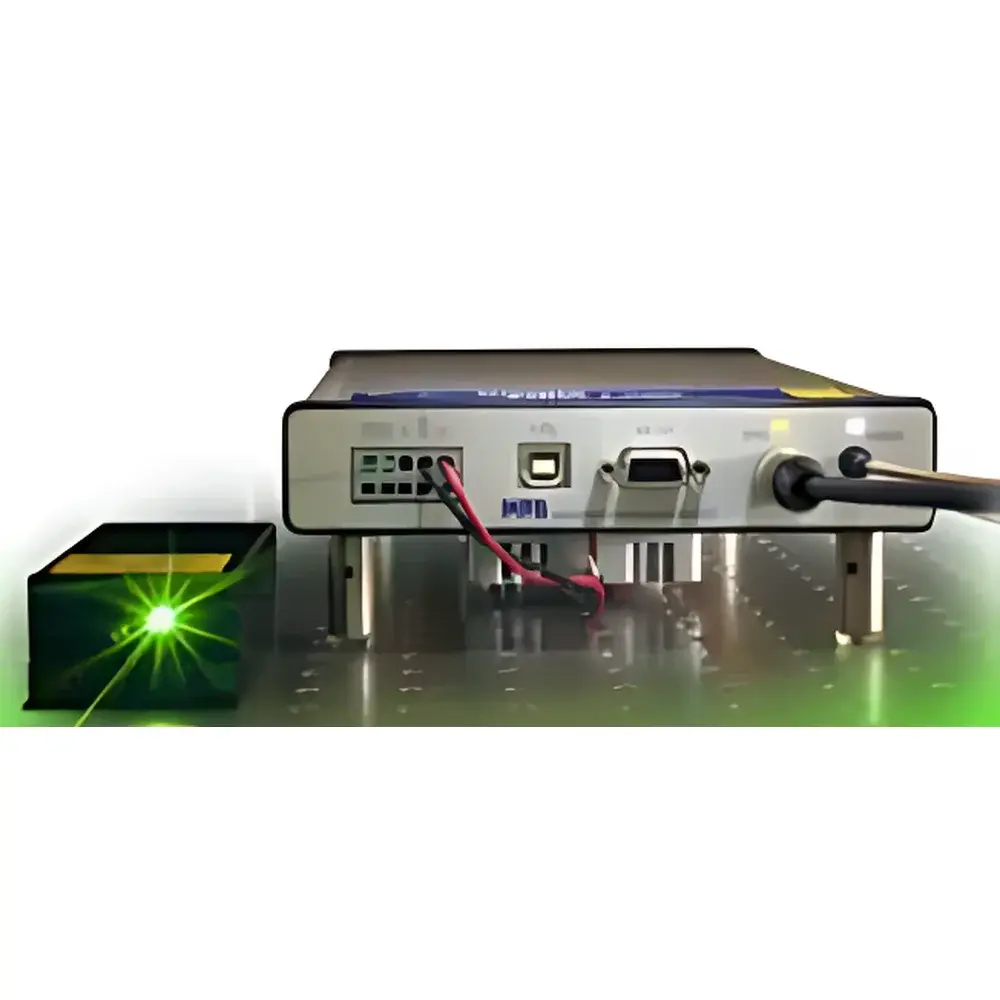
MPB VFL-P-300-546 546 nm Single-Frequency Fiber Laser
| Brand | MPB |
|---|---|
| Origin | Canada |
| Model | VFL-P-300-546 |
| Wavelength | 546 nm |
| Output Power | 300 mW |
| Beam Mode | TEM₀₀ |
| M² | ≤1.1 |
| Polarization | Linear, vertical to baseplate |
| Beam Divergence (Full Angle) | <5 mrad |
| Power Stability (RMS, 8h) | ±0.5% |
| Wavelength Stability | ±0.02 nm |
| Cooling | Air-cooled |
| Interfaces | RS232, USB |
| Form Factor | Benchtop or 2RU Rackmount (19", 23", ETSI compatible) |
| Safety | Interlock-enabled (benchtop) |
Overview
The MPB VFL-P-300-546 is a continuous-wave (CW), single-frequency fiber laser engineered for high-stability visible-light applications requiring precise 546 nm emission. Unlike diode-pumped solid-state (DPSS) lasers operating at this wavelength—prone to mode-hopping and thermal drift—the VFL-P series leverages MPB’s proprietary frequency-doubled fiber architecture, combining a robust 1092 nm Yb-doped fiber oscillator with a nonlinear periodically poled lithium niobate (PPLN) waveguide for efficient second-harmonic generation (SHG). This design delivers intrinsic wavelength stability, narrow linewidth (<100 kHz), and diffraction-limited beam quality (TEM₀₀, M² ≤1.1) without active cavity stabilization. Its 546 nm output falls within the high-quantum-efficiency region of many fluorophores (e.g., FITC, calcein, and GFP derivatives), making it particularly suited for quantitative fluorescence-based measurement systems where spectral fidelity and long-term power repeatability are critical—such as confocal microscopy alignment, flow cytometer calibration, and absorption spectroscopy reference sources.
Key Features
- Stable CW output at 546 nm with RMS power fluctuation < ±0.5% over 8 hours—validated under ISO 11554 compliant test conditions.
- Diffraction-limited beam profile (TEM₀₀) with M² ≤1.1 and full-angle divergence <5 mrad, enabling efficient coupling into single-mode fibers and high-resolution optical setups.
- Linear polarization oriented vertically relative to the mounting baseplate—ensuring consistent orientation for polarimetric measurements and interference-based configurations.
- Dual form-factor support: compact benchtop unit with safety interlock circuitry, and 2RU rackmount version (compatible with 19″, 23″, and ETSI-standard racks) featuring integrated transformer, redundant cooling paths, and certified emergency stop functionality per IEC 61000-6-2/6-4.
- Standard digital control interface via RS232 and USB 2.0, supporting SCPI command set for integration into automated test environments and LIMS-controlled workflows.
- Embedded GUI software enables real-time monitoring of output power, internal temperature, pump diode current, and fault logs—accessible without external drivers.
Sample Compatibility & Compliance
The VFL-P-300-546 is designed for use in regulated scientific and clinical instrumentation environments. Its optical performance meets key requirements for ASTM E275 (spectrophotometer verification), ISO 17025-accredited calibration labs, and FDA-aligned instrument qualification protocols (IQ/OQ/PQ). The laser complies with IEC 60825-1:2014 Class 3B laser safety standards, including mandatory labeling, key-controlled enable circuitry, and hardware-enforced interlock response time <100 ms. For GxP applications, firmware supports audit-trail logging of all parameter changes and operational events—fully traceable to user ID and timestamp. All units undergo factory calibration against NIST-traceable photodiode standards, with certificate of conformance supplied.
Software & Data Management
MPB provides the VFL Control Suite—a platform-independent application supporting Windows, macOS, and Linux—that implements full remote operation via USB or RS232. The software includes programmable power ramping profiles, scheduled on/off sequences, and real-time trending of output stability metrics. Export formats include CSV and HDF5 for direct ingestion into MATLAB, Python (NumPy/Pandas), or LabVIEW environments. For enterprise deployment, the laser supports Modbus TCP and OPC UA gateways through optional middleware, enabling seamless integration into MES and SCADA systems. Firmware updates are delivered via signed binary packages with SHA-256 verification, ensuring integrity during field upgrades.
Applications
- Fluorescence Microspectroscopy: Stable 546 nm excitation source for quantitative intensity mapping in widefield and spinning-disk confocal systems—minimizing photobleaching artifacts due to low-noise amplitude modulation.
- Flow Cytometry Calibration: Used as a primary reference for PMT gain validation and spectral overlap correction in multi-color panel setup, meeting ISO 21501-3 particle sizing and fluorescence intensity traceability requirements.
- Ophthalmic Instrumentation: Integrated into adaptive optics retinal imaging platforms where chromatic dispersion compensation relies on precisely defined visible wavelengths.
- Thin-Film Metrology: Employed in ellipsometers and reflectometers for measuring optical constants of dielectric stacks in the green spectral band, leveraging its narrow linewidth for high-fidelity phase-sensitive detection.
- Laser Sintering Process Monitoring: Serves as a non-intrusive probe beam in powder-bed fusion systems to detect melt pool dynamics and layer-wise defect formation via backscatter interferometry.
FAQ
Is the 546 nm output tunable?
No—the VFL-P series operates at a fixed fundamental wavelength; 546 nm is generated via SHG from a stabilized 1092 nm seed, with no provision for wavelength tuning.
What is the typical warm-up time to achieve specified stability?
Less than 15 minutes from cold start to meet ±0.02 nm wavelength and ±0.5% power stability specifications under ambient temperature variation of ±2 °C.
Can the laser be operated in analog modulation mode?
Yes—via 0–5 V TTL-compatible input with bandwidth up to 100 kHz; modulation depth is linear across 20–100% power range.
Does the rackmount version support redundant power supplies?
The 2RU configuration accepts dual 100–240 VAC inputs with automatic failover, conforming to IEC 62368-1 Annex Q for continuous-duty laboratory infrastructure.
Are OEM integration kits available?
Yes—MPB offers mechanical mounting flanges, fiber-pigtailed variants (PM980 or HI1060), and custom firmware builds with extended SCPI command sets for embedded system integration.




