
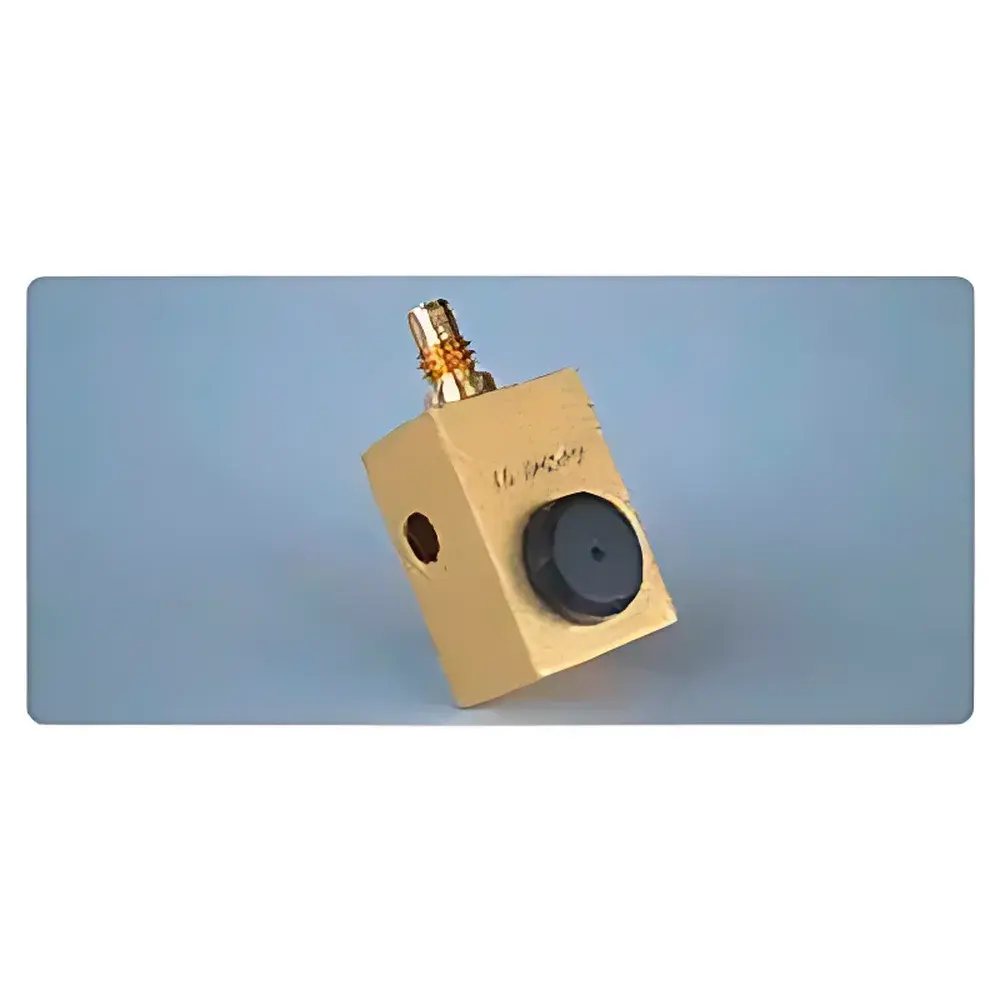
Rayscience UltraFast-20-xx MSM Ultrafast Photodetector
| Brand | Rayscience |
|---|---|
| Origin | Germany |
| Model | UltraFast-20-xx (SM/MM/FS variants) |
| Detector Type | MSM (Metal–Semiconductor–Metal) |
| Active Material | InGaAs |
| Bandwidth (-3 dB) | DC to 20 GHz |
| Rise Time (10%–90%) | < 12 ps |
| Pulse Width (FWHM) | < 20 ps |
| Wavelength Range | 400 nm – 1600 nm |
| Max Responsivity | 0.24 A/W @ 810 nm |
| Bias Voltage | 2–9 V |
| Bias Input Connector | SMC male |
| RF Output Connector | K-Type female |
Overview
The Rayscience UltraFast-20-xx is a high-bandwidth, low-jitter MSM (Metal–Semiconductor–Metal) photodetector engineered for time-resolved optical measurements in ultrafast laser systems, free-electron laser (FEL) diagnostics, and high-speed photonic signal characterization. Operating on the principle of carrier drift in a low-capacitance interdigitated electrode structure, the detector delivers sub-12 ps rise time and <20 ps full-width-at-half-maximum (FWHM) pulse response—enabling precise temporal reconstruction of ultrashort optical pulses without significant waveform distortion or ringing. Its InGaAs-based active region ensures broad spectral coverage from visible (400 nm) through near-infrared (1600 nm), making it compatible with Ti:sapphire, Yb-fiber, Er-fiber, and quantum cascade laser sources. Unlike conventional PIN photodiodes, the MSM architecture inherently minimizes junction capacitance and series resistance, resulting in superior impedance matching to 50 Ω RF instrumentation and enhanced signal fidelity across the entire 20 GHz electrical bandwidth.
Key Features
- DC–20 GHz analog bandwidth (–3 dB), validated via calibrated network analyzer measurement
- Rise time < 12 ps (10%–90%), enabling accurate capture of picosecond-scale transients
- Ultra-low pulse distortion: optimized electrode geometry suppresses transient overshoot and trailing edge artifacts
- InGaAs absorption layer with tailored doping profile for elevated responsivity (0.24 A/W @ 810 nm) and reduced dark current density
- Integrated bias tee design with SMC male input allows stable, low-noise DC biasing from 2 V to 9 V
- K-type female RF output connector ensures reliable 50 Ω impedance continuity up to 26.5 GHz, supporting compatibility with high-end oscilloscopes and spectrum analyzers
- Three fiber-coupled configurations available: single-mode (SM), multimode (MM), and free-space (FS) input options
Sample Compatibility & Compliance
The UltraFast-20-xx is routinely deployed in environments requiring traceable metrology and regulatory compliance, including EU-funded FEL facilities (e.g., FLASH, European XFEL) and national metrology institutes. Its performance characteristics align with key standards for ultrafast photonic measurement, including ISO/IEC 17025 requirements for calibration laboratories and IEEE Std 145-2013 definitions for antenna and detector frequency response characterization. While not intrinsically certified for medical or industrial safety, the device meets CE marking requirements for electromagnetic compatibility (EMC Directive 2014/30/EU) and low-voltage operation (LVD Directive 2014/35/EU). No hazardous substances are used per RoHS Directive 2011/65/EU. For GLP/GMP applications involving laser-based process monitoring, the detector supports audit-ready documentation of calibration history, linearity verification, and temperature-stability logs.
Software & Data Management
The UltraFast-20-xx operates as a passive, analog front-end component and does not include embedded firmware or onboard digitization. It interfaces seamlessly with industry-standard data acquisition platforms—including Keysight Infiniium real-time oscilloscopes, Tektronix DPO70000SX series, and National Instruments PXIe-5171R digitizers—enabling time-domain waveform capture, FFT-based spectral analysis, and jitter decomposition. When integrated into automated test systems, its stable bias dependency and linear photocurrent response (±0.5% deviation over 40 dB dynamic range) support traceable calibration routines compliant with NIST-traceable reference detectors (e.g., Hamamatsu C12702). Raw time-series data can be exported in HDF5 or MATLAB .mat format for post-processing in Python (SciPy), MATLAB Signal Processing Toolbox, or custom LabVIEW VIs implementing deconvolution algorithms for instrument response correction.
Applications
- Free-electron laser (FEL) pulse diagnostics: temporal profiling of µJ-level, femtosecond XUV/soft-X-ray pulses via optical cross-correlation with synchronized NIR gating beams
- Mode-locked laser characterization: direct measurement of repetition rate stability, pulse-to-pulse amplitude noise, and timing jitter in oscillators and amplifiers
- High-speed optical communications: BER testing, eye diagram analysis, and channel impulse response mapping in 100G/400G coherent transceiver development
- THz generation and detection: photoconductive switching synchronization and electro-optic sampling reference detection
- Time-of-flight LiDAR validation: sub-10 ps timing resolution enables centimeter-level spatial accuracy in atmospheric and automotive ranging systems
- Ultrafast spectroscopy pump–probe setups: low-latency, high-SNR detection of transient absorption or reflectivity signals under cryogenic or vacuum conditions
FAQ
What is the recommended termination impedance for optimal RF output performance?
The detector is designed for 50 Ω terminated systems; use only 50 Ω coaxial cables and matched-input instruments to preserve bandwidth and minimize reflections.
Can the UltraFast-20-xx be used without external bias?
No. A DC bias voltage between 2 V and 9 V must be applied via the SMC male port to activate the MSM junction; operation at 0 V results in negligible responsivity.
Is temperature stabilization required during operation?
While the device exhibits 8 h) benefit from ambient temperature regulation within ±1 °C.
How is calibration traceability established?
Rayscience provides factory calibration reports referencing NIST-traceable power meters (e.g., Ophir PD300-MS) and RF reference standards (e.g., Keysight E8257D + N5242A PNA-X), including measured responsivity vs. wavelength and S21 magnitude/phase data.
Are custom fiber pigtails or vacuum-compatible housings available?
Yes—Rayscience offers OEM integration options including PM fiber pigtails (PANDA or Bow-Tie), hermetically sealed TO-8 packages, and flange-mounted versions for UHV (<1×10⁻⁹ mbar) environments upon request.




