
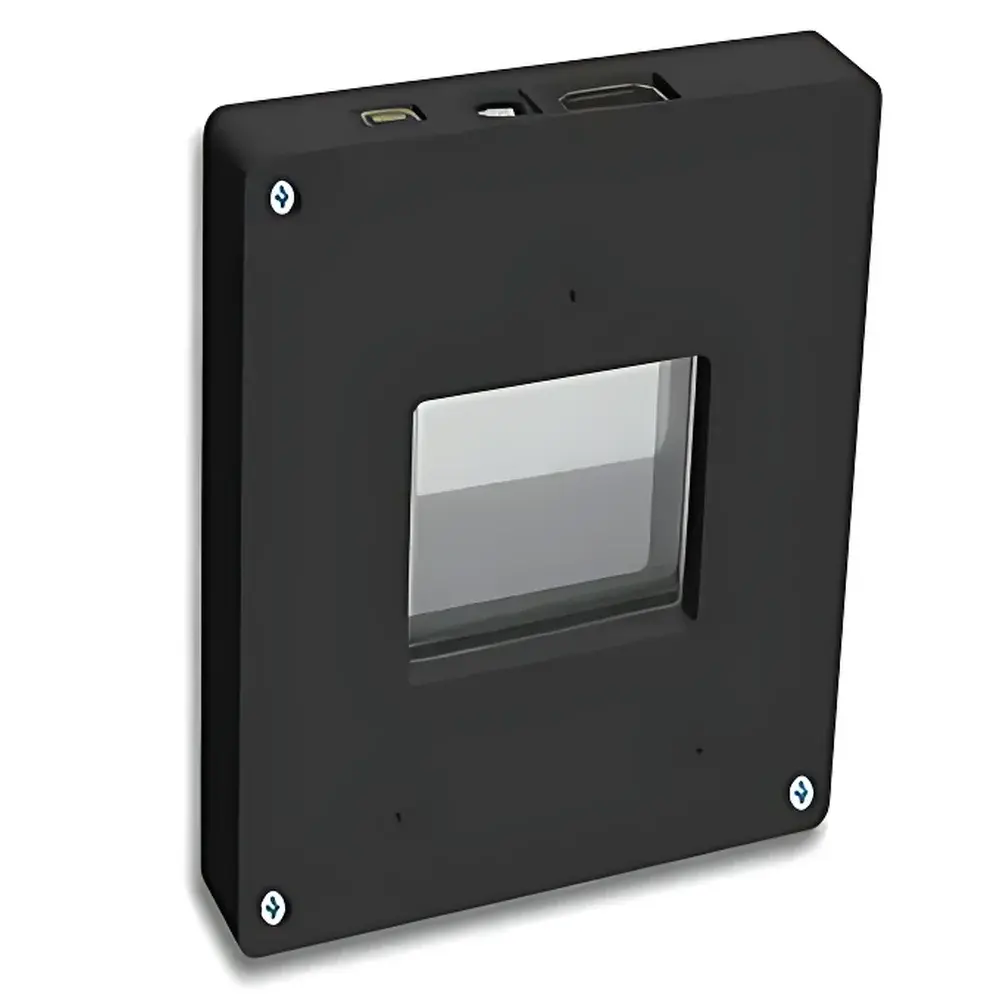
Holoeye PLUTO-VIS Spatial Light Modulator
| Brand | Holoeye |
|---|---|
| Origin | Germany |
| Model | PLUTO-VIS |
| Modulation Type | Pure Phase |
| Liquid Crystal Type | Reflective |
| Gray Levels | 8-bit (256 levels) |
| Resolution | 1920 × 1080 pixels |
| Pixel Pitch | 8.0 µm |
| Active Area | 15.36 mm × 8.64 mm |
| Phase Range | 2π @ 532 nm |
| Frame Rate | 60 Hz |
| Response Time (VIS) | ~25 ms |
| Diffraction Efficiency | 60% |
| Maximum Optical Power Density | 2 W/cm² |
| Spectral Range | 400–1100 nm |
| Interface | DVI or HDMI |
Overview
The Holoeye PLUTO-VIS Spatial Light Modulator (SLM) is a high-precision, reflective liquid crystal-based optical device engineered for dynamic, pixel-level control of the phase profile of incident coherent light. Operating on the principle of electrically addressed spatial modulation of birefringence in nematic liquid crystal layers, the PLUTO-VIS enables programmable wavefront shaping without mechanical movement. Its core architecture leverages VGA/HDMI video signal input—compatible with standard frame grabbers and graphics cards—to translate digital grayscale images into spatially resolved phase retardation maps. Designed for laboratory-grade stability and repeatability, the PLUTO-VIS delivers full 2π phase modulation at 532 nm across its 1920 × 1080 active array, with an 8.0 µm pixel pitch and >87% fill factor to minimize zero-order leakage and maximize diffraction efficiency. It is optimized for visible-to-NIR wavelengths (400–1100 nm), making it suitable for applications requiring precise, real-time coherent beam manipulation under continuous-wave or pulsed laser illumination.
Key Features
- Pure-phase modulation mode with 2π range at 532 nm and extended coverage up to 1100 nm
- High-resolution reflective LCOS microdisplay: 1920 × 1080 pixels, 8.0 µm pitch, 15.36 mm × 8.64 mm active area
- Standard DVI/HDMI interface enabling plug-and-play integration with commercial PCs and imaging hardware
- 60 Hz native frame rate with <25 ms response time in visible spectrum—sufficient for closed-loop adaptive optics and holographic trapping
- Optimized optical design yielding 60% first-order diffraction efficiency and >87% fill factor for minimal intensity loss and high fidelity wavefront reconstruction
- Robust thermal management supporting continuous operation at up to 2 W/cm² optical power density
- Factory-calibrated phase response curve supplied with each unit for deterministic phase-only encoding
Sample Compatibility & Compliance
The PLUTO-VIS is compatible with standard free-space optical benches using collimated Gaussian or flat-top beams (diameter ≤12 mm recommended). It requires no vacuum or inert gas environment and operates reliably at ambient temperature (15–30 °C) and humidity (<60% RH non-condensing). The device conforms to CE marking requirements for electromagnetic compatibility (EMC Directive 2014/30/EU) and low-voltage safety (LVD Directive 2014/35/EU). While not certified as medical or industrial safety equipment per IEC 60601 or IEC 61508, its optical performance characteristics are routinely validated against ISO 10110-5 (surface form tolerances) and ISO 11146 (laser beam parameter measurements) in peer-reviewed optical metrology workflows. For GLP/GMP-regulated environments, phase calibration data and firmware version logs can be archived as part of instrument qualification documentation.
Software & Data Management
Holoeye provides the SLM Display Software Suite—a Windows-based application supporting real-time pattern generation, phase map import (BMP, TIFF, PNG), and batch sequence execution. Key computational modules include: (1) Gerchberg-Saxton and direct binary search algorithms for user-defined hologram synthesis; (2) parametric optical element library (e.g., spherical lenses, blazed gratings, vortex plates, axicons); (3) superposition engine for multi-functional holograms (e.g., combined focusing + beam splitting); and (4) LUT editor for custom gamma correction and phase-to-gray mapping. All generated patterns are stored in lossless 8-bit format. The software supports timestamped export of phase masks and metadata (wavelength, exposure time, SLM ID), facilitating traceability in reproducible experiments. No proprietary drivers are required—standard DirectX/DirectShow APIs ensure compatibility with third-party platforms including MATLAB (via Image Acquisition Toolbox), Python (using OpenCV or PyGame), and LabVIEW (NI Vision).
Applications
- Laser beam shaping: generation of Bessel, Airy, or flat-top profiles for material processing and microscopy illumination
- Adaptive optics: wavefront correction in astronomical telescopes and ophthalmic imaging systems
- Optical trapping and micromanipulation: dynamic holographic optical tweezers for multi-particle control
- Quantum optics: spatial mode sorting (e.g., OAM decomposition), entanglement engineering, and structured photon generation
- Computational imaging: single-shot compressive sensing, Fourier ptychography, and lensless holography
- Coherent pulse shaping: spectral phase modulation via 4f pulse shaper configurations
- Education and research: hands-on teaching of Fourier optics, diffraction theory, and metasurface emulation
FAQ
Is the PLUTO-VIS suitable for ultrafast laser applications?
Yes—when used with appropriate dispersion compensation and pulse stretching, it supports femtosecond pulse shaping at 800 nm and 1030 nm, though phase response must be characterized per wavelength due to dispersion.
Can multiple PLUTO-VIS units be synchronized?
Synchronization is achievable via external TTL trigger input (optional accessory) and frame-locking through GPU-controlled display timing; sub-millisecond inter-unit jitter is attainable with proper driver configuration.
Does the device support phase-only or amplitude-only modulation?
The PLUTO-VIS is configured for pure-phase modulation; amplitude modulation requires polarization-sensitive setups (e.g., polarizer-SLM-analyzer) and is not natively supported.
What calibration data is provided with shipment?
Each unit includes a measured phase-response LUT (wavelength-specific), uniformity map, and factory alignment report traceable to NIST-traceable interferometric verification.
Is firmware update capability available?
Firmware updates are distributed via Holoeye’s secure customer portal and require Windows-based utility; version history and release notes are maintained for audit compliance.




