
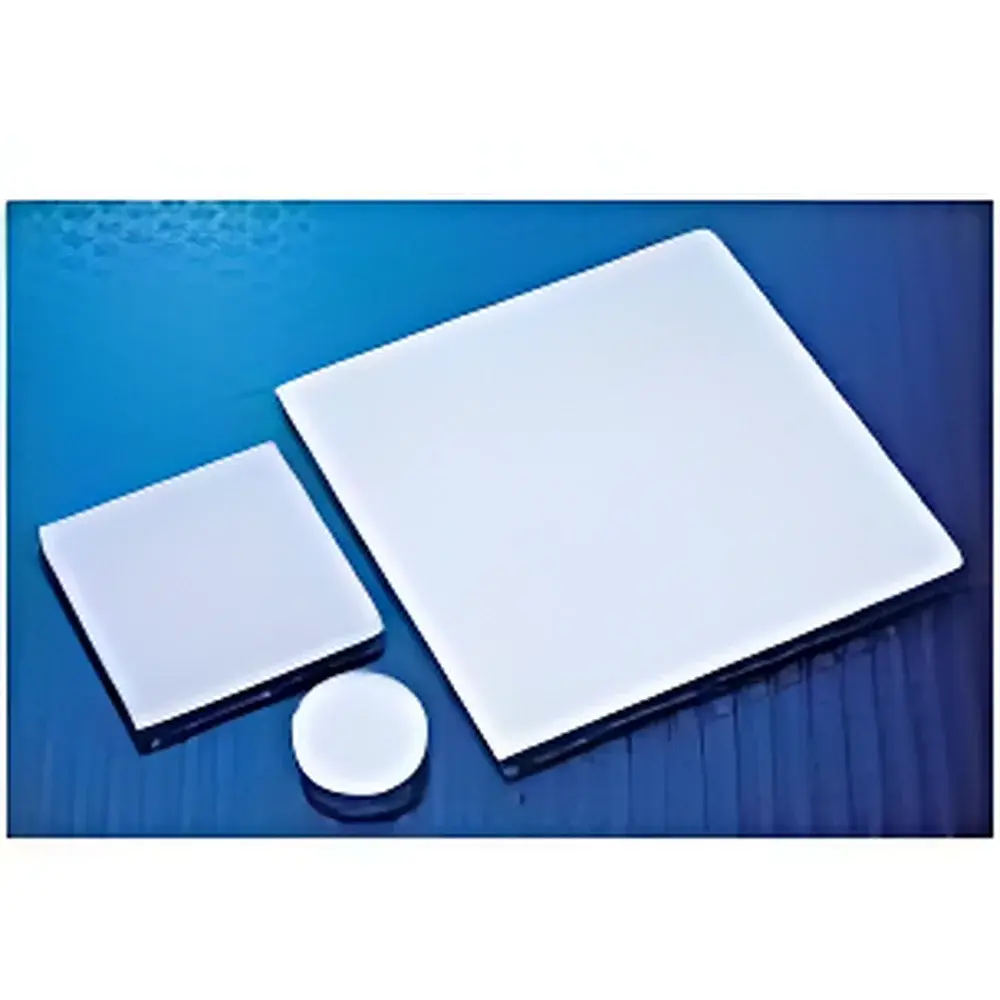
Edmund Optics 226 Ground Glass Diffuser
| Brand | Edmund Optics |
|---|---|
| Origin | USA |
| Model | 226 |
| Diffuser Surface | Frosted White Coating |
| Coating Thickness | 0.45 mm (±0.35 mm, –0.2 mm) |
| Shape Options | Circular or Square |
| Compliance | ISO 10110-7 (Surface Quality), MIL-PRF-13830B (Scratch-Dig) |
Overview
The Edmund Optics® 226 Ground Glass Diffuser is a precision-engineered optical component designed to produce highly uniform, near-Lambertian light distribution across visible and near-infrared spectral ranges (350–2000 nm). Based on controlled mechanical abrasion and proprietary frosted white coating deposition, this diffuser operates via volume scattering within the coated layer — not surface scattering alone — enabling superior angular homogeneity and minimal hotspot formation. Unlike polymer-based diffusers, the 226 series utilizes a high-purity optical glass substrate (e.g., BK7 or fused silica, depending on configuration), ensuring thermal stability, low wavefront distortion (<λ/4 over 25 mm aperture), and long-term irradiance resistance under continuous illumination. It is routinely deployed in radiometric calibration setups, integrating sphere input coupling, machine vision lighting homogenization, and photometric testing environments where spatial uniformity and spectral neutrality are critical. The diffuser’s performance is traceable to NIST-calibrated reference standards and validated per ISO/CIE photometric measurement protocols.
Key Features
- Engineered frosted white coating with nominal thickness of 0.45 mm (tolerance: +0.35 mm / –0.2 mm), optimized for isotropic scattering efficiency and minimal forward transmission loss
- Substrate options include BK7 (standard), UV-grade fused silica (for deep-UV applications), or CaF₂ (for extended IR transmission), all polished to λ/10 surface flatness
- Available in circular (diameters from 12.7 mm to 100 mm) and square (12.7 × 12.7 mm to 76.2 × 76.2 mm) configurations; custom apertures and mounting holes supported
- Coating adhesion certified per MIL-C-48497A; resistant to cleaning solvents (IPA, acetone) and moderate vacuum exposure (10⁻⁴ Torr)
- No measurable fluorescence under 365 nm UV excitation; spectral transmission flatness ±3% across 400–800 nm (measured at 5° incidence)
Sample Compatibility & Compliance
The 226 diffuser is compatible with collimated and divergent beams up to f/2.0 numerical aperture. It maintains consistent scatter profile independent of incident polarization state and exhibits negligible polarization-dependent loss (<0.5%). All units undergo 100% visual inspection per MIL-PRF-13830B (scratch-dig 60-40), and surface quality is verified using automated interferometry. The product conforms to ISO 10110-7 for surface imperfections and supports GLP-compliant documentation packages upon request, including individual test reports with measured total transmittance (Tt), diffuse transmittance (Td), and scatter angle distribution (±30° full width at half maximum). RoHS 3 and REACH compliance are standard; CE marking applies for EU-based optical subsystem integration.
Software & Data Management
While the 226 is a passive optical element, its characterization data integrates seamlessly into optical design workflows. Edmund Optics provides downloadable Zemax (.ZAR) and CODE V (.DAT) files containing measured BSDF (Bidirectional Scatter Distribution Function) datasets, generated from goniophotometric measurements per ASTM E2758. These files support accurate stray-light analysis and illumination modeling in commercial ray-tracing platforms. For traceability-critical applications, optional calibration certificates include uncertainty budgets aligned with ISO/IEC 17025 requirements, with audit trails supporting FDA 21 CFR Part 11–compliant electronic records when paired with validated LIMS environments.
Applications
- Radiometric and photometric calibration of CCD/CMOS sensors, integrating spheres, and luminance meters
- Uniform backlighting for LCD and OLED panel inspection systems
- Reference diffusers in spectroradiometer input optics and LED flux measurement fixtures
- Beam homogenization in laser-based metrology tools requiring low-coherence, speckle-free illumination
- Calibration targets for hyperspectral imaging systems operating in VNIR and SWIR bands
FAQ
What is the maximum power density the 226 diffuser can withstand without coating degradation?
For continuous-wave visible illumination (400–700 nm), the recommended maximum irradiance is 5 W/cm² at ambient temperature (23 °C) and <40% RH. Higher loads require fused silica substrates and active cooling mounts.
Can the 226 be used with pulsed lasers?
Yes — with peak fluence limits of 0.5 J/cm² for 10 ns pulses at 1064 nm (tested per ISO 21254-1). Damage threshold increases for longer pulse durations and shorter wavelengths.
Is anti-reflection coating available on the rear surface?
Standard units feature uncoated rear surfaces. Optional single-layer MgF₂ (400–700 nm) or broadband AR coatings (350–2000 nm) are available with ≤0.25% residual reflectance per surface.
How is angular scatter distribution validated?
Each production lot undergoes goniophotometric validation using a calibrated Labsphere UVS-100 system, reporting full scatter profiles from ±1° to ±80° with 0.5° resolution.
Do you provide mounting solutions for the 226 diffuser?
Yes — standard SM-threaded mounts (SM1, SM2), kinematic kinematic cells, and custom-machined aluminum holders with black anodized interiors are available as accessories.



