
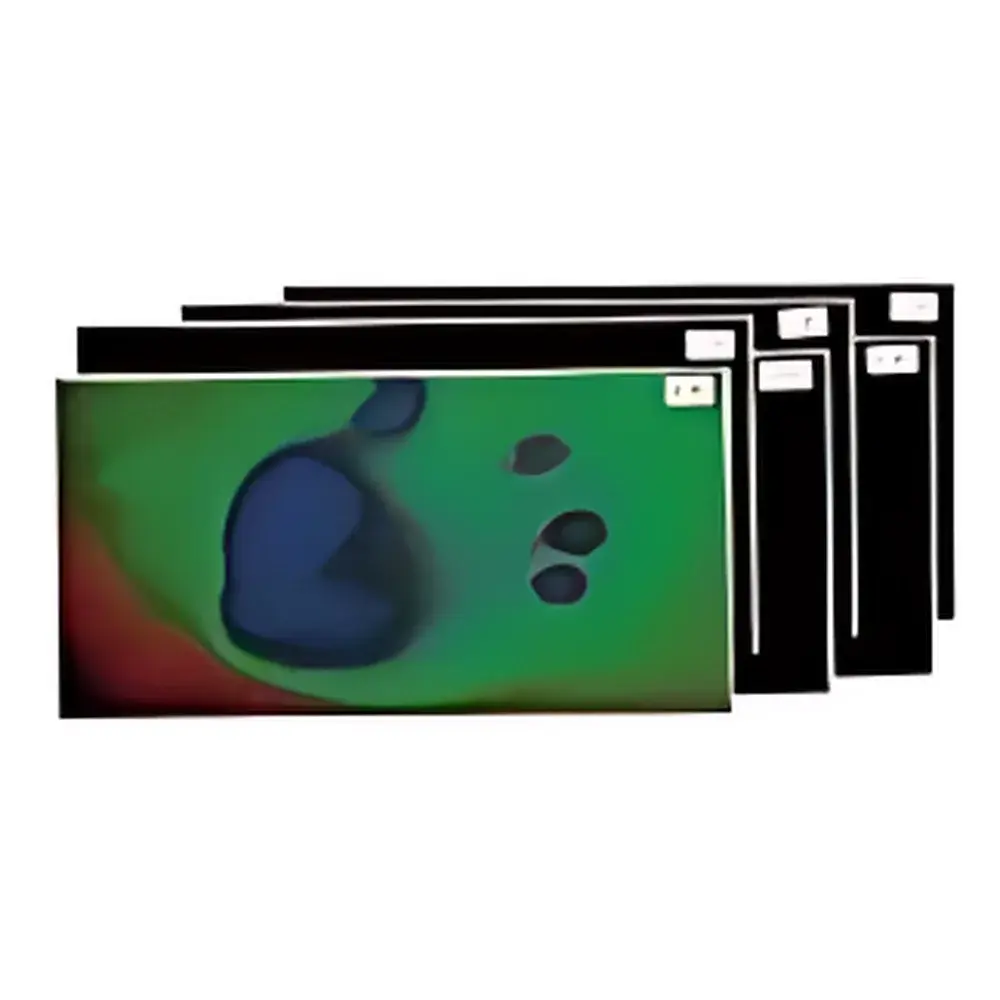
Edmund Optics NT72-375 Thermochromic Liquid Crystal Temperature-Sensitive Film
| Brand | Edmund Optics |
|---|---|
| Model | NT72-375 |
| Dimensions | 12 in × 12 in × 0.007 in |
| Operating Temperature Range | 20–25 °C (68–77 °F) |
| Material | Cholesteric Liquid Crystal Polymer Film |
| Substrate | Polyester (PET) |
| Response Time | < 1 s |
| Reusability | Fully reversible, >10⁴ thermal cycles |
| Storage Stability | 2 years at 25 °C / 50% RH |
| Compliance | RoHS 2 compliant, REACH SVHC-free |
Overview
Edmund Optics® NT72-375 Thermochromic Liquid Crystal Temperature-Sensitive Film is a precision-calibrated, reusable thermal visualization tool engineered for non-contact, real-time surface temperature mapping across electronics, thermal management, and R&D applications. Based on cholesteric liquid crystal (CLC) technology, the film exhibits reversible, wavelength-selective reflection that shifts across the visible spectrum as surface temperature changes within its calibrated range of 20–25 °C. This optical response arises from thermally induced pitch modulation in the helical molecular structure—enabling high-spatial-resolution thermal contrast without external power, sensors, or image processing. Unlike infrared thermography, which measures emitted radiation and requires emissivity correction, CLC films directly indicate local equilibrium temperature at the interface, making them ideal for qualitative hotspot localization, thermal gradient validation, and comparative thermal profiling of planar surfaces such as PCBs, heat sinks, battery modules, and microfluidic devices.
Key Features
- Calibrated narrow-band thermal sensitivity: 20–25 °C with ±0.3 °C hysteresis and <0.5 °C repeatability under controlled ambient conditions
- High spatial resolution: No pixelation or interpolation artifacts—thermal contrast resolves features down to 100 µm when viewed at 30 cm distance under white LED illumination
- Optically neutral substrate: 0.007-inch-thick PET carrier provides mechanical stability while maintaining >85% visible-light transmission outside the active reflection band
- Reusable and chemically inert: Stable against isopropyl alcohol, deionized water, and standard PCB flux residues; unaffected by static discharge or low-voltage fields
- Field-cuttable geometry: Compatible with precision die-cutting, laser scoring, or manual shearing using stainless steel blades—no delamination or edge degradation
- Traceable calibration: Each production lot undergoes spectral verification per ASTM E2847-21 (Standard Practice for Calibration of Thermographic Systems Using Liquid Crystal Films)
Sample Compatibility & Compliance
The NT72-375 film is designed for direct adhesion to clean, non-porous surfaces via optional pressure-sensitive acrylic transfer tape (sold separately) or temporary tack spray. It maintains fidelity on copper-clad FR-4, anodized aluminum, stainless steel, and glass substrates with surface roughness 1 kPa. All NT-series films comply with EU Directive 2011/65/EU (RoHS 2), are free of SVHC substances per REACH Annex XIV, and contain no PFAS, phthalates, or halogenated flame retardants. While not certified for medical device or aerospace qualification, the material meets general laboratory safety requirements per ISO 15190:2020 and supports GLP-compliant thermal documentation when used with calibrated reference sources.
Software & Data Management
This passive thermal film does not require software, drivers, or digital interfaces. For quantitative analysis, users may integrate it into existing imaging workflows: capture high-resolution RGB images under standardized D65 illumination (CIE 15:2018), then extract hue-saturation-value (HSV) channel data using open-source tools (e.g., ImageJ with ThermalColor Plugin) or commercial thermal analysis platforms (e.g., FLIR ResearchIR Max). When paired with NIST-traceable surface temperature references (e.g., PT100 contact probes at ≥3 points per field of view), the film supports semi-quantitative thermal mapping with uncertainty budgets consistent with ISO/IEC 17025:2017 Clause 7.6. Audit trails for calibration records, environmental logs (ambient T/RH), and image metadata can be maintained in LIMS-compatible formats.
Applications
- PCB thermal debugging: Rapid identification of short-circuit hotspots, solder joint anomalies, and current crowding effects without probe loading
- Heat sink performance validation: Visual confirmation of fin-to-base thermal coupling uniformity and airflow shadowing under natural convection
- Battery module thermal runaway screening: Early-stage detection of cell-level temperature divergence during charge/discharge cycling
- Microfluidic device characterization: Mapping of Joule heating profiles in electrophoretic channels and droplet actuation zones
- Educational thermodynamics labs: Demonstrating Fourier’s law, boundary layer development, and phase-change thermal lag in undergraduate engineering curricula
FAQ
Can this film be used for quantitative temperature measurement?
Yes—when combined with calibrated reference temperatures and standardized imaging protocols, it supports semi-quantitative mapping with typical uncertainty of ±0.8 °C over its operational range.
Does humidity affect performance?
Relative humidity between 30–70% RH has negligible impact; prolonged exposure >85% RH may cause slight hysteresis drift due to PET hygroscopic expansion.
Is the film compatible with vacuum environments?
No—outgassing of residual monomers occurs above 10⁻³ mbar; use only at atmospheric or nitrogen-purged conditions.
How long does the color change persist after temperature stabilization?
Visual response stabilizes within 0.8 seconds and remains stable for >30 minutes post-equilibrium, enabling time-lapse documentation.
Can multiple films be stacked for wider temperature coverage?
Not recommended—optical interference between layers degrades contrast; instead, use adjacent patches of NT72-374, NT72-373, etc., with overlapping calibration bands.



