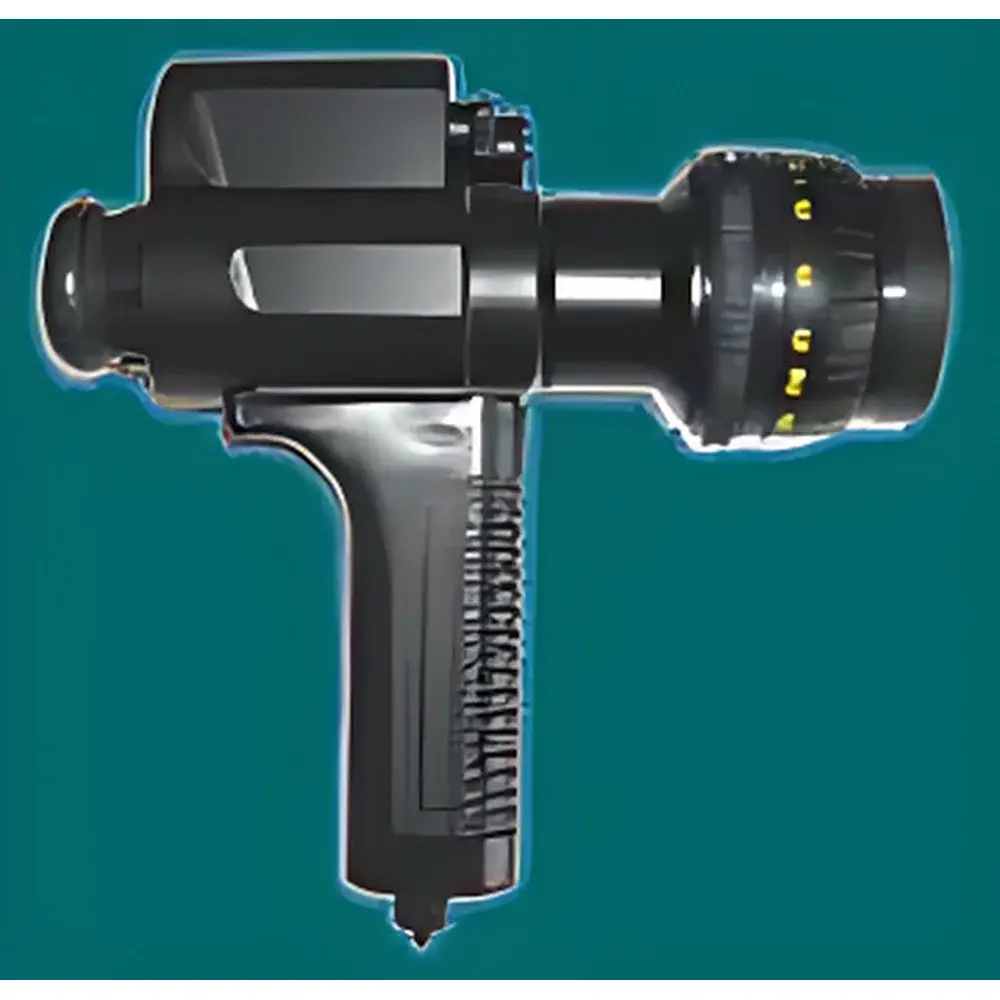
Rayscience Abris-M 2000 Infrared Laser Viewing Camera
| Brand | Rayscience |
|---|---|
| Origin | Imported |
| Manufacturer Type | Authorized Distributor |
| Model | Abris-M 2000 |
| Spectral Range | 350–2000 nm |
| Resolution (at Center Wavelength) | 60 lp/mm |
| Field of View | 18° |
| Magnification | 2× |
| Objective Lens | F2/50 mm with Adjustable Iris |
| Focus Range | 0.25 m to ∞ |
| Working Distance | 12.5 ± 0.2 mm |
| Power Supply | 1.5 V AAA battery |
| Screen Non-Uniformity | <20% |
| Response Non-Uniformity | <15% |
| Image Distortion | <18% |
| Battery Life | 35 hours |
| Weight | 0.55 kg |
| Dimensions | 205 × 78 × 52 mm |
| Operating Temperature | −10 °C to +40 °C |
| Mounting Interface | 1/4″-20 UNC tripod thread |
| Standard Accessories | IR viewing camera unit, IR bandpass filter, ergonomic handle, AAA battery, and protective carrying case |
Overview
The Rayscience Abris-M 2000 Infrared Laser Viewing Camera is an optoelectronic intensifier device engineered for real-time visualization of near-infrared (NIR), short-wave infrared (SWIR), and ultraviolet (UV) radiation that lies outside the human visual range (350–2000 nm). Unlike thermal imaging systems, the Abris-M 2000 operates on image intensification principles: incident photons strike a photocathode (S-1 type, optimized for broad spectral response), generating photoelectrons accelerated by a built-in high-voltage generator (16–18 kV from a single 1.5 V AAA cell). These electrons impact a phosphor screen (P20, peak emission at 550 nm), producing a visible green monochrome image viewable through an adjustable eyepiece. Its 2× magnification, 18° field of view, and F2/50 mm objective with variable iris enable precise spatial localization of invisible beam profiles and surface features—critical in alignment-critical optical laboratories and industrial process monitoring.
Key Features
- Wide spectral sensitivity spanning 350–2000 nm, covering UV-A/B/C, visible, NIR, and SWIR bands
- High-resolution imaging with ≥60 line pairs per millimeter (lp/mm) at center wavelength, enabling detection of fine laser mode structure and optical aberrations
- Integrated high-voltage power supply (16–18 kV) powered solely by a standard 1.5 V AAA alkaline battery—no external power required
- Ergonomic handheld design (0.55 kg) with 1/4″-20 UNC mounting interface for tripod or microscope coupling
- Optical path optimized for minimal distortion (<18%) and uniform response (<15% response non-uniformity, <20% screen non-uniformity)
- Adjustable focus (0.25 m to infinity) and working distance (12.5 ± 0.2 mm) compatible with collimated beams and macro-scale inspection
- Robust mechanical housing rated for operation between −10 °C and +40 °C in controlled laboratory and field environments
Sample Compatibility & Compliance
The Abris-M 2000 is designed for non-contact, non-destructive observation of electromagnetic emissions from diverse sample types—including semiconductor wafers (Si, GaAs), historical documents, pigment layers in oil paintings, biological tissues, and high-temperature industrial surfaces (>600 °C). When paired with appropriate bandpass filters (e.g., 1064 nm for Nd:YAG lasers or 1550 nm for telecom sources), it supports ISO/IEC 61228-compliant laser safety alignment procedures. Its optical configuration meets requirements for GLP-aligned documentation workflows in forensic labs and conservation science. While not a calibrated radiometric instrument, its consistent gain response enables comparative intensity assessment across repeated experimental sessions under fixed illumination and filter conditions.
Software & Data Management
The Abris-M 2000 is a standalone analog viewing system with no embedded digital electronics or software interface. It delivers immediate visual feedback without latency, eliminating dependence on drivers, operating systems, or firmware updates. This architecture ensures deterministic performance in electromagnetically noisy environments (e.g., laser labs, cleanrooms) and full compliance with FDA 21 CFR Part 11 when used as a qualitative verification tool within validated SOPs—no audit trail or electronic record generation is involved. For documentation purposes, users may couple the eyepiece to a DSLR or scientific CMOS camera via optional C-mount adapters (sold separately), enabling time-stamped image capture traceable to lab notebooks or LIMS entries.
Applications
- Laser Alignment & Beam Profiling: Real-time visualization of CW/pulsed IR lasers (e.g., 780 nm, 980 nm, 1064 nm, 1550 nm) during cavity alignment, fiber coupling, and M² measurement setups
- Forensic & Cultural Heritage Analysis: Revealing underdrawings, erased annotations, or pigment differentiation in manuscripts and artworks using 700–1000 nm illumination and spectral filtering
- Semiconductor Inspection: Identifying micro-cracks, dopant distribution anomalies, or mask misalignment on silicon and III-V compound wafers under NIR illumination
- High-Temperature Process Monitoring: Observing emissive signatures from molten metals, kiln interiors, or welding arcs (0.8–1.7 µm blackbody radiation)
- UV Fluorescence Imaging: Detecting UV-excited fluorescence in biological specimens, security inks, or photolithographic resist patterns (with UV-pass filter and UV lamp source)
- Optical Component Testing: Verifying coating uniformity, lens scatter, and AR/HR film integrity across broadband IR spectra
FAQ
Does the Abris-M 2000 provide quantitative irradiance measurements?
No. It is a qualitative intensifier—not a radiometer. Intensity perception depends on photocathode quantum efficiency, phosphor luminance, and observer adaptation.
Can it be used with pulsed lasers?
Yes, provided pulse energy remains below damage thresholds of the input window and photocathode; typical safe limit is ≤10 mJ/cm² for nanosecond pulses at 1064 nm.
Is the S-1 photocathode sensitive to UV-C (100–280 nm)?
Limited sensitivity below 200 nm; optimal UV response begins at ~220 nm. For deep-UV applications, fused silica input windows and quartz optics are recommended.
What is the maximum continuous operating time on a single AAA battery?
Up to 35 hours under nominal gain settings; battery life decreases with extended high-voltage activation cycles.
Can the device be mounted on a standard optical rail or breadboard?
Yes—via its integrated 1/4″-20 UNC female thread, compatible with kinematic mounts, post holders, and modular optomechanics.
Related Products