
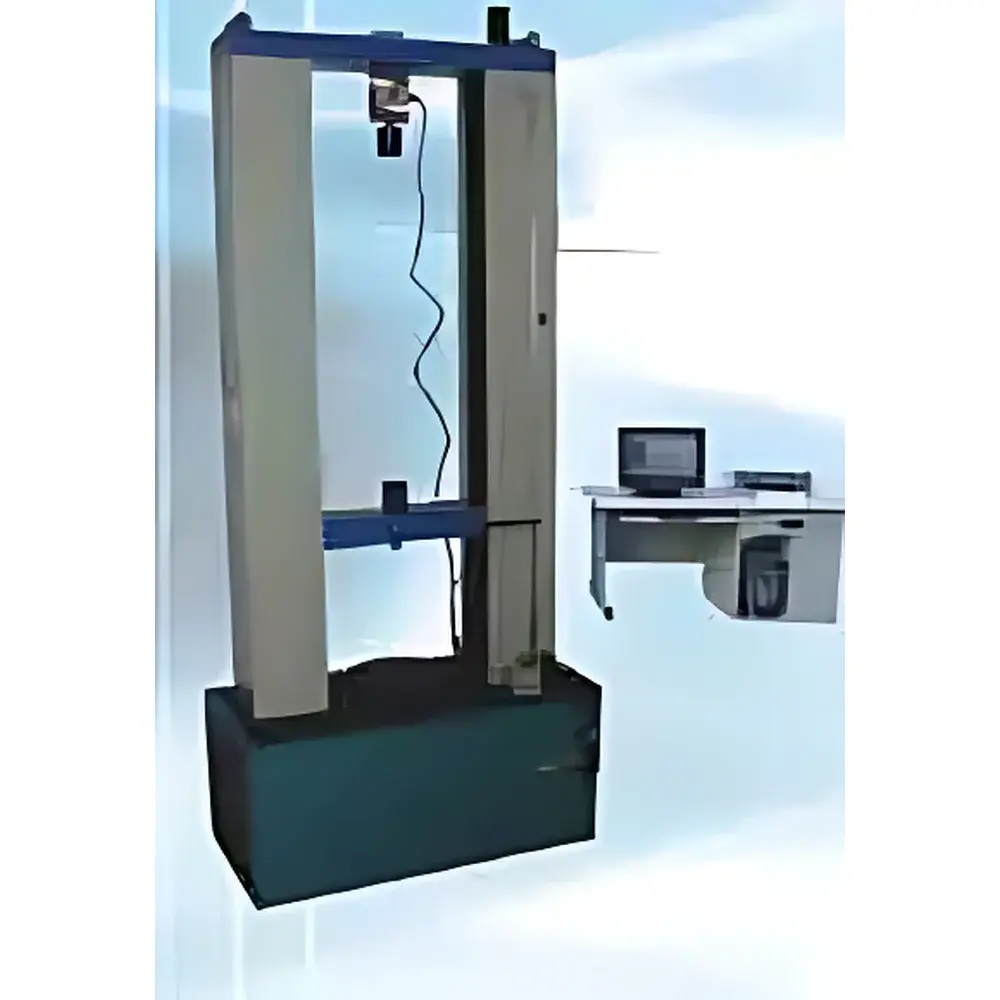
Jiubin JB-119 Series Universal Testing Machine
| Brand | Jiubin / JByq |
|---|---|
| Origin | Taiwan |
| Manufacturer Type | Authorized Distributor |
| Country of Manufacture | China |
| Model | JB-119A / JB-119B |
| Load Capacity | 0–5 kN (user-selectable) |
| Force Sensing | High-Precision Load Cell (U.S.-made) |
| Force Accuracy | ±0.5% of full scale |
| Effective Test Width | 380 mm |
| Max. Tensile Travel | 1000 mm |
| Drive System | Servo Motor (Japan-made) + AC Motor (Taiwan-made) |
| Mechanical Transmission | Precision Ball Screw (Taiwan-made) + High-Strength Zero-Backlash Screw (Korea-made) |
| Test Speed Range | 0.001–500 mm/min (infinitely variable, two selectable ranges: 0.001–500 & 5–500 mm/min) |
| Displacement Resolution | 1/200,000 |
| Displacement Accuracy | ±0.005% of reading |
| Units Supported | g, kg, N, kN, lbf |
| Safety Features | Upper/Lower Mechanical Limits, Emergency Stop Button |
| Control Interface | Dual-mode — PC-based software + Dedicated Microprocessor Display |
| Optional Accessories | PC Host, Inkjet Printer, Extensometer (2-point), Material Testing Software |
| Power Supply | 220 V / 50 Hz or 380 V / 50 Hz |
| Net Weight | 1080–1180 kg |
| Dimensions (W×D×H) | 1280 × 950 × 1800 mm |
Overview
The Jiubin JB-119 Series Universal Testing Machine is an electromechanically integrated materials testing system engineered for precision mechanical property evaluation across R&D laboratories, QC departments, and manufacturing environments. Based on the fundamental principles of uniaxial static loading—applying controlled tensile, compressive, flexural, peel, shear, and tear forces—the JB-119 complies with standardized test methodologies defined in ASTM E4, ASTM D638, ASTM D790, ISO 6892-1, ISO 178, and GB/T 228.1. Its modular architecture integrates a high-fidelity load cell, closed-loop servo-driven motion control, and dual-interface operation (PC + embedded microprocessor display), enabling repeatable, traceable, and auditable mechanical characterization under GLP-compliant workflows.
Key Features
- Modular load capacity selection (0–5 kN), allowing users to optimize force resolution for low-force polymer films or high-strength metallic specimens without hardware modification.
- Dual-speed-range drive system: ultra-low-speed capability (0.001 mm/min) supports creep and relaxation studies; high-speed range (5–500 mm/min) accommodates rapid qualification tests per ISO 527-1 or ASTM D882.
- Hybrid mechanical transmission combining Taiwan-sourced precision ball screws and Korea-sourced zero-backlash lead screws ensures minimal axial play, thermal stability, and long-term positioning repeatability (< ±0.005% displacement error).
- U.S.-sourced high-linearity load cell calibrated to ±0.5% FS accuracy—certified to ISO 376 Class 0.5—and traceable to NIST-equivalent national standards.
- Redundant safety architecture: dual mechanical end-limit switches, hardware-triggered emergency stop circuitry, and software-enforced travel boundaries prevent over-travel damage and operator hazard.
- 1/200,000 internal resolution ADC enables sub-micron displacement detection and high-fidelity stress–strain curve capture—even during brittle fracture or viscoelastic yielding transitions.
Sample Compatibility & Compliance
The JB-119 supports standardized specimen geometries per ASTM, ISO, and GB protocols—including dog-bone tensile bars, rectangular flexural beams, peel coupons, and compression cylinders—across metals, thermoplastics, elastomers, composites, textiles, adhesives, and laminated packaging. Standardized fixture mounting interfaces (M6/M8 tapped holes, T-slots) allow rapid interchange of wedge-action grips, pneumatic clamps, bend fixtures, and custom tooling. The system meets CE machinery directive requirements (2006/42/EC), conforms to IEC 61000-6-2/6-4 EMC immunity/emission limits, and supports audit-ready documentation for FDA 21 CFR Part 11 compliance when paired with validated software modules (e.g., electronic signatures, audit trails, user access controls).
Software & Data Management
JB-119’s proprietary testing software provides real-time force–displacement–time visualization, multi-curve overlay analysis, and automated parameter extraction (yield strength, modulus, elongation at break, bending stiffness, peel adhesion energy). Raw data export is supported in CSV, Excel, and XML formats; report templates comply with ISO/IEC 17025 technical record requirements. The software includes built-in statistical process control (SPC) tools—X-bar/R charts, capability indices (Cp/Cpk), and trend analysis—for longitudinal quality monitoring. All test configurations, calibration logs, and user actions are timestamped and stored with immutable audit trails, satisfying GLP/GMP data integrity mandates.
Applications
- Quality assurance of wire-and-cable insulation tensile strength and elongation (ASTM D1238, UL 1581)
- Mechanical validation of medical device components (catheter shafts, suture anchors, orthopedic polymer implants) per ISO 5832-6 and ASTM F2129
- Peel and shear adhesion testing of pressure-sensitive tapes, labels, and laminated packaging (ASTM D903, ASTM D3330)
- Three-point flexural characterization of PCB substrates, fiber-reinforced composites, and biodegradable films (ISO 178, ASTM D790)
- Compression testing of foam cushions, gaskets, and battery electrode stacks (ASTM D3574, IEC 62133)
- Routine verification of fastener proof load, bolt yield, and thread stripping resistance (ISO 898-1, ASTM F606)
FAQ
What load cell calibration standards does the JB-119 support?
The U.S.-manufactured load cell is supplied with factory calibration certificates traceable to NIST-equivalent national metrology institutes; optional UKAS-accredited recalibration services are available via authorized service partners.
Can the JB-119 perform cyclic or fatigue testing?
No—the JB-119 is designed exclusively for quasi-static mechanical testing. For dynamic or high-cycle fatigue applications, consider Jiubin’s dedicated servo-hydraulic fatigue testing systems (e.g., JB-FAT series).
Is the software compliant with FDA 21 CFR Part 11?
Yes—when deployed with role-based user authentication, electronic signatures, and enabled audit trail logging, the software satisfies electronic record and signature requirements for regulated pharmaceutical and medical device environments.
What is the warranty coverage and service response time?
Standard warranty: 24 months parts and labor; extended service contracts include quarterly preventive maintenance, remote diagnostics, and on-site technician dispatch within 72 business hours for critical failures.
Are third-party transducers (e.g., extensometers, environmental chambers) compatible?
Yes—the system features analog/digital I/O ports and standardized IEEE 488.2 GPIB communication, enabling integration with LVDT extensometers, video extensometry systems, and chamber controllers from leading OEMs including MTS, ZwickRoell, and Instron.



