
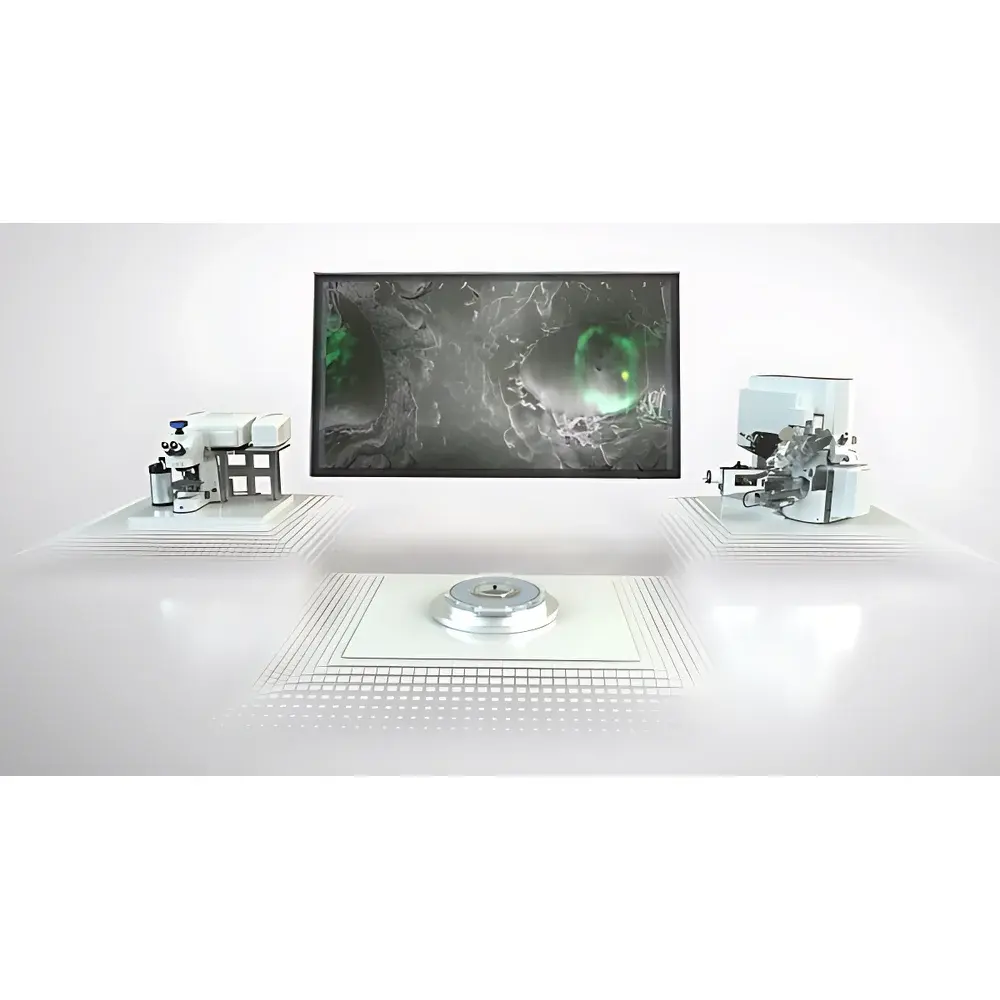
ZEISS Cryo-Correlative Workflow Solution
| Brand | ZEISS |
|---|---|
| Origin | Germany |
| Manufacturer Type | Authorized Distributor |
| Import Status | Imported |
| Model | ZEISS Cryo-Correlative Workflow Solution |
| Instrument Form Factor | Floor-standing / Conventional Large-scale |
| Electron Source | Cold Field Emission Gun |
| Secondary Electron Resolution | Not Specified |
| Magnification Range | Not Specified |
| Accelerating Voltage | Not Specified |
| Backscattered Electron Resolution | Not Specified |
Overview
The ZEISS Cryo-Correlative Workflow Solution is an integrated, cryo-optimized platform engineered to bridge light microscopy and electron microscopy for structural cell biology at near-native, vitrified states. It implements a rigorously controlled cryogenic correlative workflow—spanning widefield fluorescence microscopy (WF), laser scanning confocal microscopy (LSCM), and focused ion beam scanning electron microscopy (FIB-SEM)—to enable precise target identification, volumetric 3D reconstruction, and site-specific lamella preparation for cryo-electron tomography (cryo-ET). Unlike conventional correlative approaches, this solution enforces thermal and environmental continuity across modalities: samples remain under stable cryogenic conditions (< −180 °C) throughout transfer, imaging, and milling stages, minimizing devitrification, ice recrystallization, and surface contamination. The architecture is grounded in the principles of cryo-preservation integrity, fiducial-based coordinate registration, and multi-modal data fusion—ensuring sub-100 nm spatial correlation accuracy between fluorescent signal localization and subsequent FIB-milled TEM lamellae.
Key Features
- Cryo-integrated hardware interface: Dedicated cryo-transfer holders, cryo-stages, and vacuum interlocks ensure seamless, contamination-free sample movement between ZEISS LSM 980 with Airyscan 2, ZEISS Axio Imager upright widefield systems, and ZEISS Crossbeam 620/630 FIB-SEM platforms.
- Automated cryo-correlation software suite: ZEISS Atlas 5 and ZEISS ZEN Connect provide fiducial-guided coordinate transformation, multi-channel fluorescence-to-SEM overlay alignment, and batch-driven lamella targeting based on user-defined ROI masks.
- Vitrification-compatible optics and detectors: Optimized for low-dose imaging at cryo-temperatures; includes high-quantum-efficiency sCMOS cameras, GaAsP PMTs, and cryo-optimized objective lenses with anti-frost coatings.
- Controlled ice management: Integrated cryo-shielding, cold traps, and differential pumping reduce hydrocarbon and water-ice deposition during SEM/FIB imaging—critical for maintaining contrast and milling fidelity in amorphous ice.
- Modular scalability: Supports both room-temperature correlation (e.g., resin-embedded samples) and full cryo-mode operation, enabling method development and validation prior to vitrified sample deployment.
Sample Compatibility & Compliance
The workflow accommodates biological specimens prepared by high-pressure freezing (HPF) followed by cryo-substitution or direct plunge-freezing—compatible with standard EM grids (Quantifoil, UltrAuFoil, C-flat) and carrier supports (EM copper/palladium planchets). All cryo-handling components comply with ISO 14644-1 Class 5 cleanroom specifications for handling vitrified samples. Data acquisition and annotation adhere to FAIR principles (Findable, Accessible, Interoperable, Reusable), with metadata export supporting MIBI, EMDB, and OME-TIFF standards. Software modules are validated for GLP-compliant environments and support audit trails per FDA 21 CFR Part 11 requirements when deployed with ZEISS Lab Management System (LMS) licensing.
Software & Data Management
ZEISS ZEN Connect serves as the central orchestration hub, synchronizing acquisition parameters, stage coordinates, and image metadata across modalities. It generates traceable correlation matrices linking fluorescence centroids to FIB-SEM stage positions with < 50 nm uncertainty. Atlas 5 enables automated serial sectioning, tilt-series acquisition, and lamella thickness monitoring via real-time ion current feedback. Raw data is stored in vendor-neutral HDF5 containers; processed volumes are exportable to IMOD, Amira, and ChimeraX for downstream segmentation and subtomogram averaging. Integration with ZEISS LMS allows centralized instrument scheduling, user access control, and electronic lab notebook (ELN) synchronization.
Applications
- Cell biology: Correlative mapping of endogenous fluorescent tags (e.g., GFP-tagged spindle pole bodies in Saccharomyces cerevisiae) to ultrastructural context in native cellular environments.
- Oncology research: Structural phenotyping of membraneless organelles (e.g., stress granules, nucleoli) in cryo-preserved tumor biopsies at molecular resolution.
- Plant science: In situ analysis of chloroplast thylakoid stacking, plasmodesmata architecture, and vacuolar membrane dynamics in flash-frozen root or leaf tissue.
- Developmental biology: Time-resolved cryo-correlative studies of mitotic spindle assembly, centriole duplication, or asymmetric division in C. elegans embryos or zebrafish blastomeres.
FAQ
What sample preparation methods are supported?
High-pressure freezing (HPF), plunge freezing, and cryo-substitution protocols are fully supported. Grids must be compatible with ZEISS cryo-transfer systems (e.g., Gatan 626, ZEISS Cryo-Transfer Holder Type C).
Is remote operation available for cryo-FIB milling?
Yes—ZEISS Crossbeam systems support secure remote session control via ZEISS Remote Desktop with dual-factor authentication and encrypted VNC tunneling.
How is coordinate registration accuracy validated?
Using gold nanoparticle fiducials (10–20 nm) embedded in ice or deposited on grid surfaces; residual registration error is quantified post-alignment in ZEN Connect and reported in µm-level vector deviation maps.
Can the workflow integrate third-party fluorescence microscopes?
Only ZEISS-branded widefield and confocal platforms (Axio Imager, LSM 980, LSM 900) are natively supported for automated correlation; non-ZEISS systems require manual coordinate import and lack real-time stage synchronization.
What cryo-TEM lamella thicknesses can be achieved?
Target lamellae range from 150 nm to 300 nm thick, with final thickness uniformity ±15 nm across 10 × 10 µm fields—verified by in situ lift-out STEM imaging and post-milling TEM assessment.



