
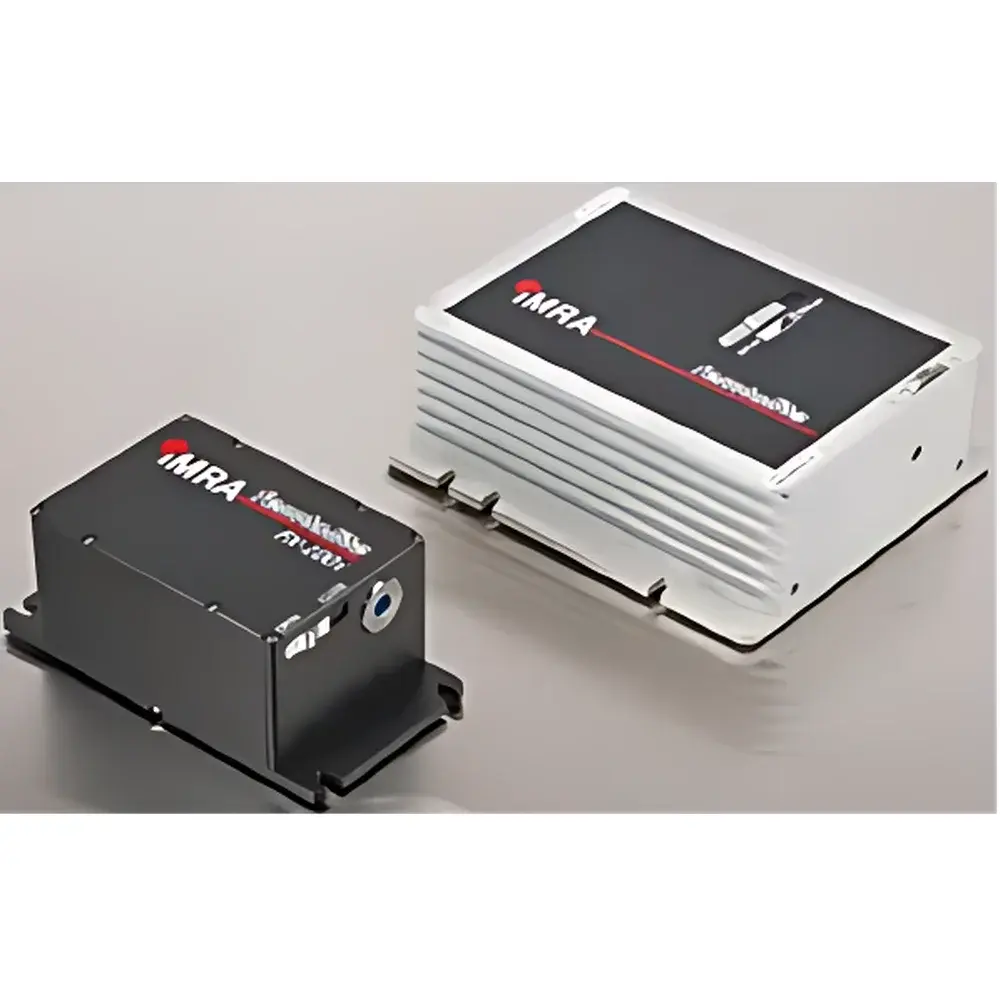
IMRA Femtolite F/G/H High-Power Femtosecond Fiber Laser
| Brand | IMRA |
|---|---|
| Origin | USA |
| Model | Femtolite F/G/H |
| Output Wavelengths | 805–810 nm (F-series), 1062 nm (G/H-series) |
| Average Power | >100 mW to >200 mW |
| Pulse Width | <100–140 fs |
| Repetition Rate | 75 ± 10 MHz |
| Polarization | Vertical or Horizontal (model-dependent) |
| Power Stability | ≤1% RMS |
| Dimensions | 142 × 98 × 76 mm³ (F-series), 3230 × 193 × 76 mm³ (G/H-series) |
| Compliance | MIL-STD-810F, IEC 60601-1 |
Overview
The IMRA Femtolite F/G/H is a series of turnkey, high-repetition-rate femtosecond fiber lasers engineered for demanding scientific and industrial applications requiring ultrashort pulses, exceptional temporal fidelity, and long-term operational stability. Based on IMRA’s proprietary Raman-shifted erbium-doped fiber oscillator architecture, the system delivers transform-limited pulses with clean temporal profiles and narrow spectral bandwidths—enabling precise control over nonlinear optical interactions without the complexity and maintenance overhead of Ti:sapphire oscillators. Unlike bulk solid-state lasers, the Femtolite platform leverages all-fiber construction and monolithic alignment, resulting in inherent immunity to thermal drift, mechanical misalignment, and environmental perturbations. Its compact laser head design—particularly the F-series at just 142 × 98 × 76 mm³—facilitates seamless integration into space-constrained setups such as multiphoton microscopes, THz time-domain spectrometers, or OEM medical instrumentation platforms. The G- and H-series variants extend functionality with dual-wavelength output (e.g., 810 nm + 1062 nm), supporting simultaneous excitation and probing across distinct nonlinear channels.
Key Features
- Proprietary Raman-shifted erbium fiber oscillator delivering stable, low-noise femtosecond pulses without external amplification
- Multiple configuration options: F-series (805–810 nm, >100 mW), FX-150/GX-200 variants (dual-wavelength capability), and G/H-series (1062 nm, >200 mW)
- Pulse widths ranging from <100 fs to <140 fs, optimized for high peak power and efficient nonlinear conversion
- High amplitude stability (≤1% RMS over 8 hours) and excellent pointing stability, critical for quantitative imaging and metrology
- Ruggedized mechanical design compliant with MIL-STD-810F for shock/vibration resistance and IEC 60601-1 for medical-grade electrical safety
- Flexible control interface: front-panel keypad with real-time parameter display, plus RS-232 serial communication for remote operation and system automation
- No water cooling required; air-cooled operation enables silent, maintenance-free deployment in cleanroom or clinical environments
Sample Compatibility & Compliance
The Femtolite F/G/H is designed for compatibility with standard optical tables, motorized translation stages, and commercial microscope frames (e.g., Nikon A1R MP+, Zeiss LSM 980 NLO). Its polarization-maintaining fiber output (vertical for F-series, horizontal for G/H-series) ensures predictable coupling into dichroic filters, waveplates, and nonlinear crystals used in SHG, THz generation, or parametric down-conversion. From a regulatory standpoint, the laser system conforms to Class 4 laser safety requirements per IEC 60825-1:2014 and incorporates interlock-ready connectors for integration into ISO 13485-certified medical device assemblies. Its electromagnetic compatibility meets FCC Part 15 Subpart B and CE EN 61326-1 standards, enabling use in GLP-compliant laboratories and FDA-regulated R&D facilities conducting preclinical optical diagnostics or therapeutic device development.
Software & Data Management
While the Femtolite operates as a stand-alone instrument, its RS-232 interface supports bidirectional communication with third-party control software—including LabVIEW, MATLAB, Python (PySerial), and EPICS-based synchrotron control systems. Users can programmatically adjust output power (via analog voltage input or digital command), monitor real-time status (temperature, power, fault codes), and log operational parameters for audit trails. For regulated environments, optional firmware upgrades enable timestamped event logging and user-access-level authentication—features aligned with FDA 21 CFR Part 11 requirements for electronic records and signatures when deployed in GMP-aligned biophotonics manufacturing workflows.
Applications
- Multiphoton fluorescence microscopy (MPM) and second-harmonic generation (SHG) imaging in live-tissue studies
- Two-photon polymerization (TPP) for sub-diffraction-limit 3D microfabrication of scaffolds, photonic crystals, and microfluidic components
- THz time-domain spectroscopy (THz-TDS) using optical rectification in ZnTe or DAST crystals
- Pump-probe spectroscopy for carrier dynamics analysis in 2D materials and perovskites
- Nonlinear Raman techniques including CARS and SRS for label-free chemical imaging in histopathology
- Quantum optics experiments requiring synchronized, low-jitter pulse trains for entanglement generation and single-photon source pumping
- OEM integration into ophthalmic surgical systems, dermatological ablation platforms, and intraoperative optical coherence tomography (OCT) probes
FAQ
Is the Femtolite F/G/H compatible with standard microscope scan heads and galvanometric mirrors?
Yes—the laser output is polarization-maintaining, TEM00-mode, and collimated to a 1/e² diameter of 1.2 mm, matching typical input specifications for commercial NLO scan modules.
Can pulse duration be externally compressed or shaped?
The output is near-transform-limited; however, users may integrate chirped mirror compressors or acousto-optic programmable dispersive filters (AOPDFs) downstream for adaptive pulse shaping.
What maintenance is required during routine operation?
None beyond periodic inspection of fiber connectors and ambient dust filtration; the all-fiber architecture eliminates alignment drift and consumables such as pump diodes or flashlamps.
Does IMRA provide application-specific support for THz generation or two-photon imaging setups?
Yes—IMRA’s Applications Engineering team offers free pre-sales feasibility assessments and post-purchase integration assistance, including beam delivery layout optimization and nonlinear crystal selection guidance.
Are calibration certificates and traceable power measurements included?
Each unit ships with a factory calibration report referencing NIST-traceable photodiode standards, documenting average power, pulse energy, repetition rate, and RMS power stability over 24-hour testing.




