
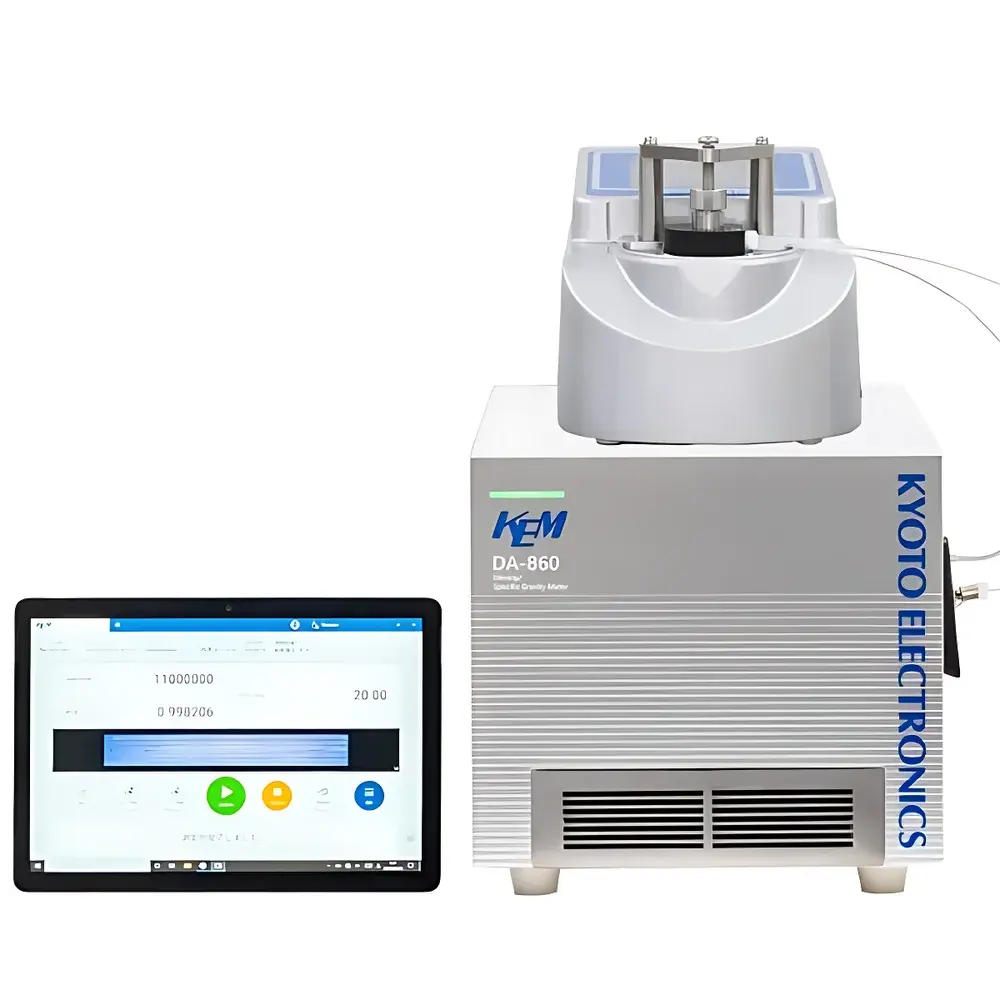
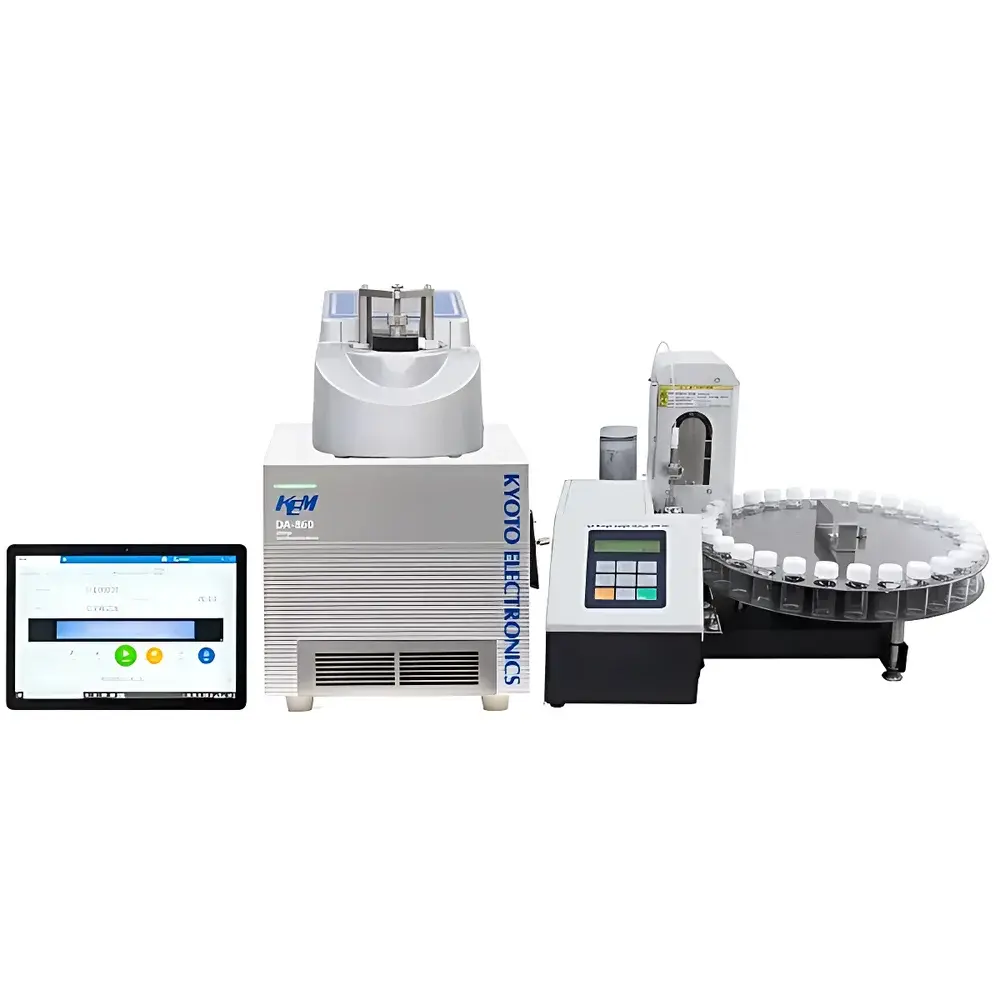
KEM DA-8XX + RA-6XX Integrated Automated Density Meter and Refractometer System
| Brand | KEM (Kyoto Electronics Manufacturing) |
|---|---|
| Origin | Japan |
| Manufacturer | Yes |
| Import Status | Imported |
| Model | DA-8XX + RA-6XX |
| Product Type | Benchtop Refractometer & Density Meter |
| Temperature Control | Peltier-controlled, 0–100 °C (density), 5–75 °C (refractometer) |
| Digital Display | Yes |
| Refractive Index Range | 1.32000–1.70000 nD |
| Brix Range | 0.00–100.00% |
| Refractive Index Accuracy | ±0.0001 nD |
| Density Measurement Principle | U-tube oscillation method |
| Density Range | 0–3 g/cm³ |
| Density Accuracy (DA-860) | ±0.000003 g/cm³ |
| Density Repeatability (DA-860) | ±0.000001 g/cm³ |
| Sample Volume | ~1 mL |
| Viscosity Correction | Built-in automatic correction |
| Auto-sampling | Integrated peristaltic pump with auto-drying judgment |
| Interface | LAN, USB, RS-232C |
| Compliance | ASTM D1250, ISO 12185, ISO 2859, USP <841>, GLP/GMP-ready audit trail support |
Overview
The KEM DA-8XX + RA-6XX Integrated Automated Density Meter and Refractometer System is a modular, benchtop analytical platform engineered for simultaneous, high-precision measurement of density (or relative density) and refractive index (nD) in liquid samples. Combining KEM’s proprietary U-tube oscillation density measurement technology with critical-angle total internal reflection refractometry at the sodium D-line (589.3 nm), this system delivers traceable, temperature-stabilized results under controlled laboratory conditions. The DA-8XX series density meter employs a resonant frequency shift principle—where sample density is derived from the oscillation period of a precisely machined, hermetically sealed U-shaped glass tube—while the RA-6XX refractometer determines refractive index via optical detection of the critical angle boundary between sample and prism surface. Both modules feature integrated Peltier thermoelectric elements enabling independent, high-resolution temperature control (0.001 °C resolution on DA-860; 0.01 °C on RA-620), ensuring compliance with ISO 12185 (petroleum products), ASTM D1250 (liquid petroleum), and USP (pharmaceutical solutions). Designed for routine QC/QA environments, the system eliminates manual intervention across sampling, measurement, cleaning, and drying phases—reducing operator variability and enhancing inter-laboratory reproducibility.
Key Features
- Modular co-location architecture: RA-6XX refractometer mounted directly above DA-8XX density meter to minimize footprint without compromising thermal isolation or optical alignment.
- Simultaneous dual-parameter acquisition: Single 1 mL sample yields synchronized density (g/cm³), relative density (d20/20), refractive index (nD), and Brix (% w/w) values—eliminating sequential re-sampling errors.
- Active viscosity compensation: DA-8XX applies real-time algorithmic correction for non-Newtonian behavior using dynamic viscosity input or built-in kinematic calibration curves—critical for glycerol, essential oils, and polymer solutions.
- Automated fluid handling: Integrated peristaltic pump performs aspiration, rinsing (with up to three solvents), purging, and moisture removal; auto-drying judgment prevents residual solvent interference in subsequent measurements.
- High-stability thermal management: Dual independent Peltier systems maintain ±0.01 °C uniformity across density cell and prism interface—validated per ISO 17025 calibration protocols.
- Full digital workflow: Touchscreen GUI (RA-6XX) and PC-based software (KEM WinDens) support method storage (up to 1000 density / 100 refractometer methods), statistical reporting (mean, SD, RSD, re-calculation), and export to LIMS via CSV, XML, or direct SQL database push.
Sample Compatibility & Compliance
The system accommodates a broad spectrum of industrial liquids—including volatile hydrocarbons (e.g., aviation turbine fuel, gasoline blends), polar solvents (ethanol, propylene glycol), viscous natural extracts (citrus oils, tobacco absolutes), aqueous sugar solutions (soft drinks, syrups), and high-purity reagents (HPLC-grade acetonitrile, sulfuric acid dilutions). All measurements conform to internationally recognized standards: density per ISO 12185 (crude oil and petroleum products), ASTM D4052 (laboratory density of liquids), and EN ISO 12185; refractive index per ISO 2859 (sampling plans), ASTM D1218 (hydrocarbon refractometry), and USP (refractometric assay of pharmaceuticals). Data integrity meets FDA 21 CFR Part 11 requirements through electronic signature capability, audit trail logging (user actions, parameter changes, calibration events), and role-based access control in WinDens software—supporting GLP and GMP-regulated laboratories.
Software & Data Management
KEM WinDens software provides full instrument control, method development, and regulatory-compliant data archiving. It supports customizable report templates aligned with ISO/IEC 17025 documentation requirements—including uncertainty budgeting per GUM (Guide to the Expression of Uncertainty in Measurement). Raw oscillation frequency and critical angle photodiode signals are logged with timestamps and environmental metadata (ambient temperature, humidity, operator ID). Data export options include PDF reports with embedded calibration certificates, Excel-compatible .csv files, and structured XML for seamless integration into enterprise LIMS or ELN platforms. Remote diagnostics and firmware updates are enabled via secure LAN connection—minimizing downtime during routine maintenance cycles.
Applications
This system serves as a primary analytical tool in quality control laboratories across multiple regulated sectors: fragrance and flavor houses (verification of relative density and nD for single-note isolates and compounded essences per IFRA guidelines); tobacco product manufacturers (QC of casing agents and topnotes per ASTM E2896); food & beverage producers (Brix standardization of fruit concentrates, ethanol content estimation in alcoholic beverages); petrochemical refineries (density grading of distillates and biofuel blends per ASTM D1298); and pharmaceutical contract labs (excipient identity testing and concentration verification per USP monographs). Its ability to correlate density and refractive index enables empirical formulation modeling—e.g., predicting sucrose concentration in syrup batches or estimating glycerin purity in cosmetic bases.
FAQ
What temperature ranges are supported for density and refractive index measurements?
Density measurement operates from 0 °C to 100 °C (±0.001 °C resolution on DA-860); refractive index measurement spans 5 °C to 75 °C (standard) or optionally 5 °C to 100 °C (RA-600 variant), both with 0.01 °C stability.
Does the system comply with FDA 21 CFR Part 11 requirements?
Yes—WinDens software includes electronic signatures, immutable audit trails, user authentication, and data encryption, fulfilling predicate rule requirements for regulated pharmaceutical and biotech applications.
Can high-viscosity samples like honey or molasses be measured accurately?
Yes—the DA-8XX’s built-in viscosity correction algorithm compensates for damping effects in U-tube oscillation, validated for samples up to 10,000 mPa·s when paired with appropriate sample introduction parameters.
Is external calibration required before each analysis?
No—factory-calibrated reference standards (air/water for density; certified sucrose solutions for refractometry) enable daily verification; full recalibration is recommended annually or after mechanical shock, per ISO/IEC 17025 internal procedure guidelines.
How is sample carryover prevented between analyses?
The automated pump sequence includes programmable multi-solvent rinse cycles (up to three solvents), nitrogen purge, and moisture detection via impedance sensing—ensuring <0.01% residual volume prior to next injection.




