
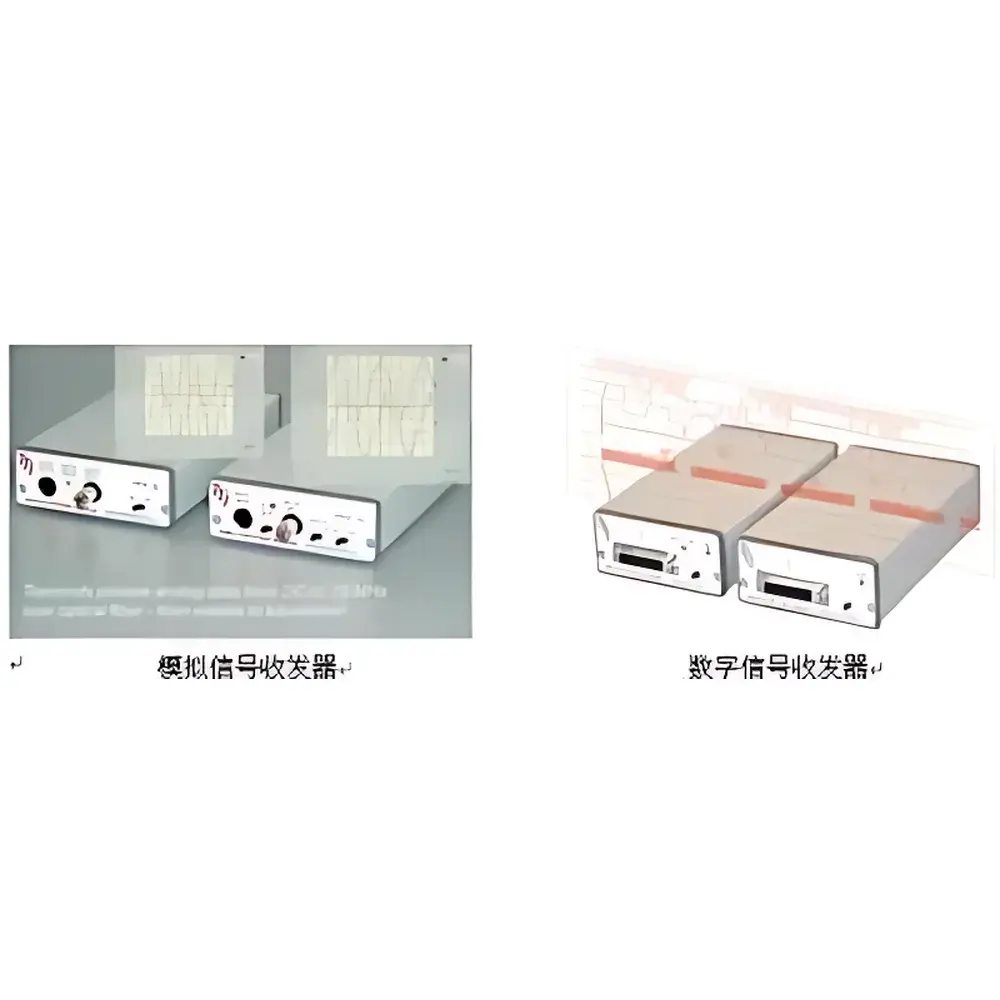
TTI LTX-55XX Series Fiber-Optic Signal Transceiver System
| Brand | TTI |
|---|---|
| Origin | USA |
| Model | LTX-5510 / LTX-5515 (Analog) / LTX-5520 / LTX-5525 (Digital) |
| Input Voltage Options | Dual-range configurable |
| Analog Bandwidth | DC–25 MHz |
| Analog Accuracy | ±0.1% FS |
| Analog Resolution | 12-bit |
| Digital Channels | 4 (analog models) / 16 (digital models) |
| Digital Channel Speed | DC–24 MHz (switching) / 0–50 Mb/s (data rate) |
| Logic Compatibility | TTL, CMOS, LVTTL (input) |
| Input Impedance Options | Two selectable values |
| Immunity | Full galvanic isolation, EMI-immune transmission via single-mode/multimode fiber |
Overview
The TTI LTX-55XX Series Fiber-Optic Signal Transceiver System is an engineered solution for high-fidelity, electrically isolated signal transmission in electromagnetically hostile or high-voltage environments. Based on bidirectional optical coupling architecture, the system converts analog or digital electrical signals into modulated light pulses for transmission over standard multimode or single-mode optical fiber—then demodulates them back to electrical form at the remote end. This galvanic isolation eliminates ground loops, suppresses common-mode voltage transients up to several kV, and ensures signal integrity where conventional copper cabling fails. Designed specifically for integration into plasma diagnostics, high-power laser monitoring, HVDC equipment testing, and pulsed power instrumentation, the LTX-55XX series complies with IEC 61000-4-3 (radiated immunity) and IEC 61000-4-4 (electrical fast transient immunity) requirements. Its compact, rack-mountable housing supports DIN-rail or panel mounting, with operating temperature range of –20 °C to +70 °C and humidity tolerance up to 95% non-condensing.
Key Features
- Fully optically isolated analog and digital signal paths—no metallic continuity between input and output sides.
- Dual analog input configurations supporting both high-impedance (1 MΩ) and low-impedance (50 Ω) source interfacing, enabling compatibility with oscilloscopes, lock-in amplifiers, and analog output modules.
- 12-bit analog resolution with monotonicity guaranteed across full DC–25 MHz bandwidth; typical integral nonlinearity (INL) < ±0.5 LSB.
- Four independently buffered digital I/O channels on analog variants (LTX-5510/LTX-5515), each supporting programmable edge-triggered switching from DC to 24 MHz.
- Sixteen fully isolated TTL/CMOS-compatible digital channels on digital variants (LTX-5520/LTX-5525), with individually configurable input thresholds and slew-rate controlled LVTTL outputs.
- Zero-latency deterministic timing architecture—propagation delay variation < ±1 ns across temperature and supply voltage ranges.
- Integrated fiber optic transceivers compliant with FC/PC or SC connectors; supports transmission distances up to 2 km (multimode) or 20 km (single-mode) without repeaters.
Sample Compatibility & Compliance
The LTX-55XX series interfaces directly with standard laboratory and industrial signal sources including function generators, data acquisition systems (e.g., National Instruments PXI, Keysight DAQ), photodetector amplifiers, and RF power sensor outputs. It requires no external power at the remote (fiber-receiving) end when configured with passive optical splitters—ideal for vacuum chamber feedthroughs or embedded sensor nodes. All units are CE-marked and meet RoHS 3 directives. Analog variants support calibration traceability to NIST standards via optional factory-certified calibration reports (ISO/IEC 17025 accredited). For regulated environments, firmware logging and configuration change audit trails comply with FDA 21 CFR Part 11 requirements when used with validated host software.
Software & Data Management
Configuration and real-time monitoring are supported via USB-C interface and TTI’s proprietary LTX Control Suite (Windows/Linux/macOS), which provides GUI-based channel mapping, gain/offset adjustment, digital trigger logic setup, and live waveform overlay. The suite exports timestamped binary or CSV data streams compatible with MATLAB, Python (NumPy/Pandas), and LabVIEW. Firmware updates are delivered via signed .hex packages with SHA-256 verification. Optional API libraries (C/C++, Python bindings) enable integration into custom test automation frameworks. All configuration parameters are stored in non-volatile memory with write-protection modes to prevent accidental modification during operation.
Applications
- Plasma physics experiments requiring synchronized acquisition across multiple Langmuir probes under ±5 kV common-mode potential.
- Real-time feedback control of high-energy laser cavities where RF noise from pump diodes would corrupt analog monitor signals.
- Condition monitoring of HVDC converter valves using isolated current transducer outputs transmitted over 800 m fiber runs.
- Digital trigger distribution across distributed timing systems (e.g., laser timing networks, particle accelerator beam diagnostics).
- EMC pre-compliance testing setups where signal integrity must be preserved despite 30 V/m radiated fields.
FAQ
Can the LTX-55XX operate in vacuum or radiation environments?
The base unit is rated for ambient use only; however, fiber-coupled remote heads (LTX-RH series, sold separately) are available in stainless-steel housings rated to 10⁻⁶ mbar and qualified to 10⁵ rad(Si) total ionizing dose.
Is fiber type selection user-configurable?
Yes—each unit ships with interchangeable FC/PC or SC receptacles; multimode (62.5/125 µm) is standard; single-mode (9/125 µm) variants require part number suffix “-SM” and are ordered separately.
Does the system support synchronization with external 10 MHz reference clocks?
Analog models include a dedicated 10 MHz input for phase-locking ADC sampling; digital models support clock forwarding via dedicated sync channel with jitter < 20 ps RMS.
What documentation is provided for validation in GxP environments?
Factory test reports, IQ/OQ protocols, and electronic signature-ready configuration logs are included in the Validation Support Package (VSP-LTX), compliant with ASTM E2500 and ISO 13485 Annex A guidelines.



