
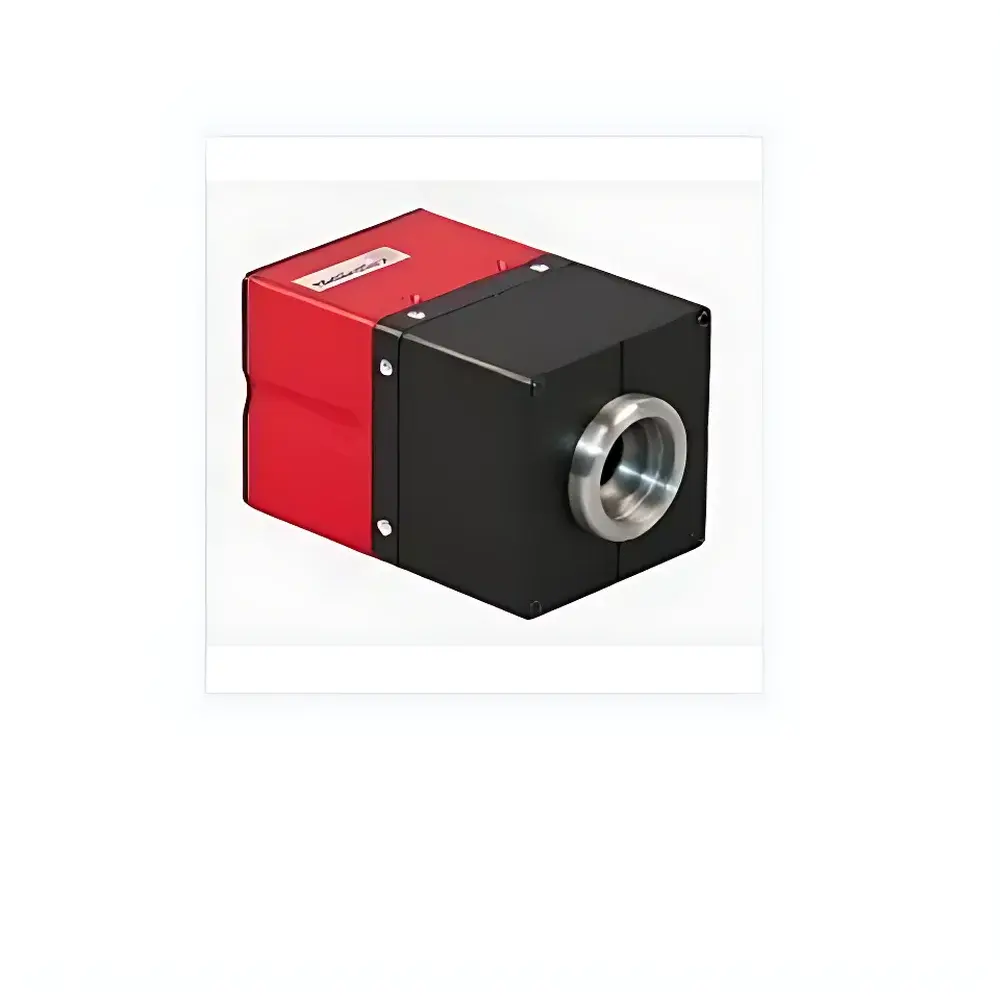
Metrolux ML4560 Wavefront Sensor
| Brand | Metrolux |
|---|---|
| Origin | Germany |
| Model | ML4560 |
| Software Suite | raylux ML1240 (wavefront analysis) + beamlux ML1200 (ISO-compliant beam quality analysis) |
| Camera | ML3743 CCD, 2/3" format, 12-bit dynamic range, 1392 × 1040 pixels |
| Wavelength Range | 350–1100 nm (standard), extendable to 190–350 nm with optional converter |
| Pupil Size | 8.97 × 6.71 mm |
| Max Frame Rate | 15 fps |
| Spatial Resolution | 200 µm |
| Sub-Aperture Array | 45 × 34 |
| Dynamic Range (Tilt) | ±1.6° (730 λ) |
| Wavefront Accuracy | <16 µrad (intrinsic sensor), system-level wavefront accuracy: 10 nm RMS |
| Repeatability | 100 nm RMS |
| Dynamic Range (Focus) | 72 mm (370 λ) |
| Curvature Accuracy | 5 × 10⁻⁴ m⁻¹ |
| System Accuracy (absolute wavefront) | 10 nm RMS |
| M² Measurement Capability | 1–20, accuracy ±3%, single-pulse compatible up to 1 kHz |
| Beam Diameter Range | <6 mm (standard), customizable |
| Spectral Options | 400–700 nm & 700–1100 nm, others on request |
| Energy Density Limit | <5 J/cm² (with optional attenuator) |
| Power Density Limit | <1000 W/cm² (with optional attenuator) |
| Attenuation Range | 1:1 to 1:10⁶, motorized and software-controlled |
Overview
The Metrolux ML4560 Wavefront Sensor is a high-precision, pre-calibrated optical metrology instrument engineered for quantitative characterization of laser wavefronts in real time. Based on the Hartmann-Shack principle, it captures local wavefront slope deviations across a defined pupil using a micro-lens array and high-resolution CCD imaging. The system delivers absolute wavefront reconstruction with traceable accuracy—enabling rigorous validation of beam quality, optical alignment, adaptive optics correction loops, and laser resonator diagnostics. Designed and manufactured in Germany, the ML4560 integrates seamlessly into R&D laboratories, industrial laser processing facilities, and metrology institutes where ISO 11146-compliant beam parameter measurement and ISO 10110-aligned wavefront specification are required.
Key Features
- Pre-calibrated sensor head with embedded reference wavefront—eliminates routine recalibration and ensures immediate measurement readiness.
- Integrated ML3743 scientific-grade CCD camera: 2/3″ format, 12-bit digitization, 1392 × 1040 active pixels, 15 fps maximum frame rate at full resolution.
- Wide spectral coverage: standard 350–1100 nm; extended UV range (190–350 nm) available via optional wavelength converter.
- High spatial fidelity: 200 µm effective sampling pitch across an 8.97 × 6.71 mm usable pupil area.
- Robust dynamic range: ±1.6° tilt sensitivity (730 λ), 72 mm defocus range (370 λ), supporting both collimated and converging/diverging beams.
- Motorized, software-controlled attenuation (1:1 to 1:10⁶) compliant with EN 60825-1 for Class 4 laser safety integration.
- Real-time wavefront reconstruction latency <50 ms, enabling closed-loop feedback in adaptive optics applications.
Sample Compatibility & Compliance
The ML4560 accommodates continuous-wave (CW) and pulsed laser sources—including nanosecond, picosecond, and femtosecond systems—with single-shot capture capability up to 1 kHz repetition rate. Beam diameters up to 6 mm are supported natively; custom pupil optics enable larger apertures. Energy density tolerance reaches 5 J/cm² and power density up to 1000 W/cm² when equipped with certified attenuators. All beam profiling and M² evaluation functions conform to ISO 11146-1:2021 (laser beam widths, divergence, and M²) and ISO 10110-5:2018 (surface irregularity specification). The system supports audit-ready operation under GLP and GMP environments through timestamped, non-modifiable data logs and user-access control in raylux ML1240.
Software & Data Management
The ML4560 operates exclusively with Metrolux’s dual-software architecture: raylux ML1240 for wavefront analysis (Zernike decomposition, PV/RMS error mapping, phase unwrapping, and aberration classification) and beamlux ML1200 for ISO-compliant beam propagation analysis (including M², D4σ, knife-edge, and caustic evaluation). Both applications run on Windows 10/11 x64, support HDF5 and CSV export, and include FDA 21 CFR Part 11-compliant electronic signature modules. Raw sensor data is stored with embedded metadata (wavelength, exposure, attenuation factor, calibration ID), ensuring full traceability. API access (C++, Python, .NET) enables integration into automated test benches and PLC-controlled manufacturing lines.
Applications
- Quantitative verification of ultrafast laser compressors and stretcher alignment.
- In-process monitoring of high-power fiber and disk laser optical trains.
- Validation of deformable mirror performance in astronomical and ophthalmic adaptive optics systems.
- Characterization of aspheric and freeform optics via interferometric comparison mode.
- M² certification for medical and industrial laser systems requiring IEC 60825-1 compliance documentation.
- Research-grade wavefront sensing in quantum optics setups involving spatial mode filtering and entanglement generation.
FAQ
Is the ML4560 suitable for ultrashort pulse measurement?
Yes—the system supports single-shot acquisition with sub-microsecond trigger synchronization; however, temporal pulse characteristics require complementary autocorrelation or FROG instrumentation.
Can the ML4560 measure wavefronts outside the visible/NIR range?
Standard configuration covers 350–1100 nm; UV extension down to 190 nm is available with a fused silica micro-lens array and deep-UV optimized CCD window.
Does the system meet regulatory requirements for medical laser validation?
Yes—beamlux ML1200 generates ISO 11146-compliant reports with full uncertainty budgets, and raylux ML1240 supports 21 CFR Part 11 audit trails for FDA-submitted documentation.
What is the minimum measurable wavefront deviation?
The intrinsic sensor resolution is <16 µrad per sub-aperture; system-level repeatability is 100 nm RMS over repeated measurements under stable thermal conditions.
Is remote operation and automation supported?
Fully supported via TCP/IP interface, LabVIEW drivers, and native Python bindings—enabling integration into CI/CD test pipelines and robotic optical alignment stations.





