
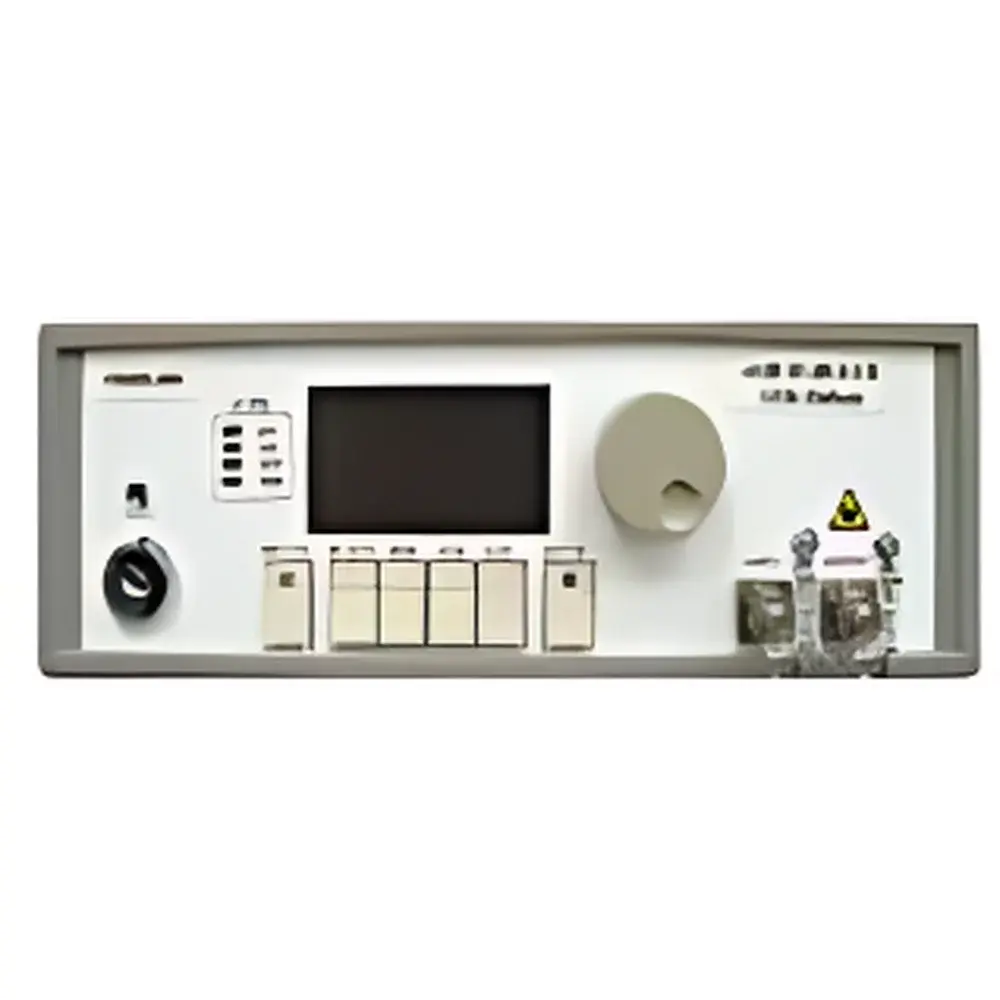
Fiberlabs AMP-FL8221-SB and AMP-FL8211-SB S-Band Fiber Amplifiers
| Brand | Fiberlabs |
|---|---|
| Origin | Japan |
| Model | AMP-FL8221-SB-XX, AMP-FL8211-SB-XX |
| Gain | 35 dB |
| Max. Output Power | +20 dBm (100 mW) |
| Active Medium | Praseodymium-Doped Fluoride Fiber |
| Control Modes | ACC / ALC |
| Monitoring Channels | Input Power, Output Power, Pump LD Current, Pump LD Temperature, Chassis Temperature |
| Remote Interface | RS-232C or GPIB |
| Protection | Automatic Input Power Lockout |
| Form Factor | Benchtop or Compact Module |
Overview
The Fiberlabs AMP-FL8221-SB and AMP-FL8211-SB series are high-performance S-band (1460–1530 nm) erbium-free optical fiber amplifiers engineered for precision signal boosting in low-noise, low-distortion environments. Unlike conventional C-band EDFAs, these amplifiers utilize praseodymium-doped fluoride glass fiber (Pr3+:ZBLAN), a material system specifically optimized for efficient 1480–1500 nm pump absorption and broadband gain across the S-band spectrum. This enables stable, polarization-insensitive amplification with intrinsic noise figures as low as 5.5 dB (typ.)—critical for analog transmission, coherent detection systems, and ultra-low-jitter timing distribution. Designed for laboratory-grade reproducibility and telecom-grade reliability, the amplifiers operate under strict thermal stabilization of the pump laser diode and active gain medium, ensuring long-term power stability (< ±0.05 dB over 8 hours) and minimal gain tilt (< 0.3 dB across full bandwidth).
Key Features
- High small-signal gain up to 35 dB with excellent flatness (±0.8 dB over 1470–1520 nm)
- Maximum saturated output power of +20 dBm (100 mW), supporting multi-channel DWDM pre-amplification and booster configurations
- Low noise figure (NF ≤ 5.8 dB at 1490 nm, 30 dB gain), enabling high OSNR preservation in cascaded amplifier chains
- Dual control architecture: Automatic Current Control (ACC) for fixed-pump operation and Automatic Level Control (ALC) for constant-output-power mode with dynamic input compensation
- Comprehensive real-time monitoring of six critical parameters: input power, output power, pump laser diode current, pump LD temperature, internal chassis temperature, and status flags
- Hardware-enforced input power lockout protection: automatically disables amplification if input exceeds user-defined threshold (configurable from −30 to −3 dBm), preventing gain saturation-induced nonlinearities and component stress
- Flexible packaging options: standard 19″ rack-mountable benchtop unit (2U height) or OEM-ready compact module (80 × 60 × 15 mm) with pigtailed FC/APC connectors
Sample Compatibility & Compliance
These amplifiers are compatible with single-mode fiber (SMF-28, HI1060, or PM1550) and support both continuous-wave (CW) and modulated signals (NRZ, PAM4, QPSK) up to 28 GBd without measurable pattern-dependent distortion. The optical design complies with IEC 60825-1:2014 Class 1M laser safety requirements when operated within specified input/output power limits. Electrical interfaces meet EN 61326-1 (EMC for laboratory equipment) and UL 61010-1 (safety). Firmware supports audit-trail logging for GLP/GMP-aligned test environments, and remote command sets adhere to SCPI-1999 syntax for seamless integration into automated test systems.
Software & Data Management
Local configuration is performed via front-panel keypad and OLED display; remote operation is supported through ASCII-based SCPI commands over RS-232C (standard) or IEEE-488.2 (GPIB) interfaces. Included PC software (Windows/Linux/macOS) provides real-time parameter visualization, trend logging (CSV export), alarm threshold setup, and firmware update capability. All monitoring data—including timestamps, sensor readings, and control state transitions—are stored in non-volatile memory with configurable retention (up to 30 days at 1 Hz sampling). For regulated environments, optional firmware upgrade enables 21 CFR Part 11-compliant electronic signatures, user role-based access control, and immutable audit trails for calibration and operational events.
Applications
- S-band DWDM system pre-amplification and in-line amplification in next-generation access networks (e.g., NG-PON2, XGS-PON extensions)
- Analog RF-over-fiber links requiring ultra-low composite second-order (CSO) and composite triple-beat (CTB) distortion—validated to < −70 dBc at 1 GHz modulation
- Optical time-domain reflectometry (OTDR) source enhancement and distributed fiber sensing (e.g., Brillouin, Rayleigh) where S-band offers reduced Rayleigh backscattering and lower water-peak attenuation
- Quantum optics experiments utilizing S-band photons for reduced silica phonon coupling and extended coherence lengths
- Calibration reference sources in metrology labs accredited to ISO/IEC 17025, where traceable gain stability and spectral flatness verification are required
FAQ
What pump wavelength is used in the AMP-FL82xx-SB series?
The amplifiers employ 1017 nm or 1047 nm InGaAs-based pump laser diodes, matched to the primary absorption peaks of Pr3+ in ZBLAN fiber.
Is polarization-dependent gain (PDG) specified?
Yes—PDG is ≤ 0.15 dB across the full S-band under standard operating conditions, verified per Telcordia GR-1312-CORE Annex A.
Can the amplifier be integrated into a LabVIEW or Python-based automation framework?
Absolutely—the SCPI command set is fully documented, and Python drivers (PyVISA-compatible) and LabVIEW VIs are available upon request.
Does the unit support dual-stage or cascaded configurations?
Yes—low-noise pre-amplifier and high-power booster variants are available; inter-stage isolation and gain tilt compensation can be implemented using optional inline filters and variable optical attenuators.
What is the typical warm-up time to achieve specified gain stability?
Less than 15 minutes from cold start to < ±0.03 dB gain variation at 25 °C ambient, per IEC 61290-3-1 test methodology.





