
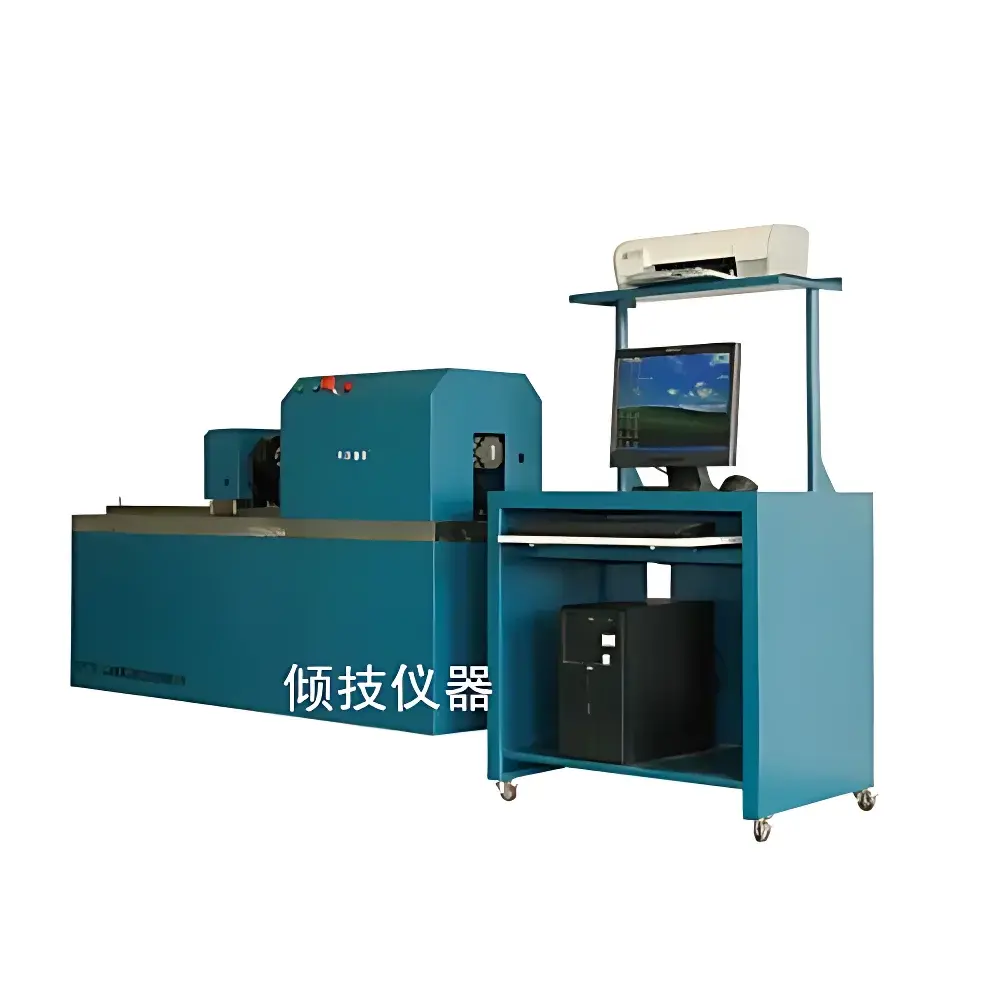
Qinji NZ Series Torsion Testing Machine for Automotive Components and Reinforcing Steel Bars
| Brand | Qinji |
|---|---|
| Origin | Shanghai, China |
| Model | NZ |
| Max Torque | 5000 N·m |
| Torque Measurement Range | 50–5000 N·m |
| Torque Resolution | ±0.001° |
| Torsion Angle Range | 0 to ±100,000° |
| Motor Power | 3000 W |
| Torque Measurement Accuracy | ±0.5% FS |
| Torsion Angle Accuracy | ±0.5% FS |
| Angular Resolution | 0.001° |
| Torsion Speed Range | 0.01–1000 °/min (infinitely variable) |
| Effective Gauge Length | 1500 mm |
| Specimen Clamping Diameter | Φ8–Φ40 mm (expandable) |
| Overall Dimensions | 2800 × 4700 × 1250 mm |
| Weight | 1500 kg |
Overview
The Qinji NZ Series Torsion Testing Machine is an electromechanical testing system engineered for high-precision static and quasi-static torsional characterization of metallic and non-metallic materials, structural components, and engineered parts—including automotive drivetrain elements (e.g., drive shafts, steering columns, suspension links), reinforcing steel bars (rebar), fasteners, and aerospace fastening assemblies. It operates on the principle of controlled angular displacement applied via a servo-motor-driven torque actuator, with simultaneous real-time measurement of applied torque and rotational angle using calibrated load cells and high-resolution rotary encoders. The system complies with internationally recognized mechanical testing standards including GB/T 9370–1999 (Methods for Torsion Testing of Metallic Materials), GB/T 239–1999 (Torsion Testing of Metallic Wires), and JJG 269–1981 (Verification Regulation for Torque Measuring Instruments). Its architecture supports both manual operation and automated test sequencing under programmable angular velocity or torque-controlled profiles.
Key Features
- High-torque capacity up to 5000 N·m with full-scale accuracy of ±0.5%, traceable to national metrological standards
- Ultra-fine angular resolution of 0.001° and torsion angle repeatability within ±0.5% FS across the full range of ±100,000°
- Infinitely variable torsion speed control from 0.01°/min to 1000°/min, enabling slow-rate creep evaluation and rapid failure mode analysis
- Integrated dual-sensor architecture: precision torque transducer and optical rotary encoder—both independently calibrated and thermally compensated
- Rigid C-frame construction with 1500 mm adjustable gauge length and self-centering hydraulic/pneumatic clamping jaws accommodating specimens from Φ8 mm to Φ40 mm (customizable for larger diameters)
- 3 kW servo motor with closed-loop vector control ensures stable torque delivery and minimal speed drift (<±0.2% of setpoint)
- Modular accessory interface supporting optional extensometers, environmental chambers, and micro-angle measurement modules for G-modulus determination
Sample Compatibility & Compliance
The NZ Series accommodates cylindrical, solid, and hollow specimens conforming to standard geometries defined in ISO 7800, ASTM E143, and EN 10002-5. It is routinely deployed for testing hot-rolled and cold-drawn reinforcing bars (HRB400, HRB500 per GB/T 1499.2), forged automotive axles, welded tubular joints, and polymer-composite drive shafts. All hardware and firmware are designed to support GLP-compliant operation: audit trails, user-level access control, electronic signatures, and data immutability meet requirements outlined in FDA 21 CFR Part 11 when paired with validated software configurations. Calibration certificates include uncertainty budgets aligned with ISO/IEC 17025 principles.
Software & Data Management
The system runs on a Windows-based virtual instrumentation platform built using LabVIEW RT architecture. It provides synchronized acquisition at up to 1 kHz sampling rate, real-time curve overlay (torque vs. angle, shear stress vs. shear strain), automatic yield point detection per ASTM E143 methodology, and modulus calculation routines for shear modulus (G) and non-proportional limit stress (τp). Test reports are exportable in PDF, Excel, and XML formats—with embedded metadata (operator ID, calibration date, environmental conditions). Raw data files adhere to HDF5 format for long-term archival integrity and third-party analysis interoperability. Software validation documentation (IQ/OQ/PQ protocols) is available upon request for regulated laboratory environments.
Applications
- Determination of torsional yield strength, ultimate torsional strength, and fracture angle for structural steels and aluminum alloys
- Evaluation of weld integrity and heat-affected zone (HAZ) ductility in torsion-loaded joints
- Quality assurance testing of threaded fasteners, universal joints, and CV axle assemblies per OEM specifications (e.g., VW TL 52201, Ford WSS-M1A351-B)
- Material qualification of high-strength rebar used in seismic-resistant concrete structures
- Research into torsional fatigue initiation and crack propagation mechanisms under controlled cyclic loading
- Validation of finite element models (FEM) by correlating experimental torque-angle hysteresis loops with simulated responses
FAQ
What standards does the NZ Series comply with for torque calibration and verification?
It conforms to JJG 269–1981 (National Verification Regulation for Torque Measuring Instruments) and supports traceable calibration against NIM (National Institute of Metrology, China) reference standards.
Can the system perform torsional fatigue testing?
The base configuration supports static and quasi-static tests; torsional fatigue capability requires optional high-cycle servo-hydraulic actuation and dedicated waveform generation modules—not included in standard NZ delivery.
Is the software compliant with 21 CFR Part 11 for regulated laboratories?
Yes—when deployed with configured audit trail logging, role-based permissions, and electronic signature enforcement, the software meets predicate rule requirements for electronic records and signatures.
What is the recommended maintenance schedule for long-term accuracy retention?
Annual recalibration of torque and angular sensors is advised; biannual inspection of jaw alignment, drive belt tension, and encoder coupling integrity ensures metrological stability over extended service life.
Does the machine support custom夹具 (fixtures) for non-standard specimen geometries?
Yes—Qinji offers engineering consultation and bespoke fixture design services compatible with ISO 14243 and ASTM F1839 mounting interfaces.



