
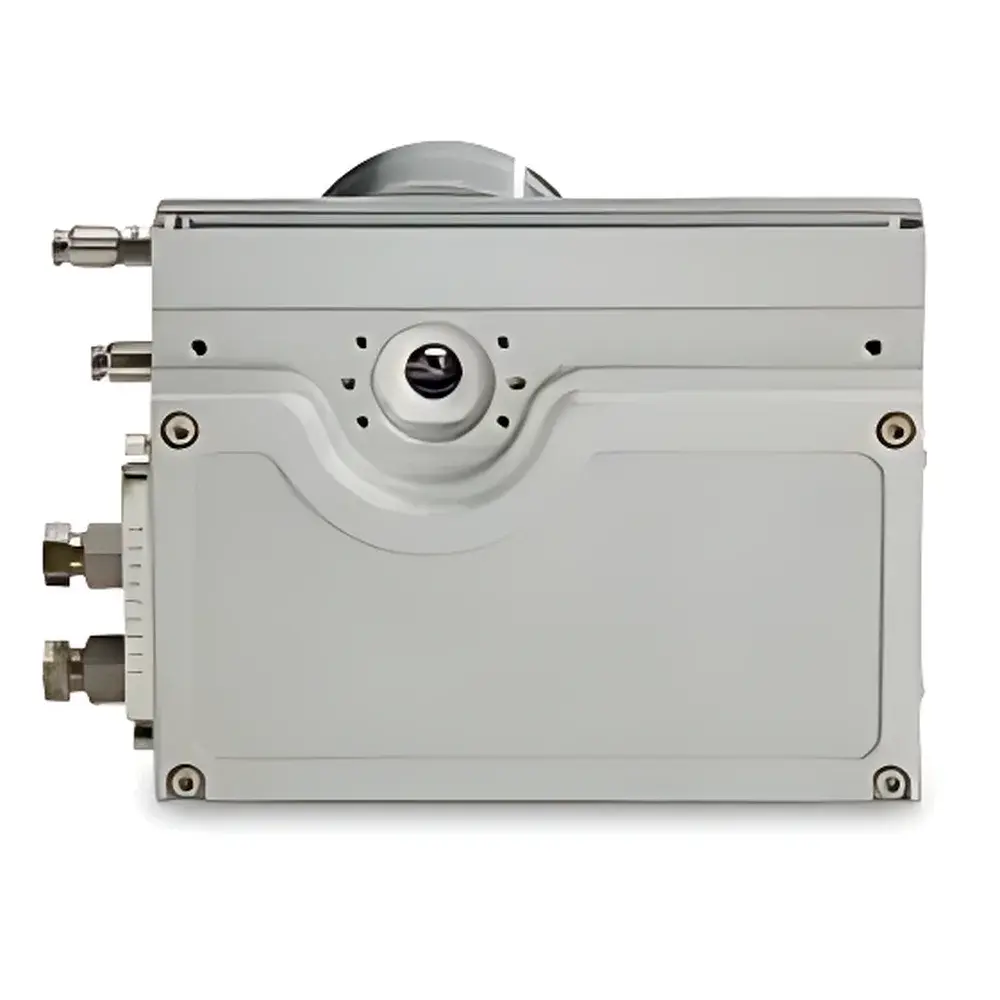
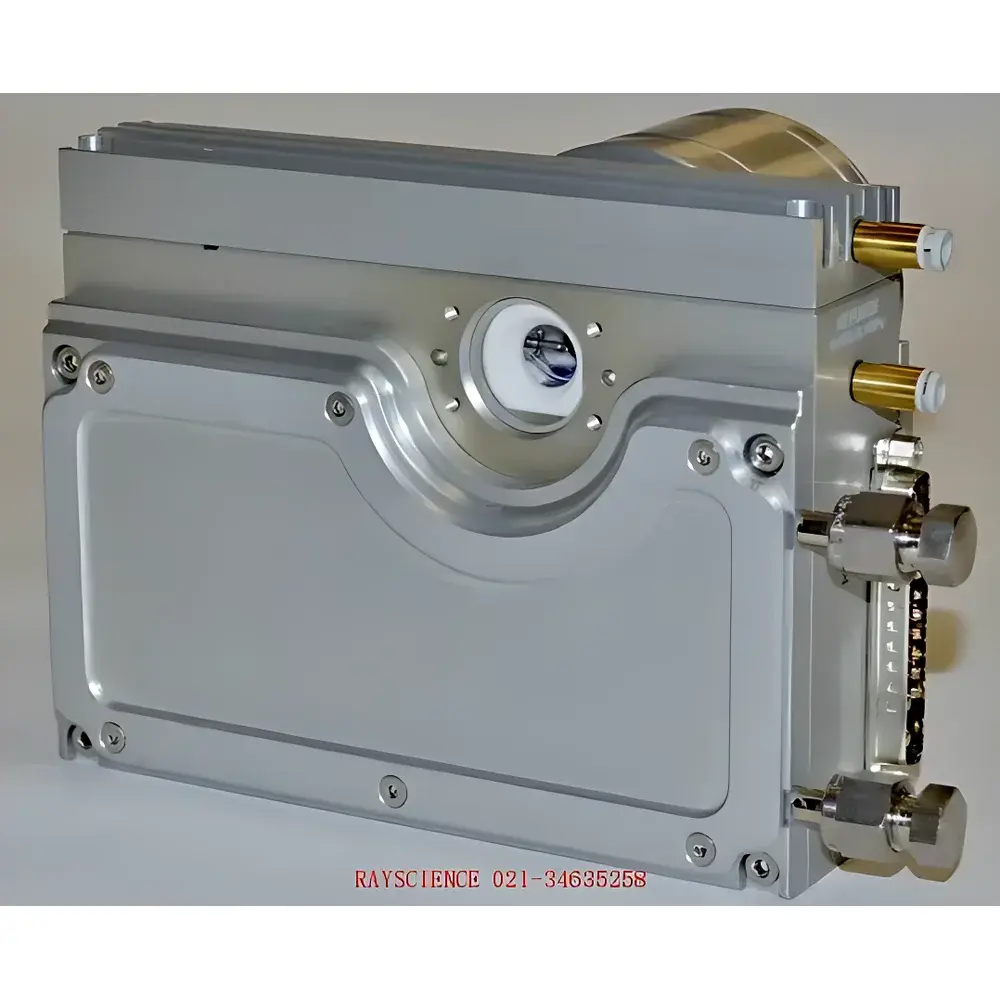
Energetiq LDLS EQ-77 Laser-Driven Light Source
| Brand | Energetiq |
|---|---|
| Origin | USA |
| Manufacturer Type | Authorized Distributor |
| Product Category | Imported |
| Model | EQ-77 |
| Core Technology | Laser-Driven Plasma Light Source (LDLS™) |
| Spectral Range | 170–2100 nm |
| Output Power | ~2 W |
| Spectral Radiance | ~40 mW/mm²·sr·nm |
| Numerical Aperture | 0.5 NA |
| Lifetime | >9000 hrs (to 10% radiant flux decay) |
| Cooling Method | Water-Cooled |
| Beam Configuration | Selectable Dual-Beam or Single-Beam (with rear-mounted reflector) |
| Lamp Housing Dimensions | 128 × 175 × 102 mm |
| Controller Dimensions | 152 × 250 × 132 mm |
| Lamp Housing Weight | 2.2 kg |
| Controller Weight | 2.9 kg |
Overview
The Energetiq LDLS EQ-77 is a high-brightness, broadband laser-driven light source engineered for demanding optical metrology, spectroscopic analysis, and industrial inspection applications. Unlike conventional electrode-based arc lamps—such as deuterium, xenon, or tungsten-halogen sources—the EQ-77 employs a proprietary Laser-Driven Light Source (LDLS™) architecture. In this design, a high-power continuous-wave laser is focused into a flowing inert gas (typically xenon), generating a stable, high-temperature plasma without physical electrodes. This electrode-free operation eliminates cathode sputtering, thermal degradation, and spectral drift associated with traditional lamps, resulting in exceptional radiometric stability and extended operational lifetime. The EQ-77 delivers continuous spectral output from the deep ultraviolet (170 nm) through visible to the near-infrared (2100 nm), with peak spectral radiance of approximately 40 mW/mm²·sr·nm at 300–400 nm. Its 0.5 numerical aperture (NA) output supports efficient coupling into monochromators, spectrometers, and fiber-optic delivery systems. Designed for integration into OEM instrumentation and laboratory-grade analytical platforms, the EQ-77 provides a robust, maintenance-reduced alternative to multi-lamp assemblies—reducing system complexity, recalibration frequency, and total cost of ownership.
Key Features
- Laser-driven plasma generation enables electrode-free operation, eliminating filament burnout and spectral instability inherent in arc lamps
- Extended operational lifetime exceeding 9,000 hours to 10% radiant flux degradation—significantly reducing consumable replacement and downtime
- High spectral radiance (~40 mW/mm²·sr·nm) across 170–2100 nm, enabling faster signal acquisition and improved signal-to-noise ratio in low-light detection
- Compact lamp housing (128 × 175 × 102 mm) with water-cooled thermal management for stable long-term performance under continuous duty
- Configurable optical output: selectable dual-beam symmetric output or single-beam mode via integrated rear reflector—facilitating flexible optical path design
- Output power of ~2 W total radiant flux, optimized for high-throughput spectroscopy and imaging applications requiring high photon flux density
- Low spatial and temporal noise profile, supporting quantitative reflectance, transmittance, and ellipsometric measurements compliant with ISO/IEC 17025 practices
Sample Compatibility & Compliance
The EQ-77 is compatible with standard optical interfaces including SMA905, FC/PC, and free-space collimated beam coupling. Its broadband UV-VIS-NIR emission supports calibration traceability to NIST-traceable reference standards (e.g., SRM 2065, 2066). The system meets CE marking requirements for electromagnetic compatibility (EMC Directive 2014/30/EU) and low-voltage safety (LVD Directive 2014/35/EU). While not classified as a medical device, its radiometric stability and reproducibility align with measurement assurance frameworks used in semiconductor process control (SEMI F20, SEMI F25), thin-film metrology (ASTM E1335, ISO 9276-2), and materials characterization per ASTM E308 and ISO/CIE 11664-3. No internal radioactive components; RoHS 2011/65/EU compliant.
Software & Data Management
The EQ-77 operates via a dedicated controller with analog (0–10 V) and digital (RS-232, USB 2.0) interfaces for remote power modulation, status monitoring, and fault logging. Firmware supports real-time reporting of lamp-on time, coolant temperature, and plasma ignition status. Integration with third-party software environments—including LabVIEW, Python (PySerial), and MATLAB—is enabled through documented ASCII command protocols. Audit trail functionality records all parameter changes and operational events, supporting GLP/GMP-aligned workflows where instrument usage documentation is required. Data export formats include CSV and plain-text logs compatible with LIMS and MES platforms. No embedded operating system; deterministic firmware ensures deterministic timing for synchronized acquisition in pump-probe or time-resolved experiments.
Applications
- High-resolution monochromator and spectrograph illumination for UV-Vis-NIR absorbance, fluorescence, and Raman excitation
- Semiconductor wafer inspection and critical dimension metrology, including scatterometry and spectral ellipsometry
- Thin-film thickness and composition analysis using variable-angle spectroscopic ellipsometry (VASE)
- Photoemission electron microscopy (PEEM) illumination requiring high-brightness, broadband UV excitation
- Defect detection in display panels, photomasks, and precision optics via broadband reflectance imaging
- Calibration of hyperspectral cameras, radiometers, and photodiode arrays across 170–2100 nm
- OEM integration into automated material inspection systems, environmental monitoring sensors, and process analytical technology (PAT) platforms
FAQ
What distinguishes LDLS technology from traditional arc lamps?
LDLS replaces thermionic electrodes with a focused laser to sustain plasma in xenon gas—eliminating electrode erosion, spectral discontinuities, and short lifetimes typical of deuterium or xenon arc lamps.
Is the EQ-77 suitable for vacuum-compatible applications?
The lamp housing is not vacuum-rated; however, it may be interfaced with UHV systems via differential pumping stages and appropriate optical viewports when coupled with external beam delivery optics.
Can output power be modulated in real time?
Yes—via 0–10 V analog input or RS-232/USB commands, enabling TTL-synchronized intensity control for time-resolved measurements.
Does the EQ-77 require periodic spectral recalibration?
Due to intrinsic plasma stability and absence of electrode drift, recalibration intervals are significantly reduced compared to conventional lamps—typically aligned with annual metrological verification per ISO/IEC 17025.
What cooling infrastructure is required?
A closed-loop recirculating chiller delivering 18–25°C water at ≥0.5 L/min flow rate and ≤1.5 bar pressure is recommended; integrated temperature sensors prevent operation outside safe thermal limits.




