
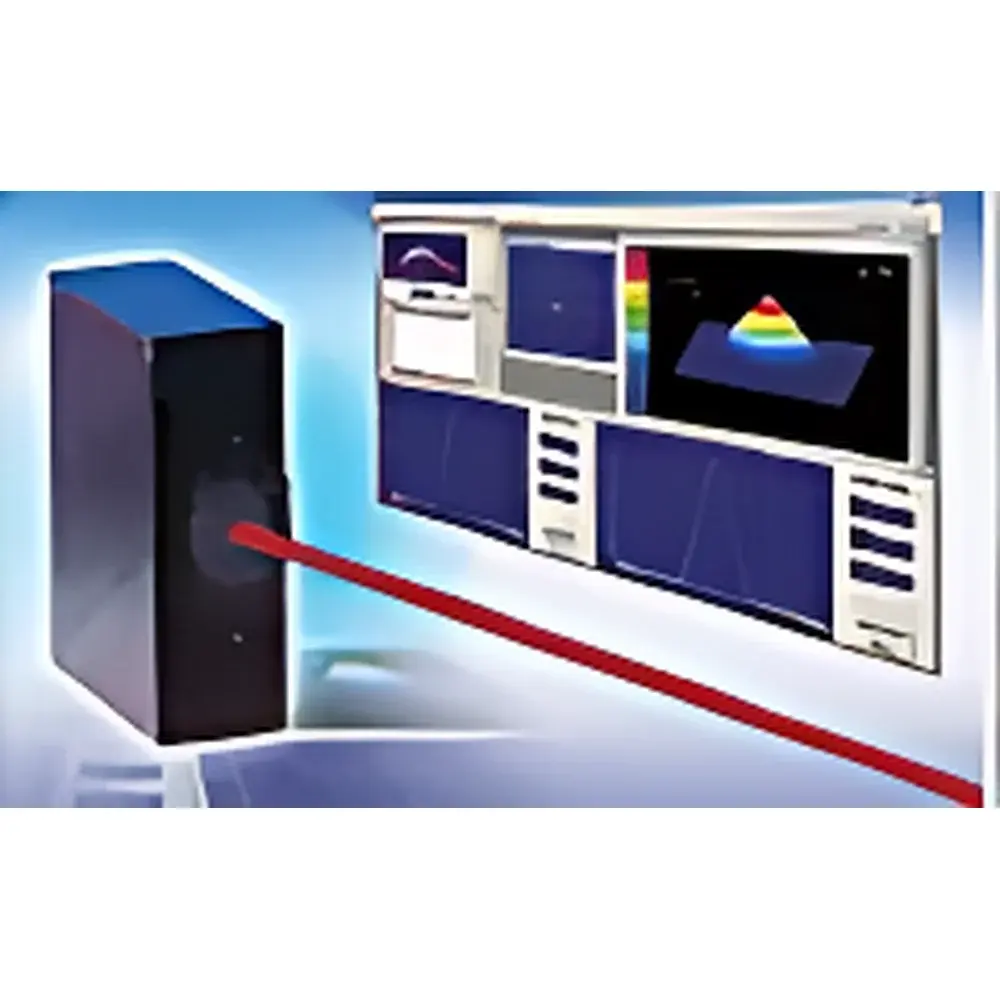
Duma Optronics BA7-IR Beam Analyzer
| Brand | Duma Optronics |
|---|---|
| Origin | Israel |
| Model | BA7-IR |
| Detection Principle | Rotating Knife-Edge Method |
| Wavelength Range | 800–1800 nm |
| Aperture | 5 mm |
| Blade Count | 7 |
| Interface | PCI |
| Software Included | BeamAnalyzer™ v6.x |
| Compliance | ISO 11146-1:2005, ISO 13694:2000, ANSI Z136.1-2022 |
| Measurement Accuracy | < ±1% (relative, calibrated), Resolution: < 1 µm (spatial), Dynamic Range: > 6 decades (intensity) |
Overview
The Duma Optronics BA7-IR Beam Analyzer is a precision optical measurement instrument engineered for quantitative characterization of continuous-wave (CW) and quasi-CW laser beams in the near-infrared (NIR) and short-wave infrared (SWIR) spectral bands. It employs the rotating knife-edge technique—a physically robust, non-destructive scanning method compliant with ISO 11146-1:2005 for beam width, divergence, and M² factor determination. Unlike camera-based profilers, the BA7-IR eliminates pixelation artifacts, saturation effects, and wavelength-dependent quantum efficiency limitations by using mechanically scanned, thermally stable silicon or InGaAs blade sensors. Its 7-blade configuration enables high-fidelity spatial sampling across a 5 mm active aperture, delivering sub-micrometer positional resolution and intensity linearity over six decades of power dynamic range. Designed for integration into laser development labs, fiber-optic alignment stations, and industrial QC environments, the BA7-IR provides traceable, repeatable beam parameter extraction without requiring external calibration standards beyond factory NIST-traceable certification.
Key Features
- Rotating knife-edge architecture ensures immunity to detector non-uniformity, blooming, and diffraction-limited resolution loss
- 7-blade sensor head optimized for 800–1800 nm operation, compatible with common NIR lasers (e.g., 1064 nm Nd:YAG, 1310/1550 nm telecom diodes, 1700 nm Er:fiber sources)
- PCI interface enables deterministic real-time data acquisition with <1 ms latency and synchronized trigger support for pulsed systems (repetition rates up to 10 kHz)
- BeamAnalyzer™ v6.x software provides full ISO 11146-compliant analysis: beam diameter (D4σ, 1/e², FWHM), ellipticity, centroid position stability, astigmatism, and M² calculation per ISO 11146-2
- Integrated thermal drift compensation algorithm maintains dimensional accuracy across ambient temperature fluctuations (15–30 °C)
- Supports both absolute power measurement (via calibrated photodiode reference channel) and normalized spatial profiling within a single acquisition cycle
Sample Compatibility & Compliance
The BA7-IR is validated for use with collimated or moderately focused CW laser beams having diameters between 50 µm and 4.5 mm at the sensor plane. It accommodates TEM₀₀, multi-mode, and higher-order LP modes typical of fiber-coupled and solid-state lasers. Beam divergence must remain below 15 mrad to ensure full aperture coverage during scanning. The system meets ISO 13694:2000 (laser beam parameter measurements), ANSI Z136.1-2022 (laser safety standard for measurement instrumentation), and EU CE Directive 2014/30/EU (EMC). All firmware and software comply with FDA 21 CFR Part 11 requirements for audit trail generation, electronic signature support, and data integrity preservation—making it suitable for GLP/GMP-regulated environments including medical laser validation and aerospace photonics QA.
Software & Data Management
BeamAnalyzer™ v6.x delivers a modular, scriptable platform supporting both interactive analysis and automated batch processing. Raw scan data are stored in HDF5 format with embedded metadata (wavelength, exposure time, serial number, calibration timestamp). The software includes built-in statistical process control (SPC) tools for long-term beam stability monitoring, including Cp/Cpk calculation, trend charting, and alarm thresholds based on user-defined σ limits. Export options include CSV, MATLAB .mat, and PDF reports with embedded ISO-compliant uncertainty budgets. Remote operation is enabled via TCP/IP socket interface; integration with LabVIEW, Python (PyVISA), and MATLAB Instrument Control Toolbox is fully documented. Audit logs record all parameter changes, file exports, and user logins with timestamps and IP addresses—fully traceable for regulatory review.
Applications
- Quantitative M² measurement of fiber-coupled diode lasers and tapered amplifiers used in material processing
- Alignment verification of free-space optical cavities and interferometric setups operating at 1064 nm or 1550 nm
- Beam quality validation of SWIR imaging illumination sources in defense and remote sensing systems
- QC testing of laser diode bars and VCSEL arrays prior to packaging
- Characterization of ultrafast amplifier output beams where camera saturation would compromise dynamic range
- Calibration reference for camera-based beam profilers in metrology laboratories
FAQ
Does the BA7-IR support pulsed laser measurements?
Yes—it captures single-shot profiles for pulses ≥10 ns duration when triggered externally; average power and pulse energy can be derived from integrated intensity traces.
Can I replace the 7-blade sensor head with other Duma blade configurations?
No—the BA7-IR is a fixed-configuration system; alternative models (e.g., BA3-IR5, BA7-UV) require separate hardware and calibration certificates.
Is NIST-traceable calibration included with purchase?
Yes—each unit ships with a factory calibration certificate valid for 12 months, covering wavelength response, spatial linearity, and power responsivity across the 800–1800 nm band.
What operating systems are supported?
Windows 10/11 (64-bit), with driver compatibility verified for Windows Server 2019 and 2022 in controlled lab environments.
How is beam pointing stability quantified?
Centroid position is calculated per scan with sub-pixel resolution; BeamAnalyzer™ computes RMS jitter over user-defined time windows and generates Allan deviation plots per IEEE Std 1139-2008.






