
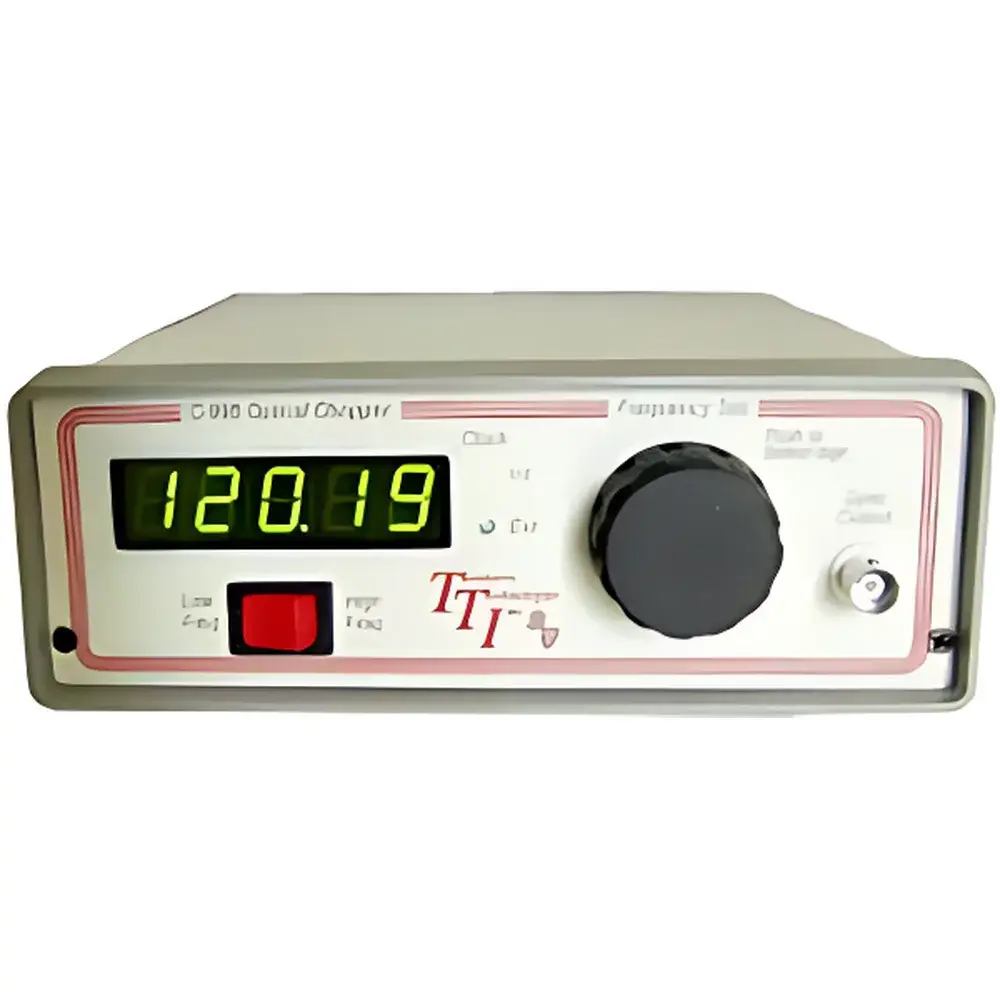
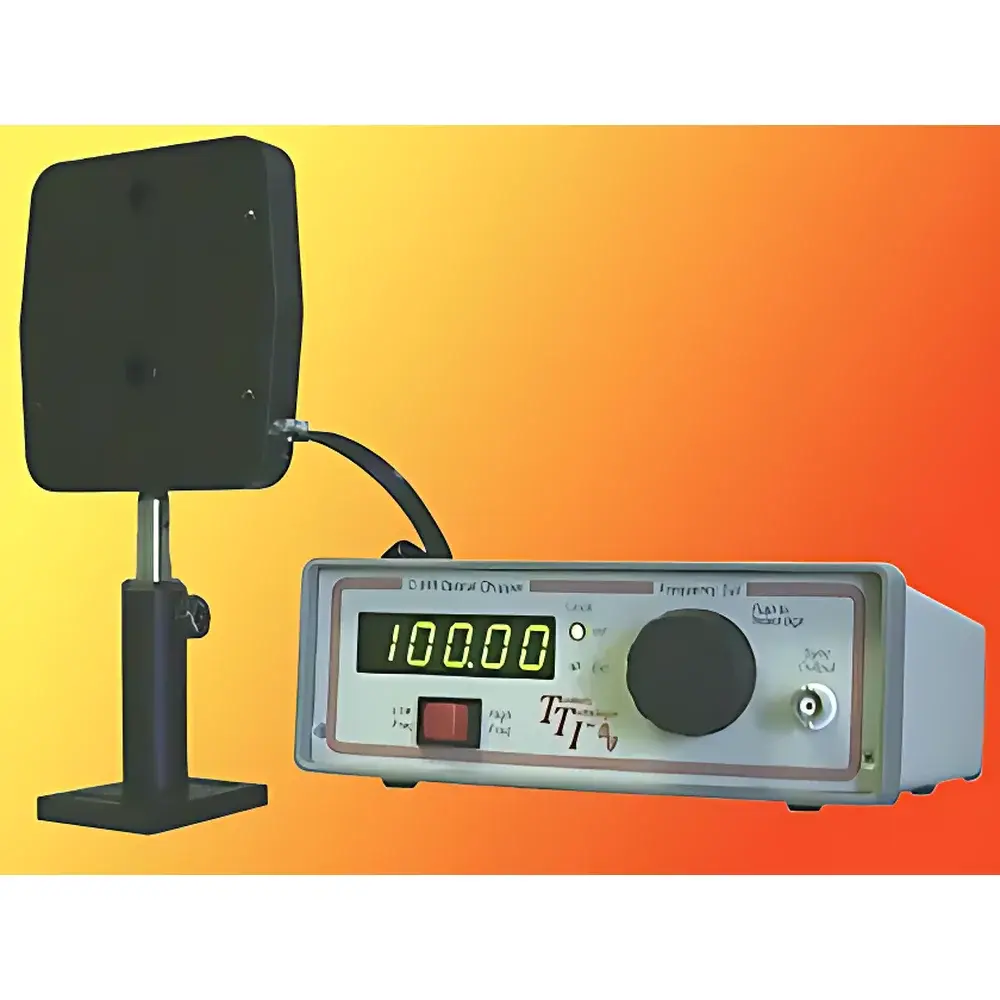
TTI C-995 Precision Optical Chopper
| Brand | TTI |
|---|---|
| Origin | USA |
| Model | C-995 |
| Frequency Range | 4.0 Hz to 500 Hz (internal aperture) / 40 Hz to 5 kHz (external aperture) |
| Aperture Diameter | 15 mm |
| Aperture Width | 4.5 mm (30-slot) / 15 mm (3-slot) |
| Frequency Stability | ±0.0025% |
| Phase Jitter | 0.1% peak-to-peak (3-slot), 1.0% peak-to-peak (30-slot) |
| Phase-Lock Response Time | <5 s |
| External Clock Input | TTL/CMOS-compatible, 40 Hz–5 kHz |
| Output Signal | TTL/CMOS square wave |
| Display | 5-digit high-brightness green LED, 0.5" height |
| Power Supply | 85–260 VAC, 50/60 Hz |
| Dimensions (Chopper Head) | 4.5" H × 4.5" W × 2" D |
| Dimensions (Controller) | 2.7" H × 7" W × 9" D |
| Weight | 1.4 kg |
| Operating Temperature | 0–40 °C |
| Warranty | 2 years |
Overview
The TTI C-995 Precision Optical Chopper is a microprocessor-controlled, phase-locked optical modulation instrument engineered for high-stability amplitude modulation of continuous-wave light sources in demanding laboratory and industrial measurement environments. Based on a precision rotating chopper wheel architecture with dual-aperture configurations (3-slot and 30-slot), the C-995 operates via synchronous motor-driven rotation coupled with a crystal-referenced feedback loop. Its core function is to convert DC or quasi-DC optical beams into precisely timed, periodic intensity-modulated signals—enabling lock-in detection, noise rejection, and signal-to-noise ratio enhancement in photometric, spectroscopic, and interferometric applications. Unlike open-loop choppers, the C-995 integrates a phase-locked loop (PLL) that permits real-time synchronization to an external reference clock (TTL/CMOS, 40 Hz–5 kHz), ensuring deterministic phase alignment critical for coherent heterodyne measurements and multi-channel timing coordination.
Key Features
- Wide, seamless frequency range: 4.0 Hz–500 Hz using the internal 3-slot aperture; 40 Hz–5 kHz using the external 30-slot aperture—supporting both low-frequency thermal emission studies and high-speed photodetector characterization.
- Crystal-controlled frequency stability of ±0.0025%, minimizing long-term drift during extended acquisition sessions typical in FTIR background subtraction or cavity ring-down decay analysis.
- High-resolution digital control: 5-digit LED display (0.5″ green digits) with front-panel entry enabling direct frequency setting down to 0.001 Hz resolution.
- RS-232 bidirectional serial interface for remote configuration, real-time status monitoring (e.g., actual rotational speed, lock status, error flags), and integration into automated test sequences compliant with LabVIEW, Python (PySerial), or MATLAB environments.
- Dual-aperture chopper head with mechanically interlocked blade enclosure—preventing accidental contact with rotating blades while maintaining optical access through two precisely aligned 15 mm diameter apertures (one configured with 3 radial slots, the other with 30).
- Adjustable mounting geometry: Two #8–32 threaded holes enable vertical positioning from 0.75″ to 13″ height when paired with standard 1/2″ optical posts—ensuring compatibility with breadboard-based optical tables and OEM integration into spectrometer or ellipsometer subsystems.
- Universal AC input (85–260 VAC, 50/60 Hz) and compact form factor (chopper head: 4.5″ × 4.5″ × 2″; controller: 2.7″ × 7″ × 9″) facilitate deployment in space-constrained cleanroom or teaching lab settings.
Sample Compatibility & Compliance
The C-995 is designed for use with free-space collimated or focused beams up to 15 mm diameter, compatible with UV–VIS–NIR sources including HeNe lasers (632.8 nm), diode lasers (405–1550 nm), thermal emitters (e.g., globars), and broadband LEDs. Its non-contact, air-bearing-supported rotor eliminates particulate generation—critical for Class 1000 cleanroom applications. The device meets IEC 61000-6-3 (EMI emissions) and IEC 61000-6-2 (immunity) standards. While not certified for medical or safety-critical systems, its stable output waveform and traceable frequency calibration support GLP-compliant documentation workflows when used in conjunction with NIST-traceable reference oscillators.
Software & Data Management
The RS-232 interface supports ASCII command protocol (e.g., “FREQ 123.456”, “LOCK?”, “STAT?”) with full query-response capability. Users may log timestamped frequency setpoints, actual RPM readings, and PLL lock status to CSV files for audit trails. When integrated with SRS lock-in amplifiers (e.g., SR830, SR844), the C-995’s TTL-sync output enables automatic harmonic tracking without manual frequency matching—reducing setup time and human error. Firmware updates are performed via serial terminal; no proprietary drivers required. All communication adheres to standard UART framing (9600 baud, 8-N-1), ensuring interoperability with industrial PLCs and SCADA systems under ISO/IEC 62443 cybersecurity frameworks.
Applications
- Lock-in amplifier reference source for low-light photometry (e.g., quantum efficiency mapping of photodiodes)
- Modulation source in Fourier-transform infrared (FTIR) spectrometers requiring precise duty-cycle control
- Beam gating in pump-probe transient absorption setups with sub-millisecond temporal resolution
- Reference signal generation for optical nulling interferometry and adaptive optics wavefront sensing
- Calibration of photodetector linearity and rise-time response across decades of modulation frequency
- Teaching labs: Demonstrating phase-sensitive detection, PLL dynamics, and optical signal conditioning principles
FAQ
Can the C-995 operate without an external reference clock?
Yes—the unit functions in free-running mode using its internal crystal oscillator across the full 4 Hz–5 kHz range.
What is the maximum beam power density the chopper wheel can withstand?
The aluminum-coated stainless steel wheel is rated for continuous exposure to CW laser power densities below 10 W/cm² at visible/NIR wavelengths; higher intensities require attenuated beam paths or pulsed operation.
Is the RS-232 interface optically isolated?
No—galvanic isolation is not provided; users deploying in electrically noisy environments should employ externally isolated USB-to-serial adapters or signal conditioners.
Does the C-995 support arbitrary waveform modulation?
No—it generates only square-wave intensity modulation at fixed fundamental frequency; arbitrary temporal shaping requires external AOM or EOM drivers.
How is phase jitter quantified, and why does it differ between 3-slot and 30-slot modes?
Phase jitter is measured as peak-to-peak deviation of zero-crossing timing over 1000 cycles; higher slot count increases sensitivity to mechanical imbalance and bearing noise, hence the 1.0% specification for 30-slot versus 0.1% for 3-slot.



