MPB VFL-P Series 670 nm Fiber-Coupled Diode Laser System
| Brand | MPB |
|---|---|
| Origin | Canada |
| Model | VFL-P-200-670 |
| Output Power | 200 mW (also available at 300 mW, 500 mW, and 1000 mW variants) |
| Beam Quality (M²) | ≤1.1 |
| Wavelength Stability | ±0.02 nm (over 8 hours, constant temperature) |
| Beam Divergence (Full Angle) | <5 mrad |
| Polarization | Linear, vertical to baseplate |
| Operating Mode | CW |
| Cooling | Air-cooled |
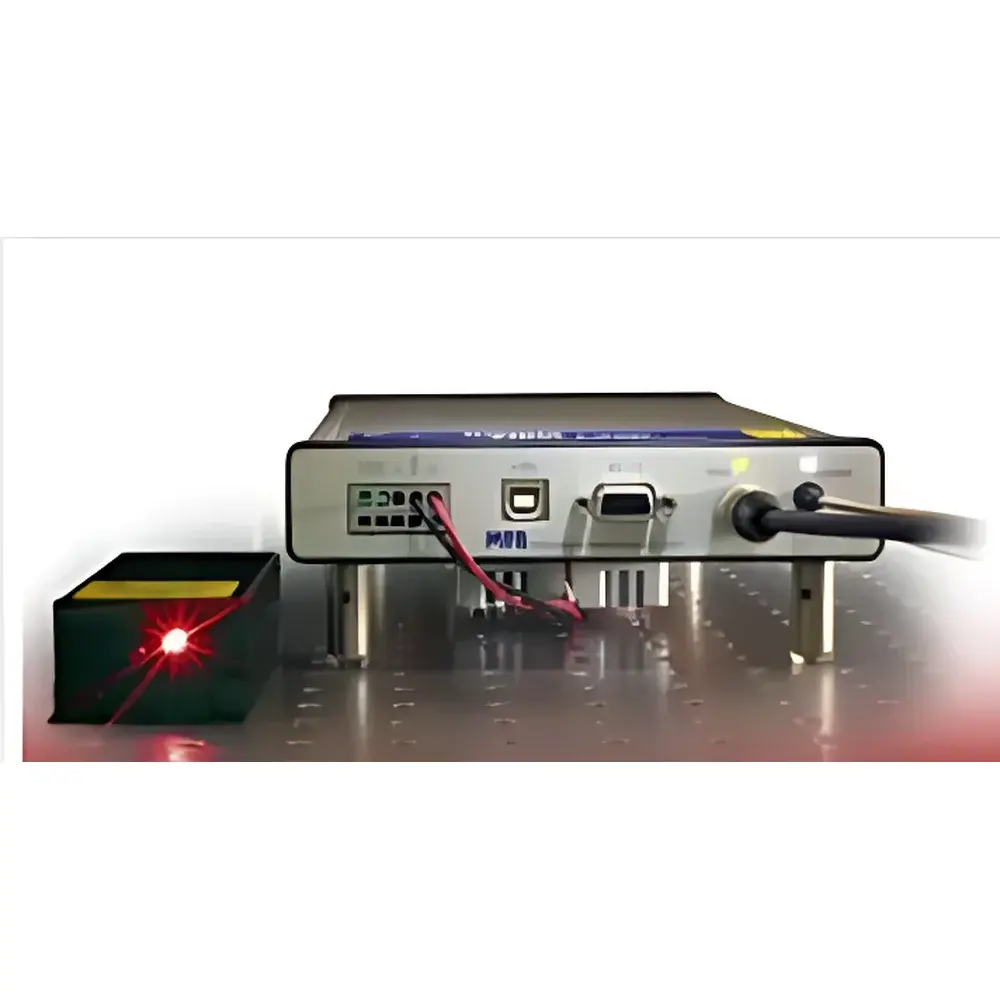
| Interface | RS232 & USB |
| GUI | Included |
| Form Factor | Benchtop and 2RU rack-mount (19", 23", ETSI compatible) |
| Safety | Interlock (benchtop), integrated transformer + emergency stop (rackmount) |
| Beam Profile | TEM₀₀ |
| Power Adjustment Range | 20–100% |
Overview
The MPB VFL-P Series 670 nm fiber-coupled diode laser system is a high-stability, continuous-wave (CW) optical source engineered for precision applications in life sciences, analytical instrumentation, and industrial photonics. Based on semiconductor diode technology with single-mode fiber delivery, the system emits at a nominal wavelength of 670 nm—strategically positioned within the red spectral band to optimize excitation efficiency for common fluorophores (e.g., Alexa Fluor 647, Cy5, and Texas Red derivatives) while minimizing autofluorescence and phototoxicity in biological specimens. The laser employs active current and temperature stabilization to maintain output power stability better than ±1% over 8 hours and wavelength stability within ±0.02 nm under controlled ambient conditions. Its TEM₀₀ spatial mode and M² ≤1.1 ensure diffraction-limited beam quality suitable for coupling into single-mode fibers, scanning optics, and interferometric setups. Designed and manufactured in Canada, the VFL-P platform adheres to IEC 60825-1:2014 laser safety standards and integrates compliance-ready features for laboratory and regulated environments.
Key Features
- High spectral purity and narrow linewidth (<0.1 nm typical), enabling selective excitation in multi-color fluorescence assays
- Factory-aligned, collimated free-space output or FC/PC-fiber-coupled variants (customizable upon request)
- Dual digital control interface: RS232 for integration into automated platforms and USB for local configuration via MPB’s native GUI
- Real-time monitoring of diode temperature, drive current, and output power via embedded sensors
- Air-cooled thermal management with passive heatsinking and low-noise axial fans—no external chiller required
- Benchtop units include mechanical safety interlock; 2RU rackmount versions feature integrated isolation transformer and front-panel emergency stop per IEC 60204-1
- 2RU chassis conforms to ETSI TS 300 119, NEBS Level 3, and ANSI/EIA-310-D mechanical standards for telecom and clinical instrumentation racks
Sample Compatibility & Compliance
The VFL-P series is compatible with standard optical tables, inverted and upright fluorescence microscopes (including Nikon Ti2, Zeiss Axio Observer, and Leica DMi8), flow cytometers (BD FACSymphony, Beckman CytoFLEX), and spectroscopic detectors (Andor iXon, Hamamatsu C12741). All models meet CE marking requirements under the EU Machinery Directive 2006/42/EC and Electromagnetic Compatibility Directive 2014/30/EU. Laser classification is Class 3B per IEC 60825-1:2014; full compliance documentation—including Declaration of Conformity, test reports, and safety labeling schematics—is provided with each shipment. For GxP-regulated laboratories, the GUI supports audit trail logging (user actions, parameter changes, timestamps) and may be configured to align with FDA 21 CFR Part 11 requirements when deployed with validated IT infrastructure.
Software & Data Management
MPB provides the VFL Control Suite—a cross-platform application (Windows/macOS/Linux) supporting real-time power modulation, scheduled ramping profiles, and remote triggering via TTL input. Configuration files are stored in XML format with SHA-256 checksums for integrity verification. The software enables export of time-stamped operational logs (CSV) containing diode temperature, setpoint vs. actual power, and error codes—essential for preventive maintenance scheduling and ISO/IEC 17025 traceability. API support (DLL and Python bindings) allows integration with LabVIEW, MATLAB, and Python-based automation frameworks (e.g., PyVISA, InstrumentKit). No cloud connectivity or telemetry is enabled by default; all data remains on-premise unless explicitly configured by the user.
Applications
- Confocal and widefield fluorescence microscopy: stable excitation for quantitative colocalization and FRET studies
- Flow cytometry: high-duty-cycle illumination for high-throughput cell sorting with minimal pulse-to-pulse intensity drift
- Ophthalmic diagnostics: alignment and calibration light source for optical coherence tomography (OCT) reference arms
- Raman spectroscopy: low-noise pump source for resonance-enhanced measurements of biological macromolecules
- Thin-film characterization: ellipsometry and reflectometry at 670 nm for transparent conductive oxide (TCO) layer analysis
- Laser-assisted manufacturing: localized photopolymerization in additive bioprinting and micro-optical component fabrication
FAQ
Is the 670 nm output wavelength tunable?
No—the VFL-P series operates at a fixed nominal wavelength of 670 nm, with inherent thermal and current-induced drift constrained to ±0.02 nm under stabilized conditions.
Can the laser be modulated externally?
Yes—TTL-compatible analog modulation input (0–5 V) supports intensity modulation up to 100 kHz bandwidth; digital modulation via RS232 command set is also supported.
What fiber connector types are available?
Standard configurations include FC/PC and SMA905; custom options (e.g., FC/APC, QD, or polarization-maintaining fiber) are available under OEM agreement.
Does the system support OEM integration into third-party instruments?
Yes—MPB provides mechanical drawings, electrical interface specifications (pinout, timing diagrams), and SDK documentation under NDA for seamless subsystem integration.
What is the expected lifetime of the laser diode?
Rated MTTF exceeds 20,000 hours at 25°C case temperature and nominal operating current, per Telcordia GR-468-CORE reliability testing protocols.