
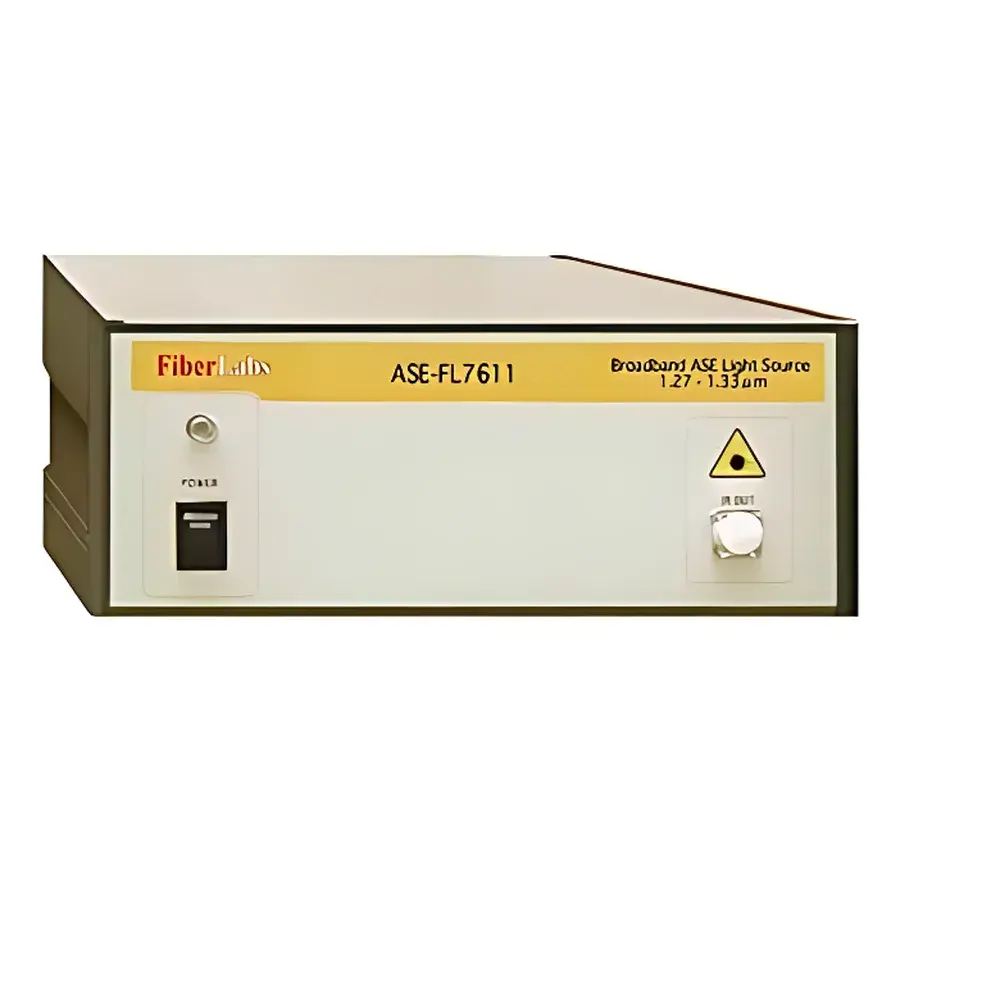
SLD Broadband Light Source Module by Fiberlabs
| Brand | Fiberlabs |
|---|---|
| Origin | Japan |
| Model | SLD- |
| Component Type | Broadband Light Source |
| Operating Wavelength Range | 600–1700 nm |
| Typical Central Wavelength | 1090 nm |
| Output Power | Up to 20 mW (typ.) |
| Spectral Bandwidth (FWHM) | 60 nm (typ.), up to 90 nm |
| Polarization Extinction Ratio | >20 dB (standard) |
| Power Stability | <±0.05 dB over 8 hours (25°C, constant current drive) |
| Operating Temperature | 15–35°C |
| Storage Temperature | –10–70°C |
| Fiber Pigtail | SMF-28e+ or PM fiber optional |
| Connector | FC/APC standard |
| Lifetime | >25,000 hours (MTTF) |
Overview
The Fiberlabs SLD Broadband Light Source Module is a high-performance superluminescent diode (SLD)-based optical component engineered for precision applications requiring low temporal coherence, high spectral brightness, and exceptional power stability. Unlike laser diodes, SLDs operate under amplified spontaneous emission (ASE) principles—producing spatially coherent but temporally incoherent light with broad Gaussian-like spectra. This fundamental property makes the SLD module ideal for interferometric sensing, where minimal coherence length (<100 µm typical) suppresses parasitic interference fringes while maintaining sufficient brightness for high signal-to-noise ratio detection. Designed and manufactured in Japan, the module adheres to stringent semiconductor optoelectronic quality control standards and is widely deployed in fiber-optic sensing systems, optical coherence tomography (OCT) development platforms, and metrology-grade calibration setups.
Key Features
- Wide Tunable Wavelength Coverage: Supports operation across the full 600–1700 nm range—encompassing visible (600–800 nm), near-infrared (NIR: 800–1300 nm), and extended NIR (1300–1700 nm) bands—enabling compatibility with silica-based single-mode fibers (SMF-28e+, HI1060, etc.) and specialty fibers used in gas absorption spectroscopy.
- High Optical Output Power: Delivers up to 20 mW of spectrally filtered, fiber-coupled output power at the pigtail end—optimized for low-loss transmission and minimal thermal roll-off under continuous-wave (CW) drive conditions.
- Broad and Smooth Spectral Profile: Achieves typical FWHM bandwidths of 60 nm, extendable to 90 nm depending on center wavelength selection—ensuring high axial resolution in OCT and robust fringe visibility in white-light interferometry.
- Thermal and Current Stability Architecture: Integrates thermoelectric cooler (TEC) control and precision constant-current driver circuitry to maintain spectral centroid drift <±0.05 nm/°C and power fluctuation <±0.05 dB over 8-hour operation—critical for long-duration FBG demodulation and laboratory reference stability.
- Robust Packaging and Fiber Integration: Housed in a compact, hermetically sealed TO-can or butterfly package with integrated fiber pigtail (SMF-28e+ standard; PM fiber available on request) and FC/APC connector—designed for OEM integration into rack-mounted instruments or benchtop test systems.
Sample Compatibility & Compliance
The SLD module is compatible with standard single-mode and polarization-maintaining optical fibers used in telecommunications, sensing, and biomedical instrumentation. Its spectral output conforms to ITU-T G.652.D and IEC 60793-2-50 specifications for SMF attenuation and mode field diameter. The device meets RoHS Directive 2011/65/EU and REACH Regulation (EC) No. 1907/2006 for hazardous substance restrictions. While not certified as a medical device, its performance parameters align with requirements for Class 1 laser product safety per IEC 60825-1:2014 when operated within specified current and temperature limits. For regulated environments—including GLP-compliant sensor validation labs—the module supports traceable calibration documentation and batch-specific spectral characterization reports upon request.
Software & Data Management
As a passive optical component, the SLD module does not incorporate embedded firmware or digital interfaces. However, it is fully compatible with third-party instrument control ecosystems including LabVIEW™ (via analog voltage/current control inputs), Python-based PyVISA drivers, and SCPI-compatible source meters (e.g., Keysight B2900 series). Fiberlabs provides comprehensive datasheets with spectral plots (normalized intensity vs. wavelength), power-current-temperature (P-I-T) curves, and aging test data for lifetime modeling. For traceability in QA/QC workflows, each unit ships with a unique serial number and optional NIST-traceable spectral calibration certificate—supporting audit readiness under ISO/IEC 17025 and FDA 21 CFR Part 11–aligned documentation practices.
Applications
- Fiber Bragg Grating (FBG) interrogation systems for structural health monitoring and aerospace strain/temperature sensing
- Fiber optic gyroscopes (FOGs) requiring broadband source coherence management to minimize Kerr effect and polarization-induced bias drift
- Optical coherence tomography (OCT) prototype development—especially swept-source and spectral-domain configurations demanding high brightness and smooth spectral envelopes
- Calibration of optical spectrum analyzers (OSAs), wavelength meters, and dispersion measurement systems
- Gas detection via tunable diode laser absorption spectroscopy (TDLAS) reference path stabilization and background noise suppression
- Characterization of passive components—including isolators, couplers, WDM filters, and circulators—under broadband illumination
FAQ
Is this SLD module suitable for integration into an FDA-regulated medical device?
Yes—provided the final system undergoes full design verification per IEC 62304 and complies with relevant sections of 21 CFR Part 820. The SLD itself is not a finished medical device but serves as a Class 1 compliant optical subassembly.
Can the central wavelength be customized outside standard stock options?
Yes—Fiberlabs offers custom center wavelength configurations between 600 nm and 1700 nm, subject to minimum order quantity and lead time confirmation.
What thermal management is required during continuous operation?
The module must be mounted on a heatsink with thermal resistance ≤1.5 K/W and operated within ambient temperatures of 15–35°C. Active TEC control is internal; external temperature stabilization is not required.
Does the module support analog modulation of output power?
Yes—via 0–5 V analog input for current control (modulation bandwidth up to 10 kHz), enabling dynamic power adjustment in closed-loop sensing applications.
Are spectral calibration files provided with each unit?
Standard shipment includes a generic spectral template. Full unit-specific spectral characterization data (including peak wavelength, FWHM, and ripple metrics) is available as an optional add-on report.




