
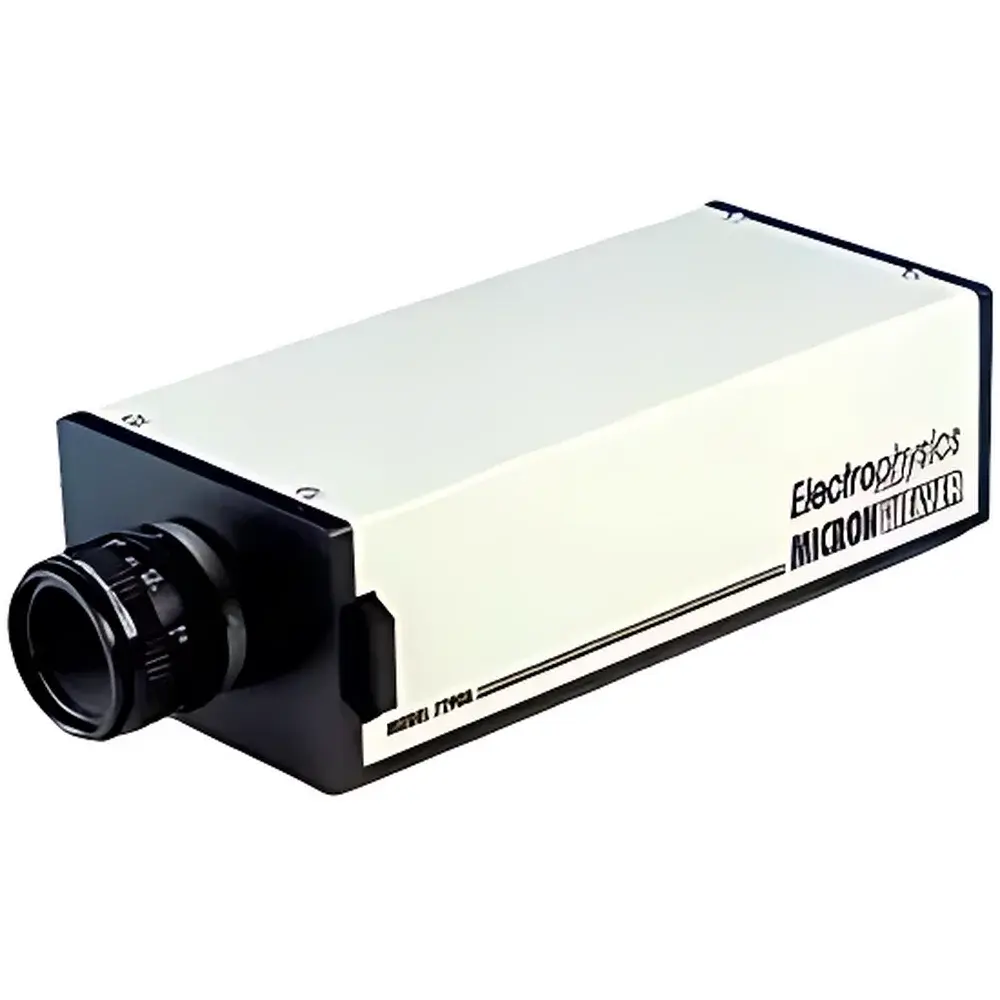
Electrophysics IRB-30 Infrared Inspection Camera
| Brand | Electrophysics |
|---|---|
| Origin | Hungary (Manufactured by SEMlab) |
| Model | IRB-30 |
| Imaging Sensor | Uncooled Microbolometer Array |
| Spectral Range | 7.5–13.5 µm (LWIR) |
| Resolution | 320 × 240 pixels |
| Thermal Sensitivity (NETD) | < 50 mK |
| Frame Rate | 30 Hz |
| Interface | GigE Vision compliant |
| Lens Mount | Standard C-mount |
| Operating Temperature | −10 °C to +50 °C |
| Compliance | CE, RoHS, ISO 18434-1 (Condition Monitoring — Thermography) |
Overview
The Electrophysics IRB-30 Infrared Inspection Camera is a purpose-built long-wave infrared (LWIR) imaging system engineered for non-destructive testing (NDT), thermal anomaly detection, and subsurface defect identification in industrial and research environments. Based on uncooled microbolometer technology, the IRB-30 operates within the 7.5–13.5 µm atmospheric transmission window, enabling high-contrast visualization of thermal gradients induced by subsurface flaws—such as delaminations, voids, disbonds, or moisture ingress—in composite materials, coatings, ceramics, and polymer-based structures. Unlike active thermography systems requiring external heating sources, the IRB-30 supports both passive monitoring and synchronized lock-in thermography workflows when integrated with external modulated excitation (e.g., halogen lamps or ultrasonic transducers). Its compact, ruggedized housing and C-mount lens interface facilitate integration into automated inspection stations, handheld NDT platforms, or benchtop R&D setups.
Key Features
- Native 320 × 240 pixel LWIR microbolometer array with < 50 mK noise-equivalent temperature difference (NETD), ensuring reliable detection of subtle thermal signatures associated with early-stage material degradation.
- GigE Vision–compliant digital interface enabling deterministic frame delivery, low-latency streaming, and seamless integration with third-party machine vision software (e.g., HALCON, Common Vision Blox, or custom LabVIEW applications).
- Standard C-mount optical interface supporting interchangeable macro, telecentric, or wide-angle lenses for optimized field-of-view and spatial resolution across diverse sample geometries.
- Robust mechanical design rated for continuous operation between −10 °C and +50 °C ambient temperatures, with conformal coating on internal PCBs to mitigate humidity-induced drift in factory-floor deployments.
- Firmware-upgradable architecture permitting future support for advanced processing features—including real-time delta-T mapping, emissivity compensation tables, and user-defined ROI-based alarm triggers.
Sample Compatibility & Compliance
The IRB-30 is routinely deployed in aerospace component screening (e.g., carbon-fiber reinforced polymer [CFRP] wing skins), automotive battery module integrity verification, and electronics encapsulation inspection. It complies with ISO 18434-1:2008 for condition monitoring via infrared thermography and supports traceable calibration per ASTM E1933-19 (Standard Test Methods for Measuring and Compensating for Emissivity Using Infrared Imaging Systems). When used in regulated manufacturing environments, the camera’s deterministic image timestamping, non-volatile configuration storage, and audit-ready metadata logging align with GLP and GMP documentation requirements. Full compliance with EU CE directives (EMC 2014/30/EU, RED 2014/53/EU) and RoHS 2011/65/EU ensures safe deployment in Class I and II industrial zones.
Software & Data Management
The IRB-30 operates natively with Electrophysics’ IR Workbench SDK—a C++/C#-compatible API supporting full control over integration time, gain, non-uniformity correction (NUC) scheduling, and radiometric data export in 16-bit TIFF or IEEE 754 floating-point formats. Raw thermal video streams are packetized using UDP over GigE, allowing direct ingestion into MATLAB, Python (via OpenCV or PyGigE), or commercial thermography suites such as FLIR Tools+ or ThermaCAM Researcher. All acquired datasets include embedded EXIF-style metadata: shutter time, lens F-number, object distance, ambient temperature, and user-defined inspection ID—enabling full traceability under FDA 21 CFR Part 11–aligned validation protocols when paired with qualified electronic signature modules.
Applications
- Active thermographic detection of impact damage in wind turbine blade composites using pulsed or modulated heating.
- In-process quality assurance of adhesive bond lines in aluminum–composite hybrid assemblies during automotive assembly line integration.
- Moisture mapping in building envelope materials (e.g., insulated concrete forms or roofing membranes) per ASTM D7954-15 guidelines.
- Failure analysis of hermetically sealed MEMS packages via thermal transient response profiling.
- Educational use in university NDT laboratories for hands-on instruction in infrared physics, heat transfer modeling, and signal-to-noise optimization in thermal imaging.
FAQ
Is the replacement camera identical to the original SEMlab-supplied unit?
Yes—the replacement IRB-30 imaging core is sourced directly from SEMlab’s production line and carries identical firmware versioning, calibration coefficients, and mechanical mounting dimensions.
Can the camera be replaced without sending the entire instrument to a service center?
Yes—field replacement requires only standard Torx drivers and takes less than 15 minutes; no optical realignment or recalibration is needed post-installation.
Does the replacement unit include factory calibration data?
Each unit ships with a unique NUC coefficient set and a traceable calibration certificate valid for 12 months from date of shipment.
Is technical support available for integration troubleshooting?
Yes—our engineering team provides remote assistance for GigE configuration, SDK deployment, and synchronization with external excitation sources.
What is the expected operational lifetime of the microbolometer array?
Based on accelerated life testing per MIL-STD-810H, the sensor exhibits > 25,000 hours MTBF under continuous duty cycle at nominal ambient conditions.




