
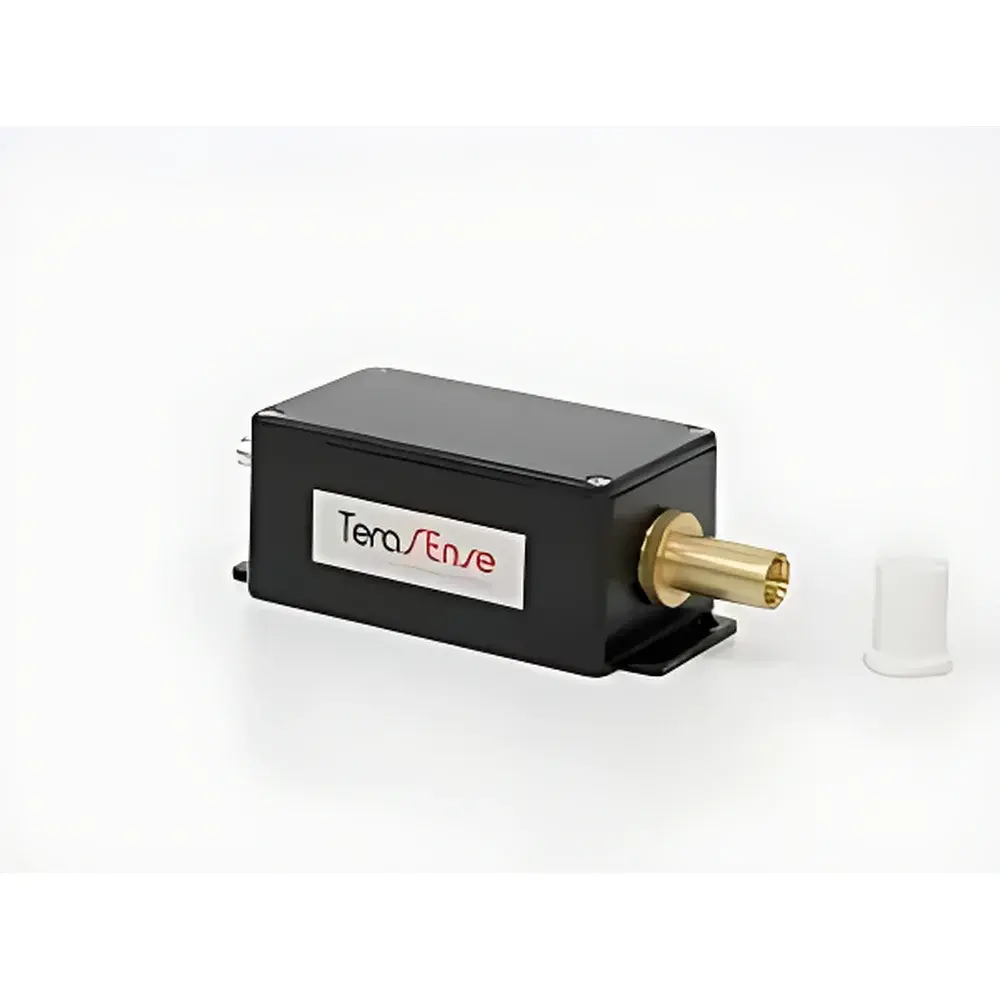
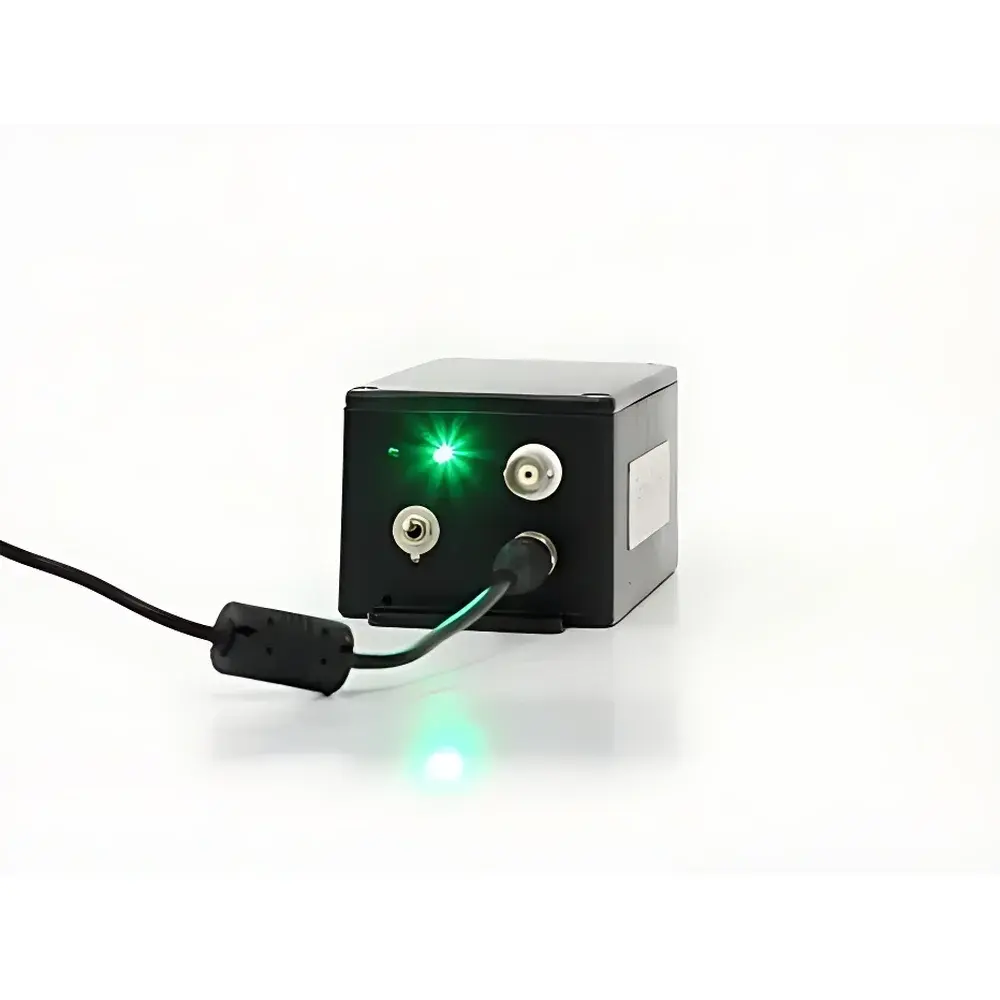
TeraSense IMPATT sub-THz Generator
| Brand | TeraSense |
|---|---|
| Model | IMPATT sub-THz Generator |
| Frequency Range | 80–120 GHz |
| Output Power | ≥10 mW (typical), optional >50 mW |
| Linewidth | 1 MHz (typical) |
| Operating Voltage | 15–16 V DC |
| Operating Current | 110–120 mA |
| Input Power | 2 W |
| Modulation Option | TTL-compatible |
| Package | Compact solid-state module |
| Compliance | RoHS-compliant, CE-marked for lab use |
| Warranty | 12 months |
Overview
The TeraSense IMPATT sub-THz Generator is a solid-state, continuous-wave (CW) terahertz source engineered for precision applications in the 80–120 GHz band—spanning the upper millimeter-wave and lower sub-terahertz spectrum. Unlike photoconductive or optical rectification-based THz emitters, this device leverages impact ionization avalanche transit-time (IMPATT) diode physics to generate coherent electromagnetic radiation via negative resistance oscillation under high-field DC bias. Its operation is rooted in carrier multiplication and drift-diffusion dynamics in doped semiconductor junctions (typically Si or GaAs), enabling efficient conversion of DC input power into narrowband RF/microwave/sub-THz output with high spectral purity. Designed for integration into laboratory test benches, spectroscopic systems, and industrial sensing platforms, the generator delivers stable, single-frequency CW emission without requiring external optical pumping or cryogenic cooling—making it a robust, turnkey solution for applications demanding compactness, reliability, and moderate output power.
Key Features
- Stable CW output across 80–120 GHz with typical linewidth ≤1 MHz, supporting high-resolution heterodyne detection and frequency-domain spectroscopy
- Compact hermetically sealed package (standard TO-8 or custom flange-mount configuration), optimized for benchtop and embedded system integration
- DC-biased operation (15–16 V, 110–120 mA) with 2 W total electrical input, eliminating need for complex RF drivers or laser subsystems
- High power efficiency: ≥10 mW RF output at fundamental frequency; optional high-power variants deliver >50 mW for extended path-length or low-reflectivity sample interrogation
- TTL modulation input (0–5 V, rise/fall time <10 ns) enables fast on/off gating, pulse train generation, and lock-in compatible measurement schemes
- Factory-aligned conical horn or WR-10 waveguide interface (optional precision taper angle) ensures optimal mode matching and minimal VSWR across operating band
- Fully RoHS-compliant construction and CE marking per EN 61326-1:2013 for electromagnetic compatibility in laboratory environments
Sample Compatibility & Compliance
This generator is designed for free-space or guided-wave coupling into standard WR-10 (75–110 GHz) or WR-8 (90–140 GHz) waveguide systems, and supports direct integration with commercial vector network analyzers (VNAs), spectrum analyzers, and heterodyne receivers. It operates reliably under ambient laboratory conditions (15–30 °C, non-condensing humidity) and requires no vacuum or thermal stabilization. While not intrinsically certified for medical or aerospace deployment, its design adheres to ISO/IEC 17025-relevant traceability practices for calibration documentation, and output stability meets requirements for ASTM E2847-22 (Standard Practice for Characterizing Terahertz Spectral Systems). Device-level compliance includes IEC 61000-4-3 (radiated immunity) and IEC 61000-4-6 (conducted immunity), ensuring robust performance in electromagnetically noisy lab settings.
Software & Data Management
The IMPATT sub-THz Generator operates as a hardware-controlled analog source and does not include embedded firmware or onboard digital control interfaces. Integration with automated test systems is achieved via external DC power supply programming (e.g., Keysight N6705B) and TTL triggering synchronized to data acquisition hardware (e.g., National Instruments PXIe-6368 or Zurich Instruments HF2LI). For traceable calibration and QA/QC workflows, users may log voltage, current, and ambient temperature alongside spectral measurements using LabVIEW, Python (PyVISA), or MATLAB instrument control toolboxes. While no proprietary software is supplied, TeraSense provides detailed datasheets, S-parameter files (S11/S21), and waveguide launch characterization reports—enabling full uncertainty budgeting per GUM (JCGM 100:2018) guidelines. Audit-ready records comply with GLP and 21 CFR Part 11 when paired with validated electronic lab notebooks (ELNs) and timestamped acquisition logs.
Applications
- Passive and active sub-THz imaging for non-destructive testing (NDT) of composites, ceramics, and packaged pharmaceuticals
- Gas-phase rotational spectroscopy targeting molecular transitions in atmospheric science and chemical vapor detection (e.g., NH₃, H₂O, O₂)
- Material characterization including dielectric constant and loss tangent mapping of polymers, foams, and thin-film coatings
- Calibration reference source for THz time-domain spectrometers (THz-TDS) and millimeter-wave radiometers
- Wireless communications research in D-band (110–170 GHz) and beyond-5G channel modeling
- Security screening systems requiring compact, high-SNR illumination sources for concealed object detection
FAQ
Is this device tunable across the 80–120 GHz range?
No—each unit is factory-tuned to a fixed center frequency within the 80–120 GHz band. Frequency selection must be specified at time of order; discrete models are available at 94 GHz, 100 GHz, 110 GHz, and 120 GHz.
What is the recommended heat sinking requirement?
A minimum thermal resistance of ≤1.5 K/W to ambient is required. We recommend mounting on an aluminum heatsink (≥100 cm² surface area) with thermally conductive grease (e.g., Wakefield 120) and forced-air cooling for continuous operation above 30 minutes.
Can multiple IMPATT generators be phase-locked?
Phase locking is not supported natively due to inherent oscillator drift and lack of external injection-locking ports. For coherent multi-source setups, users should implement external PLL architectures with low-noise reference distribution (e.g., using a common 10 MHz OCXO).
Does the device include waveguide-to-coaxial transition?
Standard units ship with WR-10 flange interface only. SMA or 2.92 mm coaxial adapters are available as optional accessories but require separate ordering and introduce insertion loss (>1.2 dB above 100 GHz).
What safety certifications apply to this generator?
The unit carries CE marking for EMC and LVD (2014/30/EU and 2014/35/EU), and complies with ICNIRP 2020 exposure limits for occupational environments up to 300 GHz. Full RF exposure assessment documentation is provided upon request for institutional radiation safety office review.



