
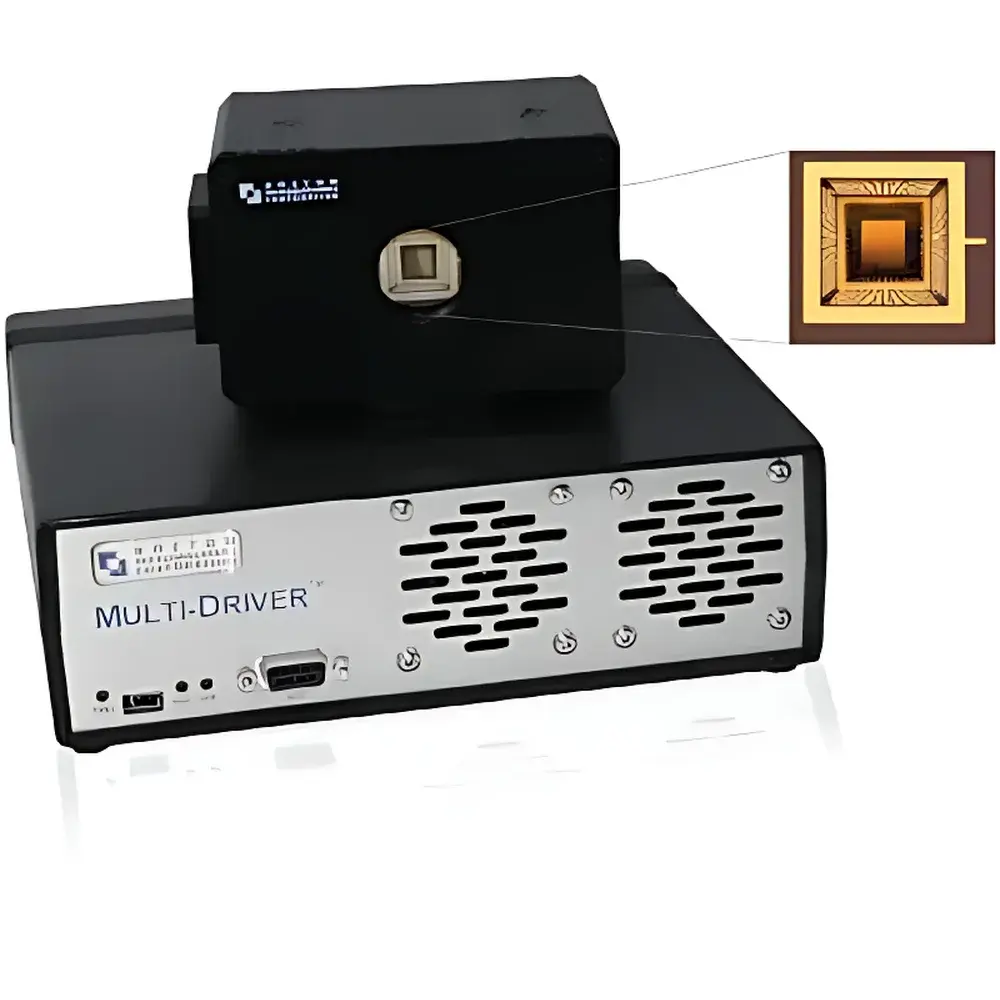
Boston Micromachines Multi-DM Deformable Mirror System
| Origin | USA |
|---|---|
| Manufacturer Type | Authorized Distributor |
| Origin Category | Imported |
| Model | Multi-DM |
| Pricing | Upon Request |
Overview
The Boston Micromachines Multi-DM is a high-performance, micro-electro-mechanical systems (MEMS)-based deformable mirror engineered for precision wavefront control in adaptive optics (AO) and spatial light modulation (SLM) applications. Operating on electrostatic actuation principles, the Multi-DM dynamically corrects optical aberrations—including higher-order Zernike modes—by precisely deforming its reflective surface in real time. Its monolithic silicon membrane design, combined with an array of 140 individually addressable actuators (arranged in a 12×12 grid excluding four corner elements), enables sub-wavelength phase modulation across visible to near-infrared spectra (400–1100 nm or 1550 nm optimized). The system is widely deployed in demanding scientific and industrial environments where stability, repeatability, and low-latency response are critical: confocal and multiphoton microscopy, ophthalmic retinal imaging (e.g., AO-SLO and AO-OCT), laser beam shaping for ultrafast laser systems, and free-space optical communications.
Key Features
- 140-actuator MEMS architecture with 99% fill factor (deformable mirror configuration) or 98% (SLM mode)
- Three standard stroke options: 1.5 μm, 3.5 μm, and 5.5 μm—optimized for trade-offs between dynamic range and mechanical response speed
- Zero hysteresis and sub-nanometer average step resolution (14-bit driver control), ensuring deterministic, repeatable surface deformation
- Low inter-actuator coupling (25–40%, depending on model), minimizing cross-talk and enabling accurate localized wavefront correction
- High-speed driver electronics supporting up to 8 kHz sustained frame rate and 34 kHz burst mode via USB 2.0 interface
- Aluminum or gold reflective coating; optional AR-coated protective window for 400–1100 nm or 1550 nm spectral bands
- Compact footprint (9″ × 7″ × 2.5″) and universal AC input (100–240 V), facilitating integration into benchtop and embedded optical platforms
Sample Compatibility & Compliance
The Multi-DM supports both continuous-membrane and segmented-surface configurations, making it compatible with diverse optical architectures—from closed-loop AO systems requiring Shack-Hartmann wavefront sensors to open-loop SLM-based beam steering and holographic projection setups. Its mechanical response time ranges from <20 μs (1.5 μm stroke) to <500 μs (5.5 μm stroke), enabling compatibility with high-repetition-rate pulsed lasers and real-time imaging modalities. The device conforms to ISO 10110 optical component standards for surface quality and is designed for operation in Class 1000 cleanroom environments. While not inherently certified for medical devices, its performance characteristics align with requirements outlined in ISO 13485 quality management systems and support GLP-compliant experimental workflows when integrated into validated optical test benches.
Software & Data Management
Control is implemented through Boston Micromachines’ proprietary DM Command Software (Windows/Linux), providing GUI-based actuator mapping, pre-loaded Zernike mode sets, and custom wavefront script execution. An open-source C/C++/Python SDK enables seamless integration with LabVIEW, MATLAB, and Python-based control stacks (e.g., PyVISA, NumPy). All driver firmware supports non-volatile memory storage of calibration matrices and user-defined actuator voltage maps. Audit-ready logging—including timestamped actuator voltage history, frame synchronization triggers, and thermal drift compensation flags—is available for compliance with FDA 21 CFR Part 11 requirements when deployed in regulated R&D environments.
Applications
- Adaptive optics in biological microscopy: correction of specimen-induced and system-based aberrations in live-cell imaging and deep-tissue two-photon excitation
- Clinical ophthalmology: real-time compensation of ocular aberrations in high-resolution retinal imaging systems for early detection of macular degeneration and glaucoma
- Laser material processing: dynamic beam profile optimization for uniform energy distribution in micromachining, lithography, and selective laser sintering
- Astronomical instrumentation: secondary wavefront correction in ground-based telescopes and space-based sensor testbeds
- Free-space optical communication: atmospheric turbulence mitigation and beam pointing stabilization in terrestrial and satellite links
- Holographic display and optical trapping: programmable phase modulation for multi-point optical tweezers and dynamic hologram generation
FAQ
What is the difference between the continuous-membrane and segmented-surface versions of the Multi-DM?
The continuous-membrane variant provides smooth, piston-and-tilt-coupled surface deformation ideal for low-to-mid-order aberration correction. The segmented version decouples actuators for independent phase control—suited for SLM applications requiring discrete pixel-level addressing.
Can the Multi-DM be used in vacuum or elevated temperature environments?
Standard units are rated for ambient operation (15–30°C, non-condensing). Vacuum-compatible variants with modified packaging and outgassing-tested materials are available upon request and require custom qualification.
Is real-time closed-loop control supported?
Yes—the USB 2.0 interface supports sub-millisecond latency, and the SDK includes APIs for synchronous readback of wavefront sensor data and actuator update cycles, enabling integration with commercial and custom AO loop controllers.
How is calibration performed, and how often is recalibration required?
Initial factory calibration includes actuator influence functions and flat-state characterization. Recalibration is recommended annually or after mechanical shock events; Boston Micromachines provides remote-assisted calibration protocols and NIST-traceable reference interferometry support.
Does the system comply with electromagnetic compatibility (EMC) directives for laboratory use?
The driver electronics meet FCC Part 15 Class A and CE EN 61326-1 emission and immunity standards, suitable for shared laboratory infrastructure without supplemental shielding.




