
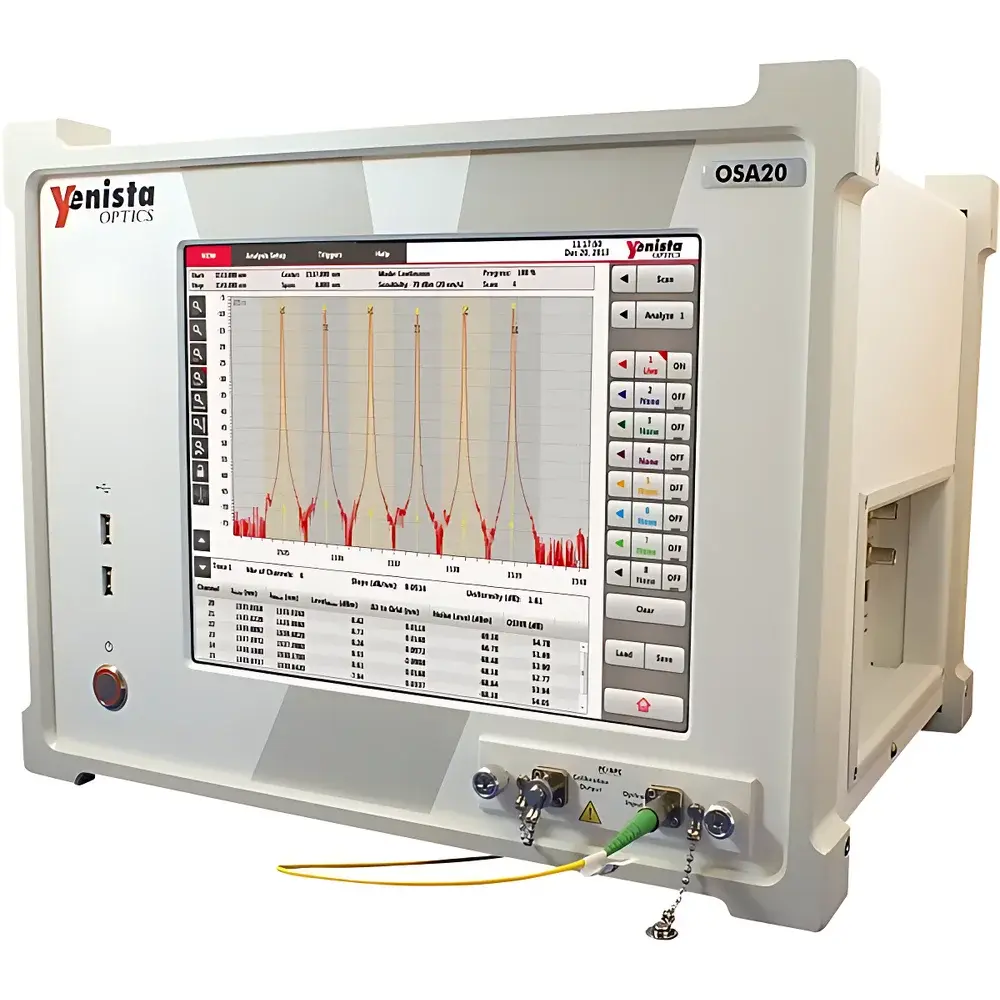
Yenista OSA20 Optical Spectrum Analyzer
| Brand | Yenista |
|---|---|
| Origin | France |
| Model | OSA20 |
| Type | Benchtop Optical Spectrum Analyzer |
| Measurement Principle | Diffraction Grating-Based Wavelength Dispersive Detection |
| Wavelength Range | 1250–1650 nm (C+L Band) |
| Resolution Bandwidth | Adjustable from 0.01 nm to 10 nm |
| Sensitivity | –75 dBm to –55 dBm (typical, with burst-mode enhancement) |
| Dynamic Range | >70 dB (typical, 1 nm RBW) |
| Number of Traces | 8 |
| Internal Storage | 2 GB SSD |
| Interface | GPIB, USB 2.0, Ethernet (LAN), RS-232 |
| Compliance | CE, RoHS, IEC 61326-1 |
Overview
The Yenista OSA20 Optical Spectrum Analyzer is a high-performance benchtop instrument engineered for precision spectral characterization of optical components and communication systems in R&D, manufacturing, and field service environments. Based on a thermally stabilized diffraction grating monochromator architecture, the OSA20 delivers high wavelength accuracy (<±5 pm, traceable to NIST standards), excellent repeatability, and low polarization-dependent loss (PDL < 0.05 dB). Its core measurement principle relies on scanning interference-free dispersion of incident light across a calibrated photodiode array, enabling quantitative analysis of optical power distribution as a function of wavelength (nm) with sub-picometer resolution capability. Designed specifically for telecom and photonics laboratories, the OSA20 supports full compliance with ITU-T G.694.1 (DWDM channel grid), Telcordia GR-1073-CORE (optical amplifier testing), and IEC 61280-2-9 (passive component characterization).
Key Features
- Multi-mode application firmware suite: Includes dedicated operational modes—OSA (general-purpose), WDM (dense/wideband multiplexing analysis), MML (multimode laser characterization), SML (single-mode laser source evaluation), OFA (erbium-doped fiber amplifier profiling), BBS (broadband source spectral shape assessment), RLT (recirculating loop transmission simulation), and PCT (passive component test including FBG and thin-film filter verification).
- Configurable scan acquisition: Supports auto-setup, single-shot, and continuous sweep modes; manual or external trigger synchronization; adjustable resolution bandwidth (RBW) from 0.01 nm to 10 nm.
- Advanced trace management: Eight independent traces with selectable types—Store, Live, Average, Rolling Average, Hold Min/Max, and Calculate (linear/logarithmic arithmetic operations).
- Comprehensive spectral analysis toolkit: Automated peak/trough detection, FWHM & x-dB width calculation, centroid (λmean), peak wavelength (λpeak), center wavelength (λcenter), standard deviation (σ), side-mode suppression ratio (SMSR), optical signal-to-noise ratio (OSNR), ripple depth, notch width, channel power integration, passband/stopband boundary validation, and optical power density mapping.
- High-fidelity optical interface: FC/APC and SC/APC adapter options; ultra-low insertion loss (<0.2 dB) and repeatable coupling via precision-machined ferrule alignment; removable connector sleeves for controlled cleaning without optical misalignment.
Sample Compatibility & Compliance
The OSA20 is validated for use with standard single-mode (SMF-28), polarization-maintaining (PM), and multimode fibers (OM3/OM4), as well as free-space-coupled lasers and amplified spontaneous emission (ASE) sources. It meets ISO/IEC 17025 requirements for calibration traceability when operated with Yenista-certified reference sources. Instrument firmware and data logging support audit-ready operation under GLP/GMP frameworks, including user access control, electronic signature prompts, and metadata-enriched result export (CSV, XML, SDF). All measurement reports include timestamp, operator ID, environmental conditions (optional sensor input), and uncertainty budgets per GUM (Guide to the Expression of Uncertainty in Measurement).
Software & Data Management
The embedded Linux-based operating system provides local GUI navigation and real-time parameter adjustment. Remote control is fully supported via SCPI commands over TCP/IP (VXI-11), USBTMC, or GPIB. Data export includes raw spectrum arrays (wavelength + power), processed analysis tables, annotated screenshots (PNG/JPEG), and configuration snapshots. Internal 2 GB solid-state storage retains ≥10,000 full-spectrum acquisitions with metadata. Optional Yenista OSA Control Suite (Windows/Linux) enables automated test sequencing, statistical process control (SPC) charting, batch report generation compliant with FDA 21 CFR Part 11 (electronic records & signatures), and integration into LabVIEW™ or MATLAB® environments via native drivers.
Applications
- Characterization of DWDM transceivers, ROADMs, and reconfigurable optical add-drop multiplexers (ROADM)
- Validation of EDFA, Raman, and semiconductor optical amplifiers (SOA) gain flatness, noise figure, and saturation behavior
- Spectral stability testing of DFB, DBR, ECL, and VCSEL lasers under thermal and current modulation
- Pass/fail verification of thin-film filters, AWGs, cascaded MUX/DEMUX modules, and FBG-based sensors
- Broadband source coherence length estimation via spectral width and shape analysis (e.g., SLEDs, ASE sources)
- Research-grade investigation of nonlinear optical phenomena—including four-wave mixing (FWM) product identification and supercontinuum spectral decomposition
FAQ
What wavelength calibration standards are supported?
The OSA20 supports internal wavelength calibration using built-in gas absorption lines (e.g., acetylene, water vapor) and external traceable references (NIST-traceable HeNe or stabilized diode lasers). Calibration certificates are issued per ISO/IEC 17025.
Can the OSA20 perform real-time OSNR measurements on live DWDM signals?
Yes—using the dedicated WDM mode with polynomial curve-fitting and interpolation algorithms compliant with IEC 61282-12 Annex A, it calculates in-band OSNR without optical filtering or out-of-band reference channels.
Is remote firmware update possible over Ethernet?
Yes—secure firmware upgrades (signed .bin files) can be deployed via HTTPS or TFTP with rollback capability and version integrity checksum verification.
Does the instrument support multi-user role-based access control?
Yes—administrator, operator, and viewer profiles enforce configurable permissions for setup modification, measurement execution, data export, and calibration log access.
What is the typical warm-up time to achieve specified wavelength accuracy?
Less than 30 minutes at ambient temperatures between 15–30 °C; thermal stabilization is actively monitored and reported in the status bar.



