
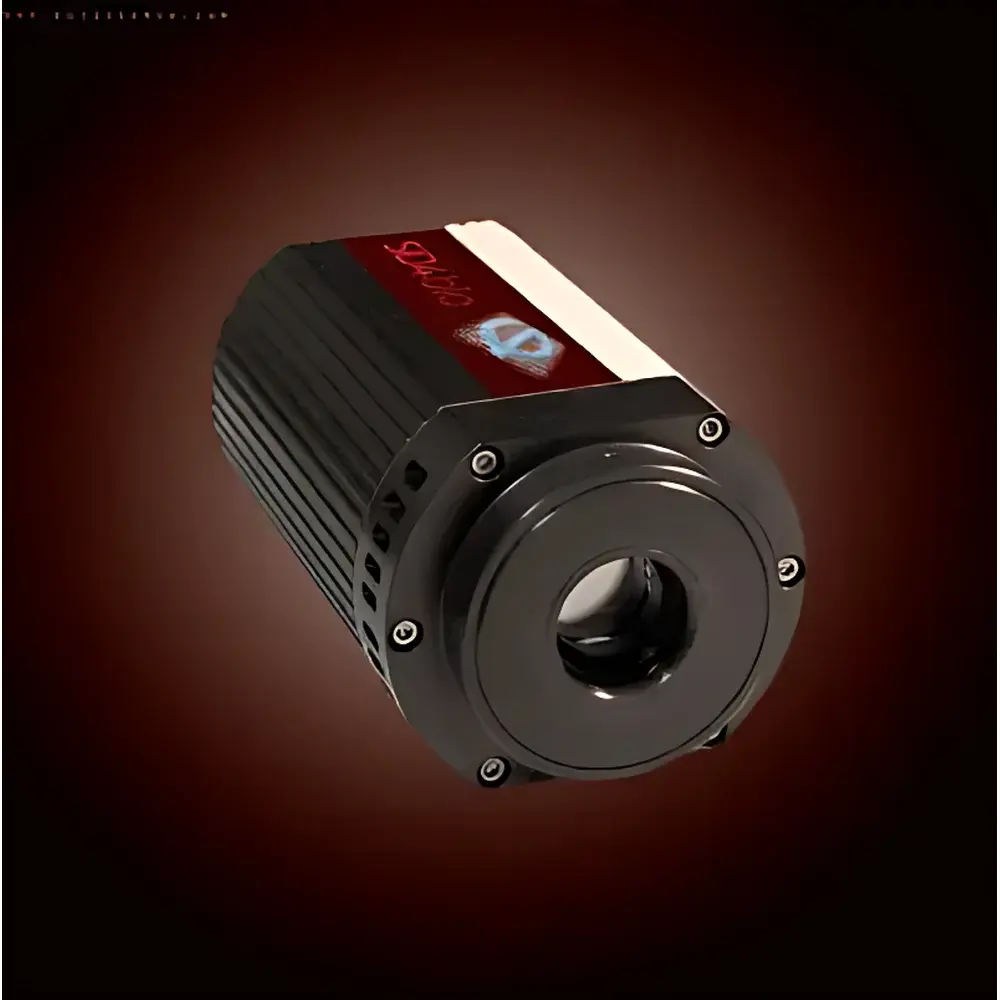
Phasics SID4-HR High-Resolution Wavefront Sensor
| Brand | Phasics |
|---|---|
| Origin | France |
| Model | SID4-HR |
| Working Principle | Shack–Hartmann-based wavefront sensing with spatial phase reconstruction |
| Imaging Mode | 3D quantitative phase mapping |
| Platform Compatibility | Ground-based and airborne deployment |
| Spectral Range | 400–1100 nm |
| Spectral Resolution | 0.025 nm (typical for calibrated monochromatic operation) |
| Spatial Resolution | 29.6 µm |
| Field of View (TFOV) | 5° |
| Instantaneous Field of View (IFOV) | 29.6 µrad |
| Frame Rate | 10 fps |
| Pixel Array | 400 × 300 sampling points |
| Dynamic Range | >500 µm PV |
| Phase Accuracy | 15 nm RMS |
| Sensitivity | <2 nm RMS |
| Processing Frequency | 3 Hz (high-resolution mode) |
| Dimensions | 54 × 46 × 79 mm |
| Weight | 250 g |
Overview
The Phasics SID4-HR is a high-resolution, Shack–Hartmann-based wavefront sensor engineered for quantitative, real-time measurement of optical phase distortions across visible and near-infrared spectra (400–1100 nm). Unlike conventional interferometric or shearing methods, the SID4-HR employs a micro-lens array to sample local wavefront gradients, reconstructing full 2D phase maps with sub-nanometer sensitivity and high spatial fidelity. Its achromatic design eliminates wavelength-dependent calibration drift—enabling consistent performance across the entire spectral band without mechanical filter changes or recalibration. The device delivers 400 × 300 spatial sampling points over an active aperture of 8.9 × 11.8 mm², supporting both collimated and highly divergent beams (up to ±15° full angle), making it suitable for laser diagnostics, adaptive optics loop closure, and precision optical surface metrology in R&D and industrial QA environments.
Key Features
- High-fidelity phase reconstruction at 400 × 300 spatial resolution with <2 nm RMS sensitivity and 15 nm RMS absolute accuracy
- Achromatic operation across 400–1100 nm—no recalibration required when switching wavelengths
- Direct compatibility with highly divergent beams (e.g., multimode fiber outputs, uncollimated laser diodes)
- Compact, lightweight form factor (54 × 46 × 79 mm; 250 g) optimized for integration into airborne platforms, vacuum chambers, and OEM optical systems
- Real-time processing at 3 Hz in high-resolution mode, with frame capture at 10 fps for external synchronization and trigger-based acquisition
- Robust thermal and mechanical stability—designed for continuous operation under laboratory and field conditions
Sample Compatibility & Compliance
The SID4-HR interfaces seamlessly with standard C-mount or F-mount imaging optics and supports direct coupling to telescopes, microscope objectives, and fiber-coupled sources. It complies with ISO 10110-5 (surface irregularity measurement), ISO 21247 (laser beam characterization), and ASTM E2847 (wavefront sensor verification protocols). Its data output meets GLP/GMP traceability requirements when used with validated acquisition workflows. While not FDA-cleared as a medical device, its phase quantification methodology aligns with ISO 13694 for laser beam quality assessment and supports audit-ready metadata logging—including timestamp, exposure settings, environmental temperature, and lens calibration coefficients.
Software & Data Management
The sensor operates via Phasics’ proprietary QWLS3 software suite (Windows/Linux), providing real-time visualization of Zernike decomposition, RMS/PV wavefront error, Strehl ratio, M² estimation, and beam propagation modeling. All raw phase maps are saved in HDF5 format with embedded metadata (wavelength, exposure time, ROI coordinates, calibration ID), ensuring FAIR (Findable, Accessible, Interoperable, Reusable) data principles. API support (C/C++, Python, MATLAB) enables integration into custom control systems, including LabVIEW-based AO loops and automated QC stations. Audit trails—including user login, parameter modification history, and export timestamps—are retained per 21 CFR Part 11 guidelines when configured with network authentication and encrypted storage.
Applications
- Laser beam quality analysis: M², BPP, focus shift, and aberration tracking during cavity alignment or thermal load testing
- Adaptive optics: Real-time wavefront sensing for closed-loop correction in astronomy, ophthalmology, and free-space optical communications
- Optical component metrology: Surface figure error mapping of lenses, mirrors, and aspheres without null optics or reference surfaces
- Biomedical imaging: Quantitative phase contrast (QPC) microscopy for label-free cellular dynamics and tissue refractive index profiling
- Plasma and combustion diagnostics: In-situ phase distortion monitoring in high-temperature, low-density media
- Aerospace EO/IR system validation: On-platform wavefront characterization under vibration and thermal cycling
FAQ
Does the SID4-HR require wavelength-specific calibration?
No—the sensor is inherently achromatic across 400–1100 nm due to its monolithic fused-silica micro-lens array and phase-reconstruction algorithm. Calibration is performed once per unit using a reference HeNe source and remains valid for all wavelengths in the specified range.
Can it measure strongly divergent beams, such as those from multimode fibers?
Yes—its extended dynamic range (>500 µm PV) and high gradient tolerance allow direct measurement of beams with divergence angles up to ±15° without beam expansion or relay optics.
Is the device compatible with vacuum or cryogenic environments?
The SID4-HR is rated for ambient operation (15–30°C, non-condensing). For vacuum integration, optional hermetic housing and low-outgassing variants are available upon request; cryogenic use requires custom thermal interface design and is not covered under standard warranty.
How is traceability maintained for metrology-grade applications?
Each unit ships with NIST-traceable calibration certificates (valid for 12 months), and the QWLS3 software logs all calibration parameters, environmental readings, and operator inputs to support ISO/IEC 17025-compliant reporting workflows.
What data formats are supported for export and third-party analysis?
Phase maps export natively as HDF5 (with metadata), TIFF (32-bit float), and CSV (Zernike coefficients); Python API enables direct NumPy array access for custom signal processing pipelines.




