
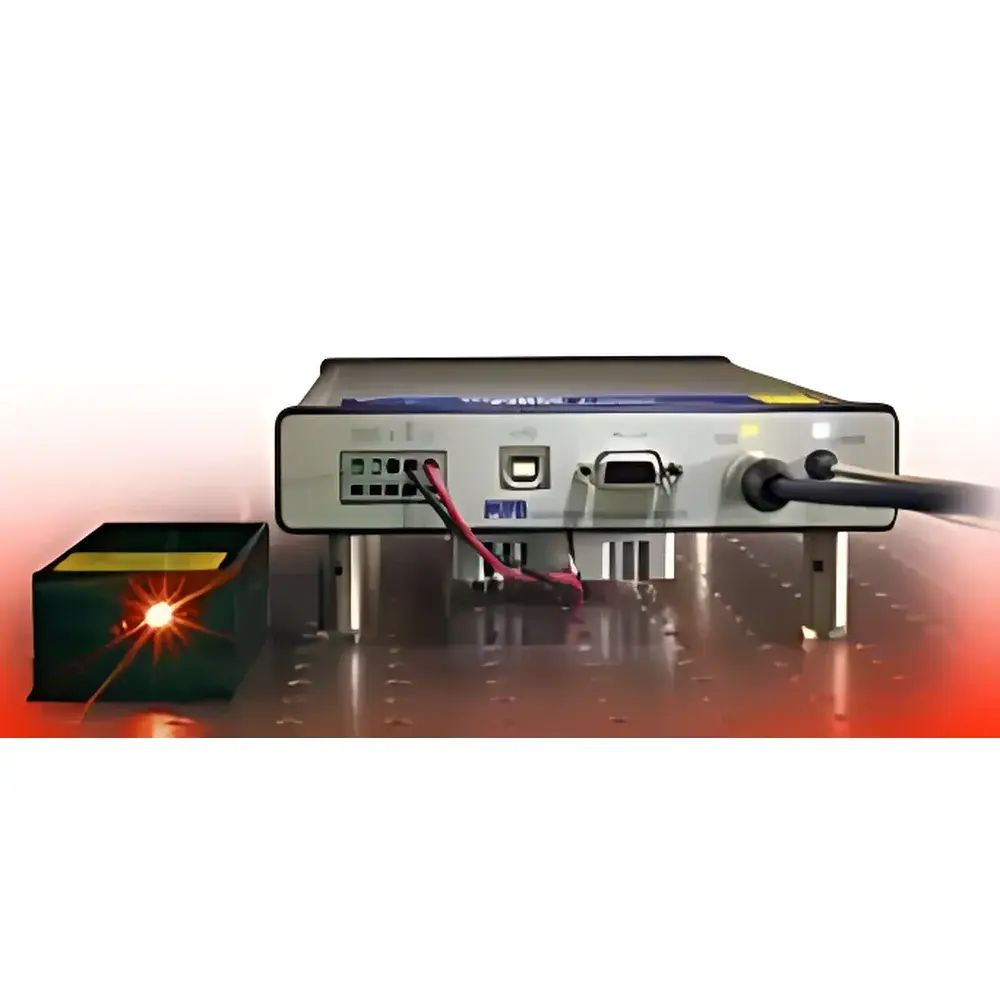
MPB VFL-P-200-628 Continuous-Wave 628 nm Fiber-Coupled Laser System
| Brand | MPB |
|---|---|
| Origin | Canada |
| Model | VFL-P-200-628 |
| Wavelength | 628 nm |
| Output Power | 200 mW |
| Beam Mode | TEM₀₀ |
| M² | ≤1.1 |
| Polarization | Linear, vertical to baseplate |
| Beam Divergence (full angle) | <5 mrad |
| Power Stability (rms, 8h) | ±0.5% |
| Wavelength Stability | ±0.02 nm |
| Control Interface | RS232 & USB |
| Cooling | Air-cooled |
| Form Factor | Benchtop or 2RU Rack-mountable (19", 23", ETSI compliant) |
| Safety | Interlock-enabled (benchtop) |
Overview
The MPB VFL-P-200-628 is a high-stability, continuous-wave (CW), fiber-coupled diode laser system engineered for precision optical applications requiring visible red emission at 628 nm. Operating on the principle of semiconductor gain medium amplification within a single-mode polarization-maintaining fiber output, this laser delivers diffraction-limited beam quality (TEM₀₀) with M² ≤1.1 and exceptional spectral purity. Its wavelength stability of ±0.02 nm (typ.) over 8 hours—achieved via thermally stabilized distributed feedback (DFB) diode architecture and active wavelength monitoring—ensures reproducible excitation conditions critical in quantitative fluorescence and resonance-sensitive measurements. Designed and manufactured in Canada by MPB Communications, a recognized developer of specialty fiber lasers, the VFL-P series integrates industrial-grade thermal management, electromagnetic compatibility (EMC)-compliant power electronics, and dual-interface digital control (RS232/USB) to support both laboratory integration and GxP-aligned deployment.
Key Features
- Stable CW output at 628 nm with narrow spectral linewidth (<0.1 nm FWHM), optimized for fluorophore excitation peaks in the orange-red region (e.g., Texas Red®, mCherry, Cy5)
- TEM₀₀ spatial mode with M² ≤1.1 and beam divergence <5 mrad (full angle), enabling efficient coupling into single-mode fibers and high-numerical-aperture microscope objectives
- Active power regulation from 20% to 100% of rated output (200 mW) with ≤0.5% RMS power fluctuation over 8 hours
- Dual digital control interface: RS232 for legacy instrument integration and USB 2.0 for plug-and-play connectivity with modern PCs and automated platforms
- Graphical user interface (GUI) supporting real-time monitoring of output power, diode temperature, and interlock status; configurable safety thresholds and logging intervals
- Air-cooled thermal design with intelligent fan speed modulation—no external chiller required—reducing footprint and operational complexity
- Compliance-ready mechanical configuration: benchtop version includes safety interlock circuitry; 2RU rackmount variant features integrated 100–240 VAC transformer, front-panel emergency stop, and ETSI/IEC 60297-3-100 mounting compatibility
Sample Compatibility & Compliance
The VFL-P-200-628 is compatible with standard SMF-28 or PM980 fiber pigtails (FC/APC or FC/PC connector options available). Its low-noise, intensity-stabilized output supports quantitative measurements in regulated environments. The system conforms to IEC 60825-1:2014 (Class 3B laser product), EN 61000-6-3 (emissions), and EN 61000-6-2 (immunity). For laboratories operating under GLP or ISO/IEC 17025, optional firmware enables audit-trail logging of power setpoints, runtime, and fault events—supporting traceability requirements analogous to FDA 21 CFR Part 11 principles when deployed with validated software workflows.
Software & Data Management
The included Windows-based GUI provides full remote control and data acquisition capabilities: users can schedule power ramps, trigger synchronized acquisitions via TTL input/output ports, and export timestamped power and temperature logs in CSV format. SDKs (C/C++, Python, LabVIEW) are provided for custom integration into MATLAB-based spectroscopy pipelines or NI TestStand test sequences. All firmware updates are digitally signed and delivered via secure HTTPS channel. Configuration files are encrypted and version-controlled to prevent unauthorized parameter changes—an essential feature for method-controlled environments.
Applications
- Fluorescence Microspectroscopy: Excitation of red-shifted fluorescent dyes and quantum dots with minimal photobleaching due to stable low-noise operation
- Flow Cytometry: Multi-laser alignment and compensation calibration using 628 nm as a reference channel for spectral unmixing algorithms
- Ophthalmic Imaging: Safe retinal stimulation and adaptive optics wavefront sensing in clinical research systems (Class 3B compliance verified per ANSI Z136.1)
- Raman Spectroscopy: Optional use as a secondary excitation source for resonance Raman enhancement in heme proteins and carotenoids
- Thin-Film Characterization: Ellipsometry and photoluminescence mapping where precise wavelength matching to absorption edges is required
- Laser Sintering R&D: Low-power process development for photosensitive polymer resins sensitive to 620–640 nm irradiation
FAQ
Is the 628 nm wavelength suitable for exciting common red fluorescent proteins?
Yes—628 nm aligns closely with the excitation maxima of mCherry (λex ≈ 587 nm), tdTomato (λex ≈ 554 nm), and Janelia Fluor® 635 derivatives, enabling efficient two-photon compatible single-photon excitation in widefield and confocal systems.
Can the laser be integrated into an automated microscopy platform?
Absolutely—the RS232 and USB interfaces support command-line protocols (SCPI-compliant syntax), and TTL synchronization I/O allows hardware-triggered start/stop functionality synchronized to camera exposure or stage motion controllers.
What is the expected lifetime of the laser diode under continuous operation?
MPB specifies >20,000 hours MTBF for the VFL-P series when operated within the recommended thermal envelope (20–30°C ambient, unrestricted airflow) and power range (20–100%).
Does the system include beam collimation optics?
Yes—all standard configurations ship with an adjustable, kinematic collimator pre-aligned to the fiber output, delivering a collimated beam with diameter ~1.2 mm and divergence <5 mrad.
Are higher power variants (e.g., 500 mW or 1000 mW) offered with identical beam specifications?
Yes—the VFL-P-500-628 and VFL-P-1000-628 maintain identical M², polarization, and wavelength stability specifications; only output power and thermal management subsystems are scaled accordingly.




