
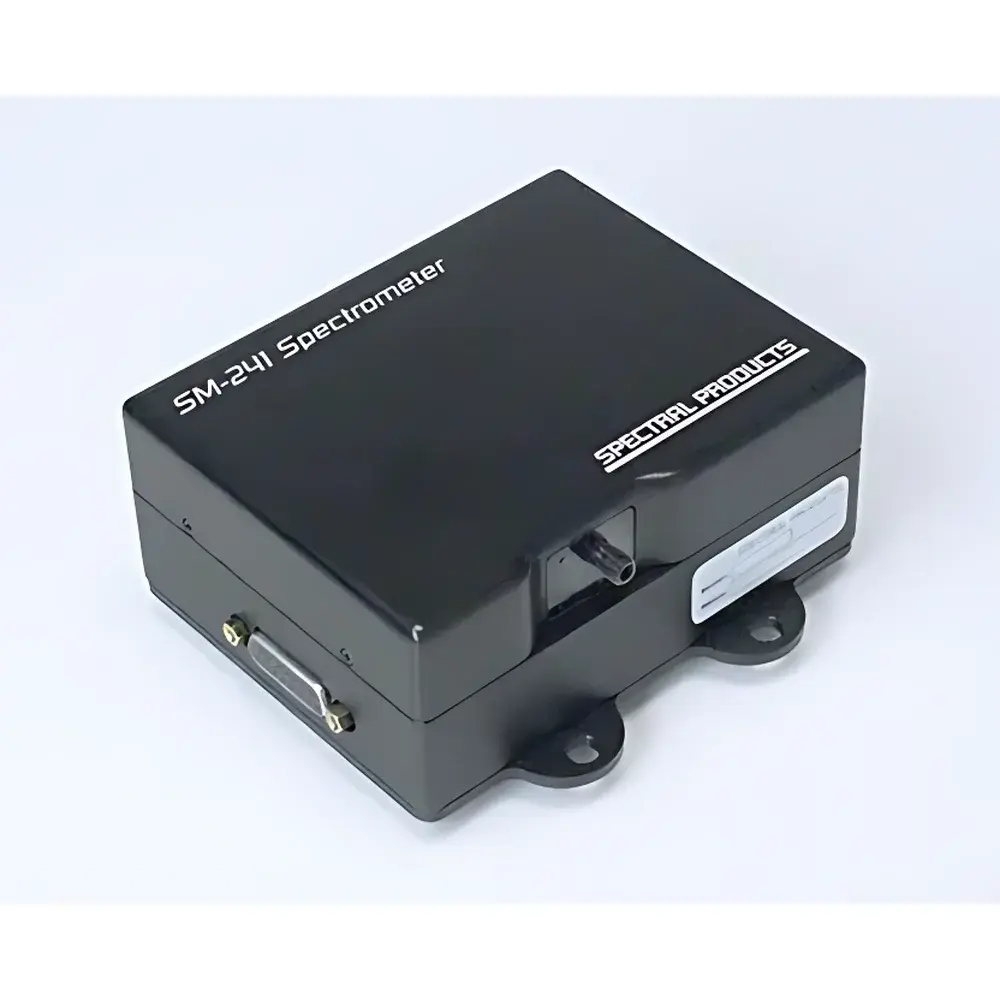
Spectral Products SM241 Near-Infrared Fiber Optic Spectrometer
| Brand | Spectral Products |
|---|---|
| Origin | USA |
| Manufacturer Type | Authorized Distributor |
| Import Status | Imported |
| Model | SM241 |
| Spectral Range | 900–1700 nm |
| Detector Type | CCD with IR-upconversion phosphor coating |
| Resolution | 1.0–10 nm (FWHM, configurable via slit and grating selection) |
| Sensitivity | High (enhanced beyond 1100 nm via proprietary upconversion coating) |
| Signal-to-Noise Ratio | >500:1 (at full integration, 900 nm), >150:1 (at 1600 nm, typical) |
| Dynamic Range | 16-bit (65,536:1 digitized range) |
| Stray Light | <10⁻³ (typical, 600 nm reference) |
Overview
The Spectral Products SM241 is a compact, fiber-coupled near-infrared (NIR) spectrometer engineered for high-fidelity spectral acquisition in the 900–1700 nm wavelength region. Unlike conventional silicon-based CCD spectrometers—whose quantum efficiency drops sharply beyond 1100 nm—the SM241 employs a proprietary infrared-upconversion phosphor coating applied directly to the CCD sensor surface. This enables photon-to-electron conversion of NIR photons (up to 1700 nm) into detectable visible-range emissions, effectively extending the usable spectral response while retaining the cost-efficiency, linearity, and stability of standard CCD architectures. The optical design features gold-coated mirrors and a ruled or holographic diffraction grating optimized for NIR throughput and minimal polarization dependence. Its modular platform supports both handheld deployment and rigid benchtop mounting, making it suitable for integration into OEM laser characterization systems, process monitoring setups, and laboratory-grade NIR spectroscopy applications where moderate resolution and high repeatability are required.
Key Features
- Fiber-optic input interface compatible with SMA 905 connectors—accepts direct coupling to slit or external fiber delivery
- 16-bit analog-to-digital conversion with USB 2.0 host interface and optional PCI card for legacy system integration
- Configurable spectral resolution from 1.0 nm to 10 nm (FWHM), adjusted via interchangeable slits and grating options
- Upconversion-enhanced CCD detector delivering measurable responsivity across the full 900–1700 nm band, with peak QE near 900 nm and usable response at 1600 nm under optimized integration conditions
- Optical stray light rejection better than 10⁻³ (measured per ASTM E275-21 guidelines using calibrated halogen source and bandpass filters)
- Thermally stabilized housing (passive design) minimizes wavelength drift (<0.05 nm/°C typical) during extended acquisitions
- Support for multi-channel synchronization: up to eight SM241 units can be triggered simultaneously via TTL-compatible external trigger input
Sample Compatibility & Compliance
The SM241 is designed for use with collimated or fiber-delivered light sources including tunable diode lasers, superluminescent LEDs (SLEDs), and broadband NIR lamps. It does not incorporate internal light sources or sample compartments; instead, it functions as a detection module within externally configured optical paths. Its performance complies with key elements of ISO/IEC 17025:2017 for spectrometer calibration traceability when used with NIST-traceable reference standards. While not certified for GMP environments out-of-the-box, its hardware architecture—including deterministic timing, non-volatile configuration storage, and firmware checksum validation—supports qualification under FDA 21 CFR Part 11 when integrated with compliant software platforms (e.g., validated SM32Pro deployments). The instrument meets CE marking requirements for electromagnetic compatibility (EN 61326-1) and low-voltage safety (EN 61010-1).
Software & Data Management
Spectral Products provides two primary software layers: SM32Pro—a fully featured Windows application supporting Windows 7 through 11 (32- and 64-bit)—and a comprehensive SDK including C/C++, Visual Basic, and LabVIEW-compatible DLLs. SM32Pro enables real-time spectral acquisition, baseline correction, absorbance/transmittance/reflectance calculation (with reference spectrum normalization), spectral overlay, signal averaging (up to 10,000 scans), and user-defined integration time control (1 ms to 65 s). All acquired datasets are saved in ASCII-compatible .txt or binary .spc formats, facilitating import into MATLAB, Python (NumPy/Pandas), or JMP for statistical modeling. Audit trail functionality—including operator ID, timestamp, instrument serial number, and acquisition parameters—is available when SM32Pro is deployed in “compliance mode” with external user authentication. Raw data buffers support lossless streaming at up to 120 spectra/sec over USB 2.0, enabling time-resolved NIR monitoring in dynamic processes.
Applications
The SM241 serves critical roles in laser diode characterization (wavelength stability, side-mode suppression ratio, and linewidth estimation), NIR absorption spectroscopy of organic solvents and polymers, moisture content analysis in pharmaceutical granules, and quality assurance of telecom components (e.g., FBG interrogation, WDM filter testing). Its compact footprint and fiber-input flexibility make it ideal for field-deployable instrumentation, embedded OEM systems, and teaching laboratories requiring accessible NIR spectral access without cryogenic cooling or exotic detector materials. Due to its sensitivity profile—optimized for narrowband, high-intensity sources—it is particularly well-suited for applications involving pulsed or CW lasers operating between 1064 nm and 1550 nm, where SNR and temporal reproducibility outweigh ultra-broadband coverage requirements.
FAQ
Is the SM241 suitable for measuring broadband NIR sources such as tungsten-halogen lamps?
While functional, its upconversion-enhanced CCD exhibits reduced quantum efficiency above 1400 nm; for broadband measurements requiring uniform responsivity across 900–1700 nm, thermoelectrically cooled InGaAs detectors remain the metrological standard.
Can the SM241 be calibrated for radiometric accuracy?
Yes—when paired with NIST-traceable tungsten-halogen or deuterium lamp standards and calibrated using Spectral Products’ optional Radiometric Calibration Kit (P/N RCAL-SM241), it achieves ±5% absolute irradiance uncertainty in the 900–1350 nm range.
Does the USB interface support isochronous data transfer for real-time triggering?
Yes—the firmware implements hardware-level trigger synchronization with sub-microsecond jitter, and USB endpoints are configured for bulk transfer with guaranteed latency under Windows Driver Framework (WDF) compliance.
What is the maximum recommended integration time before dark current dominates the signal at 1600 nm?
At ambient temperature (25°C), dark current accumulation becomes significant beyond 10 seconds integration; active cooling is not supported, so users should apply dark-frame subtraction and limit integration to ≤5 s for optimal SNR in long-wavelength acquisitions.
Are grating and slit options user-replaceable in the field?
Yes—optical modules are mechanically standardized and tool-free exchangeable; Spectral Products offers six pre-aligned grating options (300–1200 grooves/mm) and four slit widths (10–200 µm), all with factory-measured LSF and calibration files included.







