
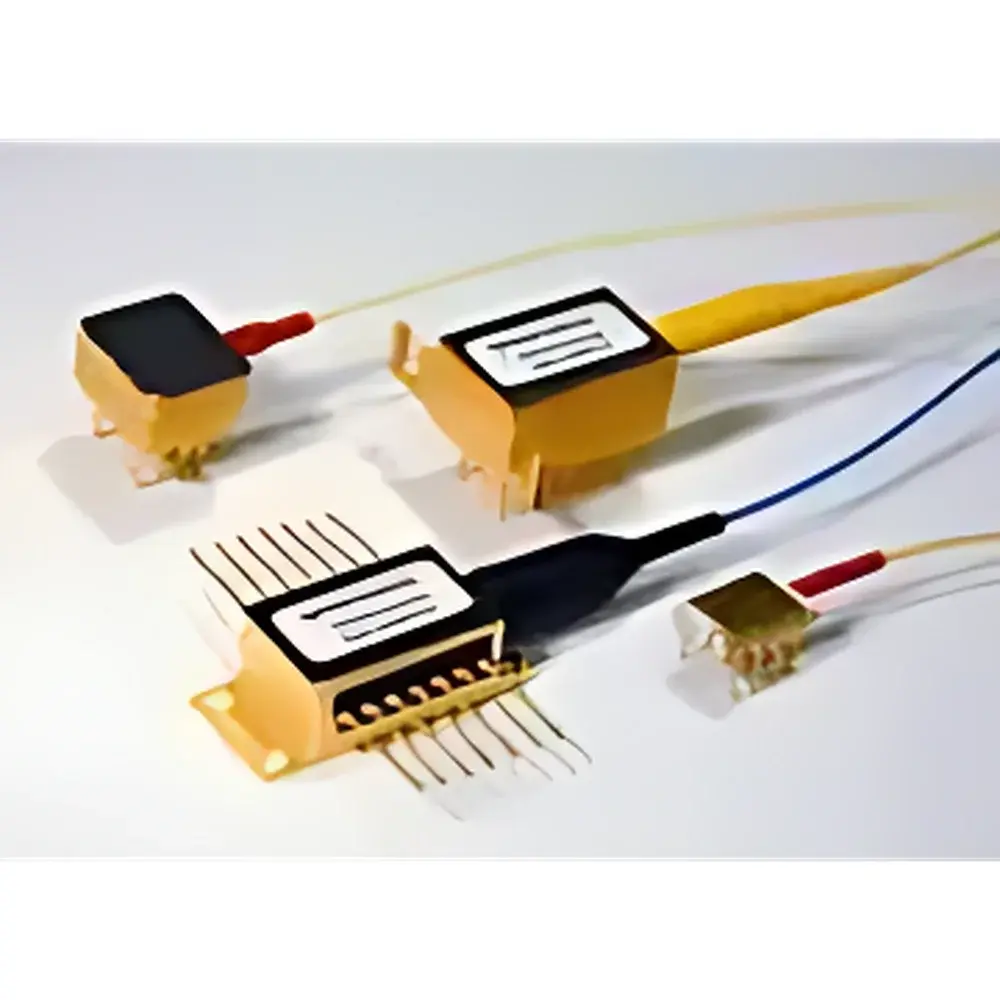
Qphotonics FBG Single-Frequency Laser Diode
| Brand | Qphotonics |
|---|---|
| Origin | USA |
| Manufacturer Type | Authorized Distributor |
| Product Origin | Imported |
| Model | FBG Series |
| Light Source Type | Semiconductor Laser Diode (FBG-Stabilized) |
| Wavelength Range | 405–1650 nm |
| Output Power Range | 0.5–350 mW |
| Spectral Linewidth | ≤500 kHz (typical), up to 10 MHz (select models) |
| Tuning Range | ±0.05 nm (center wavelength) |
| Package Options | 14-pin DIL or Butterfly |
| Fiber Options | Single-mode or Polarization-Maintaining (PM) |
| Connector | FC/PC or FC/APC |
| Built-in Components | Thermistor, TEC, Monitor Photodiode |
| Rise Time | 0.5 ns |
| Operating Mode | CW or Pulsed |
Overview
The Qphotonics FBG Single-Frequency Laser Diode is a precision-stabilized semiconductor laser source engineered for applications demanding narrow linewidth, high wavelength stability, and low relative intensity noise (RIN). Unlike conventional Fabry–Pérot or multi-mode diodes, these devices integrate a monolithically fabricated Fiber Bragg Grating (FBG) directly into the laser cavity or as an external feedback element—enabling robust single longitudinal mode (SLM) operation without external optical isolation or complex locking electronics. The FBG acts as a highly selective wavelength-selective reflector, suppressing side modes and ensuring stable, mode-hop-free output across temperature and current variations. Designed for integration into fiber-optic sensing systems, coherent communications testbeds, atomic physics setups (e.g., Rb or Cs vapor cell spectroscopy), and metrology-grade interferometers, this series delivers deterministic spectral performance in compact, industry-standard packages.
Key Features
- Single-frequency operation with spectral linewidth ≤500 kHz (standard), down to <100 kHz in optimized butterfly-packaged variants
- Wavelength coverage from 405 nm to 1650 nm—including visible (635 nm), NIR (780–1080 nm), and telecom bands (1300 nm, 1460 nm, 1550 nm, 1650 nm)
- Output power options ranging from 0.5 mW (low-noise alignment sources) to 350 mW (high-power sensing or pumping applications)
- Integrated thermistor and thermoelectric cooler (TEC) enable precise temperature control (±0.01 °C stability), critical for sub-picometer wavelength repeatability
- On-board monitor photodiode provides real-time power feedback for closed-loop current/temperature control systems
- Available in both 14-pin dual-in-line (DIL) and hermetically sealed butterfly packages—optimized for OEM integration and long-term reliability under thermal cycling
- Choice of single-mode (SMF-28) or polarization-maintaining (PANDA or Bowtie) fiber pigtails, terminated with FC/PC or angled FC/APC connectors to minimize back-reflection
- Rise time of 0.5 ns supports nanosecond-scale pulsed operation for time-resolved spectroscopy or LIDAR seed applications
Sample Compatibility & Compliance
This laser diode series is compatible with standard fiber-coupled optical components including isolators, modulators, circulators, and interferometric sensors. All units comply with RoHS 2011/65/EU directives and meet IEC 60825-1:2014 Class 3B laser safety requirements when operated within specified current and temperature limits. Device-level calibration data—including wavelength vs. temperature curves, power-current-voltage (LIV) characteristics, and spectral stability over 1000-hour burn-in—are supplied with each unit. For regulated environments (e.g., ISO/IEC 17025-accredited labs or FDA-regulated instrumentation), traceable NIST-traceable wavelength calibration certificates are available upon request. While not pre-certified for specific medical or aerospace standards, the modular design facilitates integration into systems compliant with DO-160, MIL-STD-810, or IEC 61000-4 EMC requirements when paired with appropriate driver and housing solutions.
Software & Data Management
Qphotonics provides comprehensive driver compatibility documentation for third-party laser controllers (e.g., Thorlabs LDCxx, Wavelength Electronics LDTCxx, ILX Lightwave LDX-3620) supporting analog/digital modulation, temperature ramping, and interlock monitoring. No proprietary software is required; all operational parameters—including drive current (0–200 mA typical), TEC setpoint (−10 °C to +50 °C), and photodiode monitor voltage—are accessible via standard 0–5 V analog interfaces or RS-232/USB protocols. For automated test systems, LabVIEW™, Python (PyVISA), and MATLAB® drivers are available through the Qphotonics Developer Portal. Audit trails for wavelength drift, power degradation, and thermal history can be logged externally using timestamped analog outputs—supporting GLP/GMP-aligned instrument qualification per ASTM E2500 and USP guidelines.
Applications
- Fiber-optic distributed acoustic sensing (DAS) and strain/temperature monitoring using Φ-OTDR or Brillouin-based interrogation
- Cold atom trapping and optical lattice experiments requiring ultra-narrow linewidth and frequency agility
- High-resolution absorption spectroscopy of trace gases (e.g., CH₄, CO₂, NH₃) in environmental monitoring or industrial process control
- Coherent optical time-domain reflectometry (C-OTDR) for submarine cable fault localization
- Seed lasers for MOPA-based ultrafast amplifiers operating at 1030 nm, 1064 nm, or 1550 nm
- Calibration references for optical spectrum analyzers (OSAs) and wavemeters in metrology laboratories
- Interferometric biosensors leveraging phase-sensitive detection in label-free molecular binding assays
FAQ
What distinguishes an FBG-stabilized laser diode from a DFB or DBR device?
FBG stabilization uses a discrete, photosensitive grating written into passive fiber spliced directly to the laser chip, offering broader wavelength flexibility and higher power handling than monolithic DFBs—while maintaining comparable linewidth and side-mode suppression ratio (SMSR >50 dB).
Can these lasers be used in continuous-wave (CW) and pulsed modes simultaneously?
Yes—devices support both CW operation and direct current modulation up to 1 GHz (depending on package parasitics); however, pulse fidelity and extinction ratio must be validated per model using appropriate drivers and impedance-matched circuits.
Is wavelength tuning possible beyond the specified ±0.05 nm range?
Fine tuning (sub-pm) is achievable via temperature (0.1 pm/°C typical) and coarse tuning (up to ±1 nm) via injection current—though mode hops may occur outside the FBG’s reflection bandwidth; consult the datasheet for mode-hop-free tuning maps.
Do you offer custom wavelengths outside the listed ranges?
Yes—Qphotonics supports custom FBG design and packaging for wavelengths between 405 nm and 1650 nm, subject to minimum order quantities and lead time validation.
What is the typical lifetime under rated operating conditions?
MTTF exceeds 50,000 hours at 25 °C case temperature and 70% of maximum rated current, per Telcordia GR-468-CORE reliability testing protocols.




