
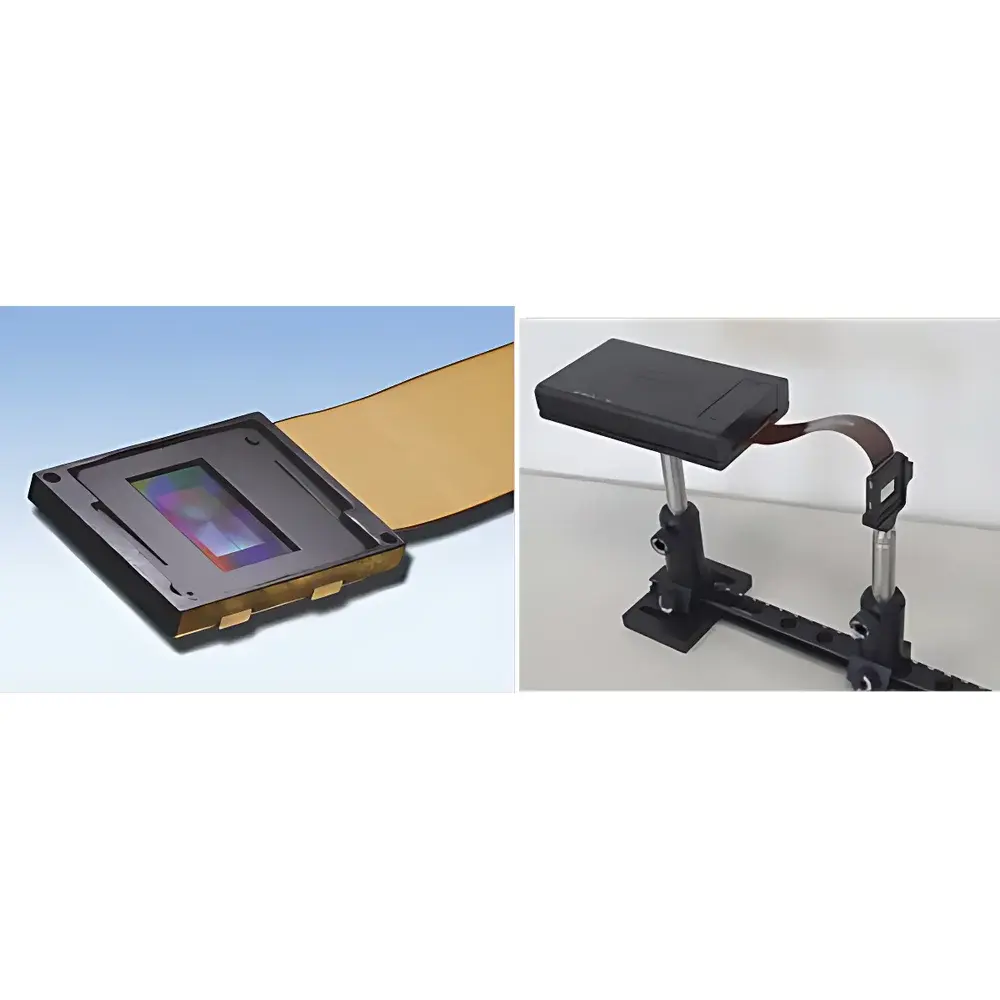
Holoeye PLUTO-2.1-VIS-014 Pure-Phase Spatial Light Modulator
| Brand | Holoeye |
|---|---|
| Origin | Germany |
| Model | PLUTO-2.1-VIS-014 |
| Resolution | 1920 × 1080 pixels |
| Pixel Pitch | 8 µm |
| Wavelength Range | Visible (VIS), optimized for ~400–700 nm |
| Interface | USB-controlled gamma/dynamic range calibration + HDMI/DisplayPort video input |
| Bit Depth | 8-bit grayscale addressing (via green channel) |
| Hot-Swappable Operation | Yes |
| Compliance | CE, RoHS |
Overview
The Holoeye PLUTO-2.1-VIS-014 is a high-resolution, pure-phase spatial light modulator (SLM) engineered for precision wavefront shaping in visible-light optical systems. Based on transmissive liquid crystal on silicon (LCoS) technology, it operates exclusively in phase-only modulation mode—enabling diffraction-limited control of optical phase profiles without introducing significant amplitude distortion. With a native resolution of 1920 × 1080 pixels and a pixel pitch of 8 µm, the device provides a total active aperture of approximately 15.36 mm × 8.64 mm, supporting fine spatial sampling of complex holograms, beam steering patterns, and adaptive optics masks. Its design targets laboratory-scale applications requiring deterministic, repeatable phase modulation—including digital holography, optical trapping, structured illumination microscopy, vortex beam generation, and real-time wavefront correction experiments. The SLM is calibrated for optimal performance across the visible spectrum (400–700 nm), with factory-tuned voltage-response characteristics ensuring linearized phase response at designated wavelengths.
Key Features
- Pure-phase LCoS architecture with >2π phase stroke across the visible band, enabling high-diffraction-efficiency holographic reconstruction
- Native 1920 × 1080 pixel resolution and 8 µm pixel pitch—optimized for compatibility with standard 1:1 imaging optics and Fourier-plane filtering setups
- USB-controlled gamma calibration interface: allows dynamic adjustment of gray-level-to-voltage mapping to maintain phase fidelity across varying operating wavelengths
- Hot-pluggable operation via standard graphics card output (HDMI or DisplayPort); phase patterns loaded as 8-bit grayscale images using the green channel only
- Integrated driver unit with firmware-upgradable calibration tables—supports user-defined wavelength-specific phase maps and multi-wavelength sequence switching
- CE- and RoHS-compliant construction; designed for integration into ISO-classified optical benches and vibration-isolated interferometric environments
Sample Compatibility & Compliance
The PLUTO-2.1-VIS-014 is compatible with collimated visible-light beams up to Ø12 mm diameter and supports continuous-wave (CW) and pulsed laser sources with average power densities below 1 W/cm². It requires no external cooling under standard lab conditions (20–25 °C ambient, <60% RH). As an optical component—not a standalone measurement instrument—it does not require FDA clearance or IEC 61000-4 electromagnetic immunity certification for integration into larger systems. However, its CE marking confirms conformity with EU directives on electromagnetic compatibility (2014/30/EU) and low-voltage safety (2014/35/EU). When deployed in GLP- or GMP-aligned research workflows (e.g., optical metrology validation or biophotonics assay development), the device supports traceable calibration logs via USB-accessible firmware registers and timestamped gamma-table versioning.
Software & Data Management
Holoeye provides the proprietary SLM Display Software (v3.x), a Windows-based application enabling real-time phase pattern generation, GPU-accelerated hologram calculation (Gerchberg-Saxton, direct binary search), and hardware-synchronized frame sequencing. The software exports phase maps in standard BMP/TIFF formats and supports batch scripting via Python COM interface. For custom integration, low-level USB command protocols are documented in the Developer’s Guide, permitting full control over gamma curve selection, frame rate (up to 60 Hz native, lower for high-fidelity phase ramping), and internal look-up table (LUT) uploads. All calibration data—including per-wavelength voltage-phase transfer functions—is stored non-volatilely in onboard memory and can be exported for audit trails in regulated environments.
Applications
- Digital holographic microscopy (DHM): programmable reference wavefront generation and object beam modulation
- Optical tweezers and micromanipulation: dynamic holographic optical trapping (HOT) with multi-point trap reconfiguration at video rates
- Adaptive optics testbeds: closed-loop wavefront sensing and correction using Shack-Hartmann or interferometric feedback
- Vortex and Bessel beam synthesis: precise topological charge encoding and propagation-invariant beam shaping
- Structured illumination super-resolution (SIM): real-time pattern projection with sub-pixel phase stepping capability
- Educational optics labs: hands-on demonstration of Fourier optics, diffraction theory, and coherent image processing principles
FAQ
Is the PLUTO-2.1-VIS-014 suitable for pulsed laser applications?
Yes—provided pulse energy density remains below 10 mJ/cm² for nanosecond pulses and peak intensities stay within the manufacturer’s specified damage threshold for VIS-band LCoS devices.
Can multiple PLUTO units be synchronized for multi-plane holography?
Synchronization is achievable via external TTL trigger input (optional add-on module) and frame-locking through shared graphics card outputs, though inter-unit phase drift must be compensated in software.
Does the device support 12-bit or higher phase addressing?
No—the hardware accepts only 8-bit grayscale input; however, temporal dithering techniques implemented in host software can effectively extend effective phase resolution.
What is the typical phase stability over 1-hour operation?
Under constant temperature and stable drive voltage, RMS phase deviation is ≤0.02π rad when operated within calibrated gamma settings and at frame rates ≤30 Hz.
Is MATLAB or Python API officially supported?
Yes—Holoeye provides documented COM interface bindings for MATLAB and native Python wrappers (via PyWin32 on Windows), enabling automated experiment control and real-time phase map streaming.





