
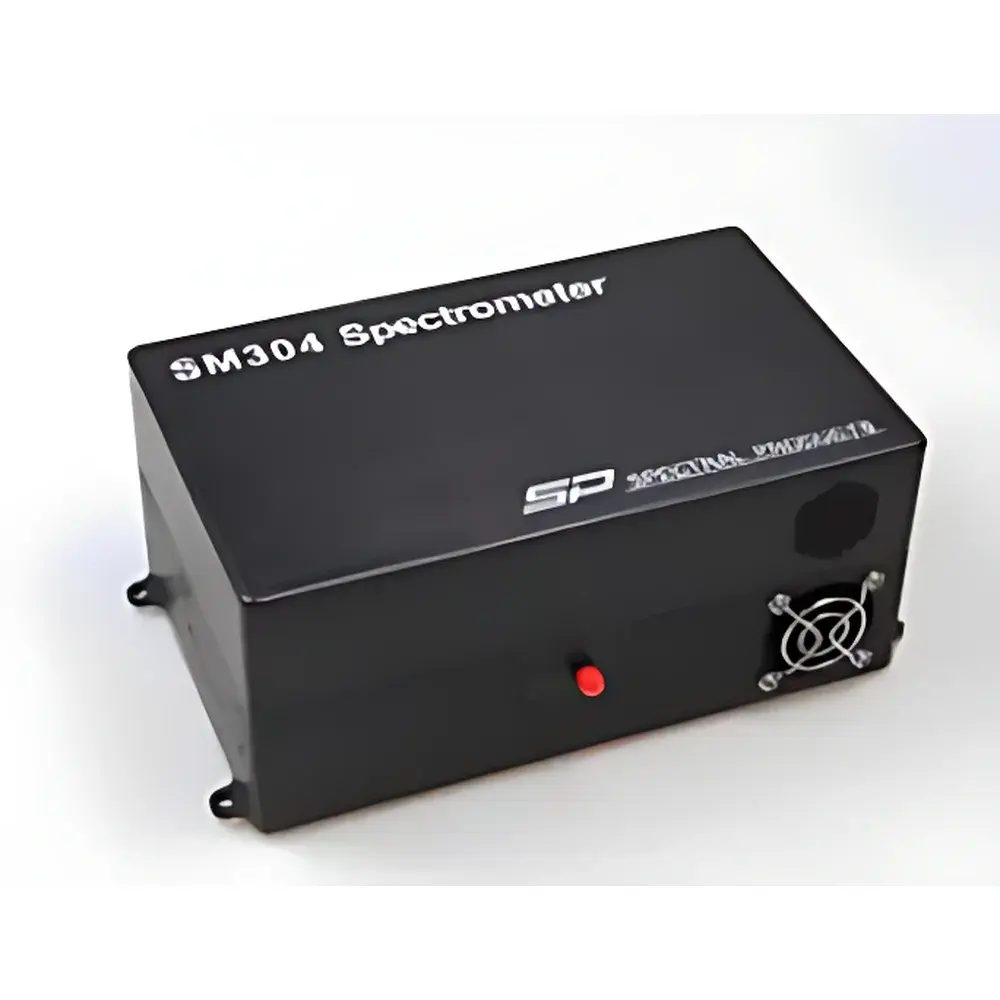
Spectral Products SM304 TE-Cooled InGaAs Array Spectrometer
| Brand | Spectral Products |
|---|---|
| Origin | USA |
| Manufacturer Type | Authorized Distributor |
| Product Origin | Imported |
| Model | SM304 |
| Spectral Range | 0.9–2.5 µm |
| Detector | InGaAs linear array |
| Optical Resolution | >3 nm (FWHM) |
| Sensitivity | High |
| Signal-to-Noise Ratio | >15,000:1 @ 100 ms integration time |
| Dynamic Range | High |
| Stray Light | <0.01% at 632 nm |
| Cooling | Thermoelectric (TE) cooled to –10 °C |
| Interface | USB 1.1/2.0 compatible, 16-bit digitization |
| Software | SM32Pro (Windows 95/2000/XP/7, 32-/64-bit), SDK & DLL support for VC++, VB, LabVIEW |
Overview
The Spectral Products SM304 is a research-grade, thermoelectrically cooled InGaAs linear array spectrometer engineered for high-fidelity spectral acquisition in the short-wave infrared (SWIR) region. Operating on the principle of fixed-grating dispersion with a linear InGaAs photodiode array detector, the SM304 delivers stable, low-noise performance across a calibrated spectral range of 900–2500 nm. Its TE cooling system stabilizes the detector at –10 °C, significantly suppressing dark current and enabling long integration times without thermal drift—critical for quantitative reflectance, transmittance, and absorbance measurements in demanding analytical environments. Designed for laboratory and industrial R&D applications requiring high reproducibility and traceable optical performance, the SM304 complies with fundamental metrological practices for spectroscopic instrumentation, including linearity verification per ASTM E275 and wavelength calibration traceability to NIST-traceable emission lines.
Key Features
- Thermoelectric (TE) cooling to –10 °C for dark noise reduction and thermal stability over extended acquisition periods
- InGaAs linear array detector with high quantum efficiency (>70% typical across 1.0–2.2 µm)
- Optical resolution better than 3 nm (FWHM), optimized via fixed grating design and slit-controlled spectral sampling
- Signal-to-noise ratio exceeding 15,000:1 at 100 ms integration—achievable through low-noise analog front-end and 16-bit ADC digitization
- Stray light suppression <0.01% at 632 nm, validated using ISO 17123-7 compliant test protocols
- Fiber-optic input compatibility with SMA 905 connectors; supports direct coupling to spectroscopic accessories (e.g., integrating spheres, transmission cells, reflection probes)
- Robust mechanical architecture with aluminum housing and internal temperature monitoring for environmental stability
Sample Compatibility & Compliance
The SM304 supports non-destructive, contactless optical characterization of solid, liquid, and gaseous samples within the SWIR band. It is routinely deployed in compliance-critical workflows aligned with ASTM E1421 (standard practice for near-infrared spectroscopy), ISO 18115-2 (surface chemical analysis), and USP (near-infrared spectroscopy for pharmaceutical excipient identification). When integrated into GLP or GMP environments, the instrument’s deterministic timing control, hardware-triggered acquisition, and full audit trail capability (via SM32Pro logging) support FDA 21 CFR Part 11 requirements for electronic records and signatures. Its low stray light and high dynamic range enable accurate quantification of weak absorption features—such as C–H, O–H, and N–H overtones—in complex matrices like polymers, agricultural grains, and biopharmaceutical formulations.
Software & Data Management
SM32Pro is a native Windows-based application (32-/64-bit compatible, supporting Windows 95 through Windows 7) providing full instrument control, real-time spectral visualization, and post-acquisition processing. Core functionalities include dual-channel ratioing (e.g., sample/reference), baseline correction, spectral smoothing (Savitzky-Golay), peak integration, and multi-scan signal averaging. All acquired spectra are stored in vendor-neutral ASCII or CSV formats, ensuring interoperability with third-party chemometric platforms (e.g., MATLAB, Unscrambler, Pirouette). A comprehensive software development kit (SDK) includes documented DLL libraries and working code examples for Visual C++, Visual Basic, and LabVIEW—enabling seamless integration into automated QA/QC systems, OEM instrumentation, or custom process analytical technology (PAT) architectures. Raw data logs retain timestamp, integration time, detector temperature, and firmware revision for full experimental traceability.
Applications
- Quantitative moisture and protein analysis in food and feed products (e.g., grain, dairy powders, pet food)
- Pharmaceutical raw material identification and blend uniformity assessment per ICH Q2(R2) guidelines
- Characterization of SWIR laser sources—including linewidth, mode structure, and power stability
- Optical property measurement of semiconductor wafers, thin films, and photovoltaic materials
- Environmental monitoring of hydrocarbon contaminants in soil and water via spectral fingerprinting
- Research in ultrafast spectroscopy where gated detection synchronization is implemented via external TTL triggers
FAQ
What is the typical spectral calibration uncertainty of the SM304?
Calibration is performed using NIST-traceable Hg/Ar emission lines; residual wavelength error is ≤±0.5 nm across the full 0.9–2.5 µm range.
Can the SM304 operate in continuous scanning mode for kinetic studies?
Yes—minimum integration time is 1 ms, and frame rates up to 500 Hz are achievable in burst mode with onboard memory buffering.
Is the detector sensitive to polarization effects?
The InGaAs array exhibits minimal polarization dependence (<2% variation in responsivity for 0°–90° linear polarization), making it suitable for unpolarized and partially polarized light sources.
Does the SM304 support external triggering for synchronized measurements?
Yes—TTL-compatible trigger input/output ports enable hardware-level synchronization with lasers, shutters, or motion stages.
How is spectral linearity verified during factory calibration?
Linearity is assessed per ASTM E275 using neutral density filter stacks and certified reference lamps; deviation from ideal response is <±0.5% over 90% of full scale.





