
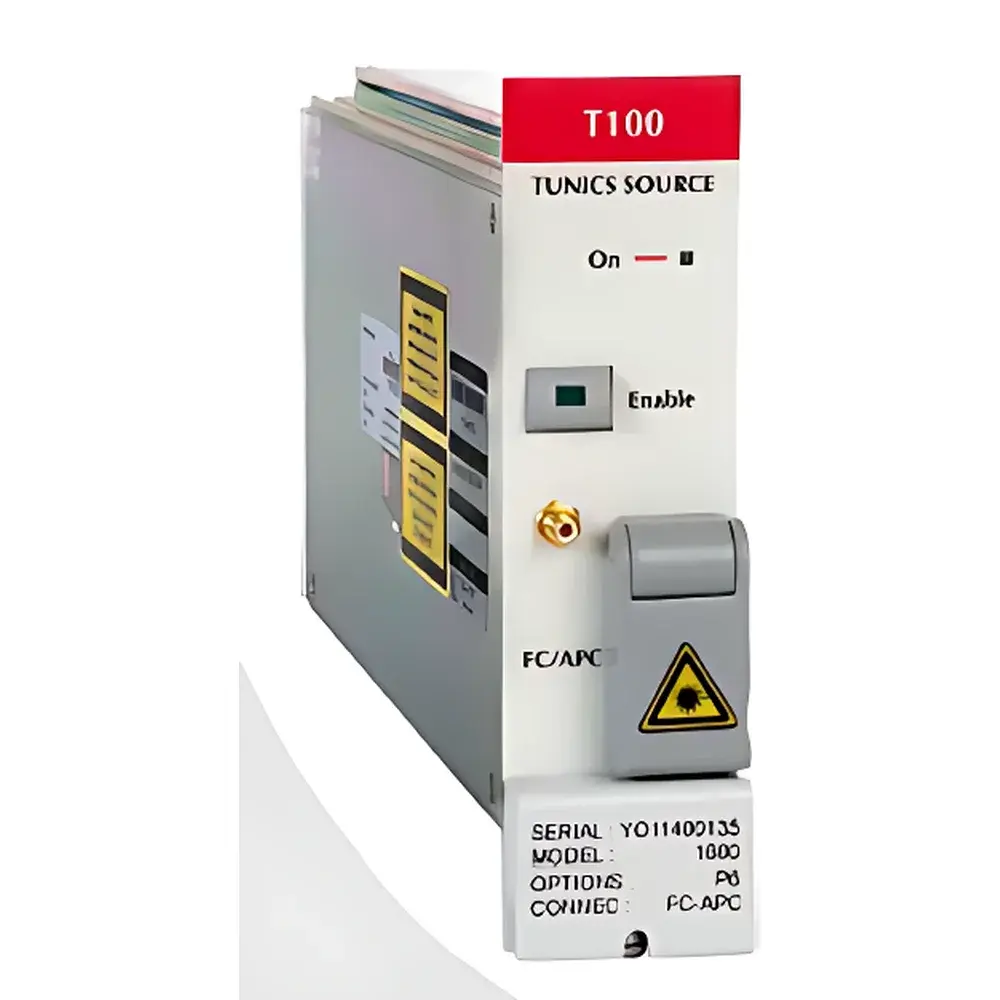
Yenista OSICS T100 Narrow-Linewidth Tunable Laser Source
| Brand | Yenista |
|---|---|
| Origin | France |
| Model | OSICS T100 |
| Laser Type | External Cavity Semiconductor Laser (ECSL) |
| Tuning Range | ≥100 nm (O/E/S/C/L/U bands) |
| Output Power | +6 dBm |
| Spectral Linewidth | <100 kHz (typ.) |
| Relative Intensity Noise (RIN) | <−170 dB/Hz (typ.) |
| Tuning Speed | <50 ms (full range) |
| Modulation Bandwidth | DC to 1 MHz |
| Interface | Front-panel keypad & LCD, RS-232, USB, Ethernet (SCPI-compliant) |
| Compliance | CE, RoHS, IEC 61000-6-3, IEC 61000-6-4 |
Overview
The Yenista OSICS T100 is a high-performance, external cavity semiconductor laser (ECSL) source engineered for precision optical testing, coherent communications characterization, and advanced photonic research. Based on Yenista’s proprietary T100 monolithic cavity architecture, the module delivers exceptional spectral purity and long-term wavelength stability without requiring active thermal or mechanical feedback loops. Its fundamental operating principle relies on Littrow-configuration diffraction grating feedback within a rigid, athermalized cavity—enabling sub-kHz-level intrinsic linewidths and ultra-low relative intensity noise (RIN). Designed for integration into automated test systems or benchtop optical laboratories, the OSICS T100 supports continuous, mode-hop-free tuning across ≥100 nm—spanning the O-, E-, S-, C-, L-, and U-bands (1260–1675 nm)—making it uniquely suited for multi-band DWDM component validation, optical coherence tomography (OCT) source development, and interferometric sensor calibration.
Key Features
- External cavity design with monolithic T100 resonator for enhanced mechanical and thermal stability
- Continuous, mode-hop-free tuning over ≥100 nm across six ITU-defined telecom bands (O/E/S/C/L/U)
- Typical output power of +6 dBm into single-mode fiber (SMF-28), with optional integrated isolator
- Spectral linewidth <100 kHz (measured via delayed self-heterodyne interferometry), enabling high-fidelity coherent detection
- Ultra-low RIN performance (<−170 dB/Hz, 10 MHz–1 GHz), critical for low-noise photonic measurements and analog optical links
- Analog and digital modulation support up to 1 MHz (direct current injection and external TTL/CMOS input)
- Dual-control architecture: intuitive front-panel operation with 4-line LCD and membrane keypad, plus full SCPI command set over RS-232, USB, and Ethernet interfaces
- Integrated safety interlocks compliant with IEC 60825-1 Class 1 requirements when used with appropriate fiber termination
Sample Compatibility & Compliance
The OSICS T100 is optimized for coupling into standard single-mode fibers (ITU-T G.652.D, G.657.A1) and compatible with polarization-maintaining (PM) fiber variants upon request. It meets essential electromagnetic compatibility (EMC) and safety standards for laboratory and industrial environments, including CE marking per Directive 2014/30/EU (EMC) and 2014/35/EU (LVD), RoHS 2011/65/EU, and IEC 61000-6-3 (emission) / IEC 61000-6-4 (immunity). While not certified for medical or aviation use out-of-the-box, its stable spectral output and deterministic tuning behavior align with GLP-aligned optical metrology workflows and support traceable calibration against NIST-traceable wavemeters (e.g., Burleigh WA-1100 or EXFO WA-1650).
Software & Data Management
Yenista provides the OSICS Control Suite—a Windows-based application supporting real-time wavelength monitoring, power stabilization routines, sweep sequencing, and data logging in CSV and HDF5 formats. The instrument implements full SCPI-1999 compliance (IEEE 488.2), enabling seamless integration with LabVIEW, MATLAB, Python (via PyVISA), and TestStand. Audit trail functionality—including timestamped parameter changes, user login tracking, and configuration snapshots—is available through optional firmware upgrade for labs operating under FDA 21 CFR Part 11 or ISO/IEC 17025 requirements. All firmware updates are delivered via signed .bin packages with SHA-256 verification.
Applications
- Characterization of optical filters, multiplexers/demultiplexers (AWG, TFF, PLC), and tunable transceivers across C+L band
- Coherent receiver testing and local oscillator (LO) sourcing for QPSK/QAM signal analysis
- High-resolution spectroscopy and cavity ring-down measurements requiring narrow-linewidth, low-phase-noise sources
- Calibration of optical spectrum analyzers (OSAs), interferometric wavelength meters, and chromatic dispersion analyzers
- Development and validation of photonic integrated circuits (PICs), especially those incorporating Mach–Zehnder modulators or microresonators
- Time-domain reflectometry (OTDR) reference source enhancement and distributed acoustic sensing (DAS) system evaluation
FAQ
What is the typical tuning repeatability of the OSICS T100?
Tuning repeatability is ±0.5 pm over 24 hours at constant ambient temperature (23 ±0.5 °C), verified using an optical frequency comb referenced wavemeter.
Can the OSICS T100 be integrated into a rack-mounted ATE system?
Yes—the unit features 19-inch 1U chassis mounting options, rear-panel I/O connectors, and programmable trigger synchronization (TTL input/output) for precise timing alignment with other instruments.
Is polarization control available as a factory option?
Standard output is unpolarized; however, PM-fiber-pigtailed versions with >20 dB PER and adjustable fast-axis alignment are available upon request.
Does the laser support automatic wavelength locking to an external reference?
While not built-in, the analog monitor photodiode output and wavelength readback via SCPI enable third-party PID loop implementation using external controllers (e.g., Thorlabs K-Cube or custom FPGA platforms).
What maintenance is required for long-term operational stability?
No routine maintenance is specified; the T100 cavity is hermetically sealed and qualified for >50,000 hours MTBF under continuous operation at rated conditions.





