
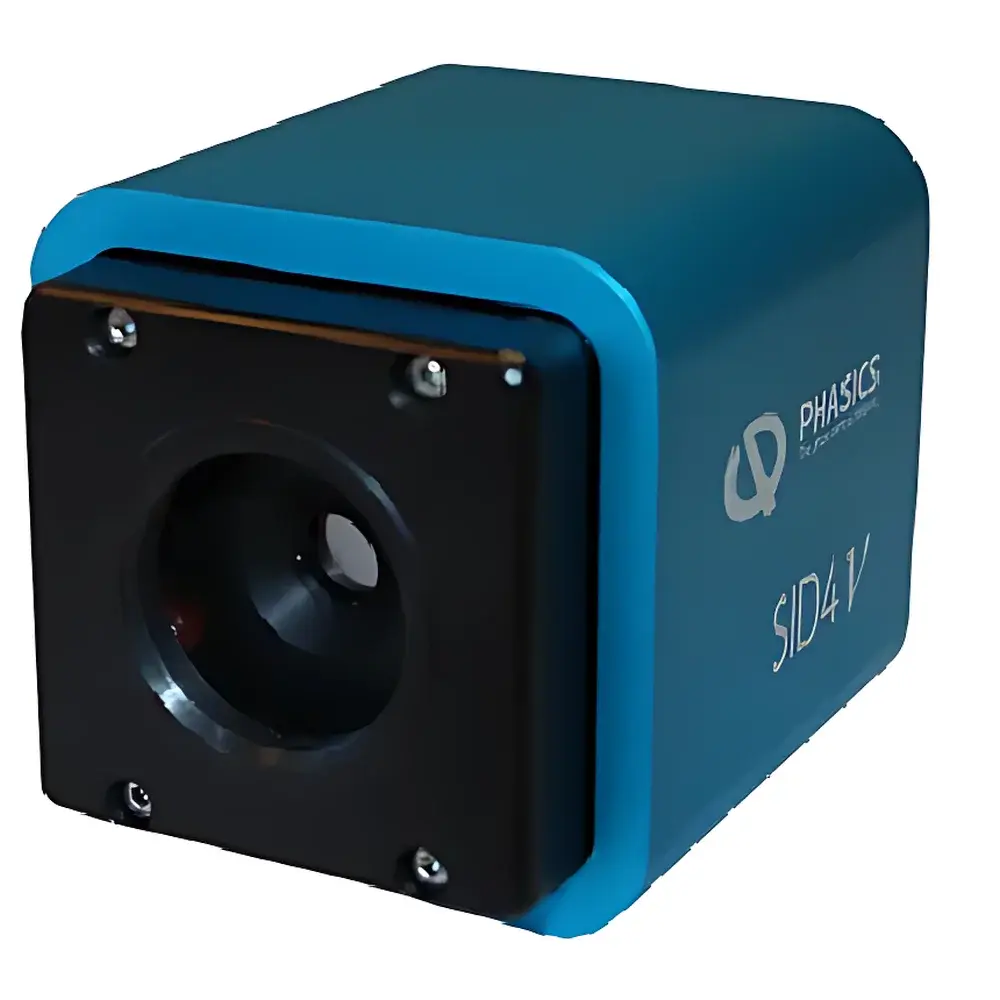
Phasics SID4-V Vacuum-Compatible Wavefront Sensor
| Brand | Phasics |
|---|---|
| Origin | France |
| Model | SID4-V |
| Vacuum Compatibility | < 10⁻⁶ mbar |
| Wavelength Range | 400–1100 nm |
| Aperture | 4.73 × 3.55 mm² |
| Phase Sampling | 160 × 120 points (>19,000) |
| Spatial Resolution | 29.6 µm |
| Phase Accuracy | 15 nm RMS |
| Phase Sensitivity | <2 nm RMS |
| Dynamic Range | >100 µm |
| Frame Rate | ≥60 fps (acquisition), ≥7 Hz (full-resolution real-time processing) |
| Interface | Gigabit Ethernet |
| Dimensions | 54 × 46 × 75.3 mm |
| Weight | ~250 g |
Overview
The Phasics SID4-V is a vacuum-compatible wavefront sensor engineered for quantitative, in-situ optical metrology under ultra-high vacuum (UHV) conditions down to <10⁻⁶ mbar. Unlike conventional Shack-Hartmann or interferometric sensors, the SID4-V employs Phasics’ proprietary four-wave lateral shearing interferometry (4-LSI), a self-referencing, common-path technique that delivers intrinsic immunity to environmental vibration, thermal drift, and air turbulence—critical advantages when operating inside vacuum chambers where mechanical stability and thermal equilibrium are inherently constrained. The sensor enables direct, non-invasive measurement of optical phase and intensity simultaneously across the full beam profile, supporting both static and dynamic wavefront characterization of laser beams, plasma columns, gas jets, and optical surfaces without requiring beam re-routing or atmospheric re-entry. Its compact, low-outgassing mechanical design (ISO-UHV compliant materials, no internal adhesives or lubricants) ensures long-term reliability during repeated vacuum cycling—a requirement for high-power laser facilities, EUV lithography R&D, and inertial confinement fusion diagnostics.
Key Features
- Vacuum-rated operation from atmosphere to <10⁻⁶ mbar—fully functional in both ambient and UHV environments without recalibration
- High-fidelity phase sampling at 160 × 120 spatial points (>19,000 independent phase measurements per frame)
- Broad spectral response spanning 400–1100 nm, compatible with Ti:sapphire, Yb:fiber, Nd:YAG, and HeNe sources
- Optimized for diverging and converging beams up to NA 0.2 (with optional software module)
- Thermally and mechanically invariant: no performance degradation after repeated vacuum cycles or chamber bake-outs
- Low outgassing rate (<1×10⁻¹² Pa·m³/s per cm², per ISO 14644-8 Class 1 cleanroom compliance)
- Gigabit Ethernet interface enabling deterministic data streaming at ≥60 fps with hardware timestamping
- Compact form factor (54 × 46 × 75.3 mm) and lightweight construction (~250 g) for integration into confined optical paths
Sample Compatibility & Compliance
The SID4-V is designed for use with laser beams (CW or pulsed), axisymmetric plasma plumes, and supersonic gas jets—particularly in applications requiring inverse Abel transform reconstruction. It meets key regulatory and operational standards for scientific instrumentation deployed in vacuum environments: ISO 14644-8 (cleanliness classification for UHV components), ASTM E2653-20 (standard practice for vacuum system leak testing), and ESA/SCC Basic Specification No. 100 (space-qualified material outgassing limits). While not FDA-regulated, its architecture supports GLP-compliant audit trails when integrated with validated acquisition software. All internal optics utilize fused silica substrates and dielectric coatings certified for <10⁻⁹ g/(cm²·day) total mass loss (TML) and <0.1% collected volatile condensable materials (CVCM) per ECSS-Q-ST-70-02C.
Software & Data Management
The SID4-V operates with two primary software packages: SID4 Studio for general wavefront analysis and SID4 Density for quantitative electron/gas density mapping. SID4 Studio provides real-time Zernike/Legendre decomposition, M² calculation, beam propagation modeling (Rayleigh range, waist location), PSF/MTF synthesis, and surface error quantification (RMS, PTV, WFE). SID4 Density implements robust inverse Abel transform algorithms calibrated for monoatomic gases (e.g., Ar, He, N₂) and laser-produced plasmas; it supports triggered acquisition synchronized to pump-probe delays, wavelength-specific refractivity correction, and symmetrization filtering to mitigate shot-to-shot asymmetry. Both packages log metadata (timestamp, pressure, temperature, laser energy) with SHA-256 checksums and support HDF5 export for traceable post-processing in MATLAB, Python (SciPy), or LabVIEW. Full audit trail functionality—including user login, parameter change history, and raw frame provenance—is available under 21 CFR Part 11-compliant deployment modes.
Applications
- Laser Beam Diagnostics: In-situ M², Strehl ratio, wavefront error budgeting, and adaptive optic loop closure upstream of vacuum targets
- Plasma & Gas Jet Metrology: Single-shot electron density reconstruction in laser-wakefield acceleration experiments and Z-pinch diagnostics
- Optical Assembly Validation: Real-time alignment feedback during vacuum-compatible lens mounting and mirror figure verification
- Compressor & Pulse Compression Monitoring: Wavefront evolution tracking inside vacuum compressor vessels (e.g., chirped pulse amplification systems)
- Surface & Component Testing: Quantitative surface flatness (λ/20 RMS), radius-of-curvature, and coating uniformity assessment under operational vacuum
- Quantitative Phase Imaging (QPI): Label-free, nanoscale optical path difference mapping in vacuum-stable biological samples (e.g., cryo-mounted protein crystals)
FAQ
Is the SID4-V compatible with femtosecond laser pulses?
Yes—the sensor’s 4-LSI principle is inherently insensitive to pulse duration. With appropriate attenuation and dispersion compensation, it supports single-shot wavefront capture for pulses from CW to <30 fs, provided the average power remains within the damage threshold of the micro-lens array (<500 mW/cm² for 1030 nm).
Can it measure wavefronts in reflection mode?
No—the SID4-V is transmission-only. For reflective measurements, a separate reference arm or off-axis configuration using a beam splitter is required; Phasics offers custom optical mounts for such integrations.
Does vacuum exposure affect calibration stability?
No—factory calibration is performed under vacuum and retained across pressure cycles. Drift is <0.5 nm RMS over 100 hours at constant 10⁻⁷ mbar, verified per ISO 20473 Annex B.
What is the minimum measurable electron density using SID4 Density?
For an argon gas jet at 2–300 bar and 1.5 mm nozzle diameter, the single-shot detection limit is 1×10¹⁷ cm⁻³—subject to imaging system NA, probe wavelength, and gas molar refractivity.
Is remote operation supported?
Yes—GigE Vision compliance enables full control via TCP/IP from Windows, Linux, or real-time OS platforms. SSH-based CLI and REST API endpoints are available for automated test sequences.



